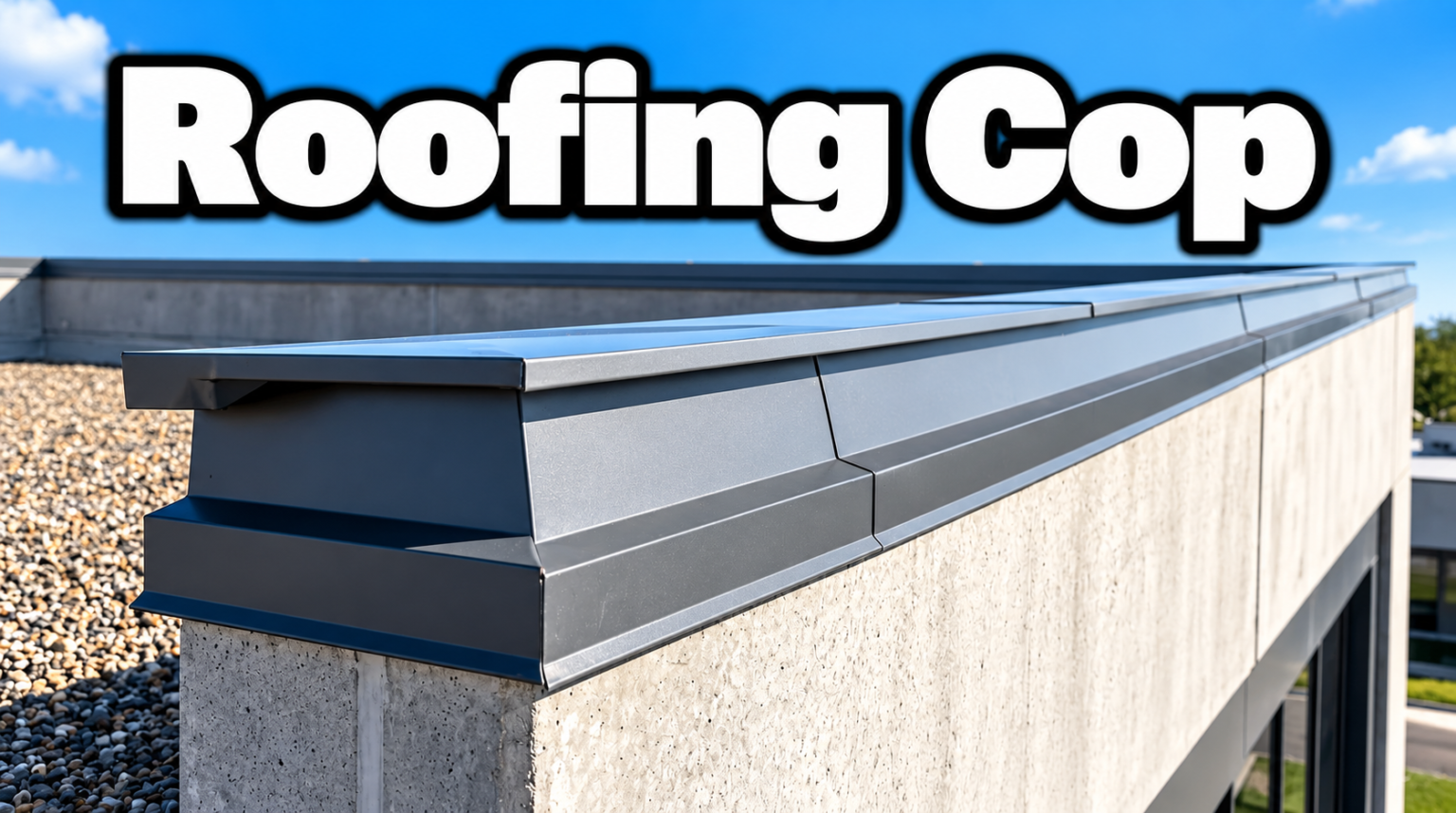

A roofing cop is the cap that runs along the top of a parapet wall, the short wall that rises above the edge of a flat or low-slope roof. “Cop” is just short for coping, and the two words mean the same thing. Its job is simple and important. It covers the exposed top of the wall and sheds rainwater away, so moisture can’t soak down into the wall or sneak in behind the roof.
Most people never think about this strip of metal or stone until water shows up where it shouldn’t. On a commercial building, a failed or missing cop is one of the most common reasons a roof edge starts to leak. This guide covers what a roofing cop is, what it’s made of, what makes a good one, how it differs from flashing and drip edge, how it goes on, the warning signs to watch for, and what it costs.
What is a roofing cop?
A roofing cop, or coping, is a protective cover fitted over the top of a parapet or boundary wall. A parapet is the low wall that runs around the edge of a flat roof, and its top is left open to the sky. The cop caps that open edge so the wall below stays dry.
Think of it as a lid on a wall. Without it, rain lands straight on the porous top of the brick, block, or concrete and slowly works its way in. With it, water hits a sloped, sealed surface and runs off instead. You’ll see cops on commercial buildings, apartment blocks, garden walls, and anywhere a wall top is left exposed to the weather. The word turns up in a few spellings, but on a roof it always points to the same part: the cap on top of the wall.
What does a roofing cop do?
The main job of a roofing cop is water control. It keeps rain off the top of the wall and sends it running off in a controlled way, so moisture never gets the chance to soak into the structure. That one function protects a surprising amount.
When water gets into a parapet wall, it doesn’t stay put. It travels down through the masonry, freezes and expands in cold weather, stains the inside and outside faces, and eventually reaches the point where the roof membrane turns up to meet the wall. That junction is the weakest spot on most flat roofs, and a failed cop is often what lets water find it. A solid cop also helps the roof edge stand up to wind, because it locks down the top course of the wall and pins the edge of the roof membrane in place.
There’s a knock-on benefit too. By keeping the wall dry, the cop protects everything tied to that wall: the insulation inside it, the fixings that hold the roof edge down, and the finish on the inside face. A dry parapet stays strong. A wet one slowly loses all of that at once.
For the building science behind why the top of a parapet matters so much, Building Science Corporation’s guide to parapets is a clear, no-nonsense read.
What makes a good roofing cop?
A roofing cop only works if four things are right at the same time: a slope, an overhang on both sides, a drip edge under each overhang, and a waterproof layer beneath it. Miss one and water finds the gap.
The top has to slope so rain runs off instead of sitting in puddles that work into the seams over time. Each side needs to hang a little past the face of the wall, so runoff clears the wall rather than dribbling down it. Under each of those overhangs sits the drip edge, the lip or groove that forces water to let go and fall. And under the whole thing runs the waterproof membrane, the last line of defense for the day a joint finally opens.
Width matters as well. A cop should cover the full thickness of the wall with a little to spare on each side. One that’s too narrow leaves part of the wall top exposed, which defeats the point. These are small details, but they’re what separate a cop that quietly works for thirty years from one that stains the wall from the first rain.
What is a roofing cop made of?
Roofing cops come in metal, stone, or concrete, and the material affects cost, looks, and how long it lasts. Metal is the most common choice on modern commercial roofs because it’s light, easy to shape to any wall width, and simple to seal.
Here’s how the common options compare:
| Material | What it’s like | Typical lifespan |
| Aluminum | Light, rust-proof, affordable, easy to fabricate | 20 to 40 years |
| Galvanized steel | Strong and budget-friendly, needs a good coating | 20 to 40 years |
| Stainless steel | Very tough, resists corrosion well | 40 to 60+ years |
| Copper | Premium look, ages to a green patina, very durable | 60+ years |
| Zinc | Long-lasting with a self-healing surface, higher cost | 60+ years |
| Stone or concrete | Heavy, traditional, very long-lived | Often the life of the building |
Metal cops are usually custom-made to fit the exact width of the wall, and they often come pre-finished in a baked-on coating so the color matches the rest of the building and holds up to the sun. Stone and concrete suit older or high-end buildings, but they’re heavy to handle and will leak at the joints if those joints aren’t sealed and kept up.
Gauge and coating are worth a word too. Thicker metal holds its shape better over long runs and stands up to hail and to foot traffic during maintenance. A quality factory finish, rather than paint brushed on at the site, is what keeps a metal cop from fading and rusting early. If you’re matching an existing building, most metal cops can be made in a color close to the trim, so the cap blends in instead of standing out.
Roofing cop vs flashing vs drip edge
These three parts all manage water at the roof edge, but they do different jobs, and people mix them up constantly. The short version: a cop caps the top of a wall, flashing seals a joint, and a drip edge guides water off the edge of a sloped roof.
| Part | Where it goes | What it does |
| Roofing cop (coping) | On top of a parapet or boundary wall | Covers the open wall top and sheds water off both sides |
| Flashing | At joints: wall-to-roof, pipes, chimneys, skylights | Seals the gap where two surfaces meet so water can’t pass |
| Drip edge | Along the eaves and rakes of a sloped roof | Kicks runoff away from the fascia and into the gutter |
On a flat roof with a parapet, you’ll usually find all three working together. The cop handles the wall top, flashing seals the spot where the roof membrane turns up the wall, and the whole system moves water toward the drains. One part doesn’t replace another, and a weak point in any of them can let water in.
How is a roofing cop installed?
A roofing cop is installed over a waterproof layer, held down with a hidden cleat, then sealed at every joint and sloped to drain. Getting these steps right is the difference between a cop that lasts for decades and one that leaks within a year.
- Lay a waterproof membrane first. A continuous waterproof layer goes over the top of the wall before anything else. This is the backup if water ever gets past the cop, so it is never skipped.
- Fix a continuous cleat. A metal cleat runs along the wall edge and grips the cop. A concealed cleat holds it tight against wind while letting the metal expand and shrink with temperature, so there are no fasteners punched through the top surface to leak later.
- Set the cop sections. The cop is fitted in lengths along the wall and pitched so water drains off to one side instead of pooling. On many buildings it slopes toward the roof, so runoff lands back on the roof and not down the outside wall.
- Seal the joints. Where two sections meet, they are overlapped or joined with a cover plate and sealed. Joints are the number one place a cop leaks, so this step gets real care.
- Check the drip edges. Both the front and back edges should have a lip or a small groove on the underside, called a kerf. It breaks the flow of water so it drips clear instead of running back under the cop or down the face of the wall.
None of this is complicated, but all of it has to be right at once. A perfect cop over no membrane still leaks, and a great membrane under a cop with open joints leaks too. The parts only work as a set.
Signs your roofing cop needs attention
The clearest sign of a failing cop is water showing up inside near the roof edge, or dark stains running down the top of an outside wall. Catching these early saves a much bigger repair later.
Watch for open or cracked joints between sections, lifted or rattling edges after high wind, rust or peeling coating on metal, and crumbling mortar under stone or concrete cops. Streaks down the wall just below the cop usually mean the drip edge has failed or was never fitted, and water is tracking down the face. If the cop itself is loose, you’ve also lost some of the roof edge’s wind resistance, which is worth fixing fast.
It helps to know what a healthy cop looks like, so a change stands out. The joints should be tight and sealed, the edges should sit flat and firm, the finish should be even, and the wall below should be clean and dry. A quick look once or twice a year, and again after any big storm, is usually enough to spot trouble while it’s still cheap to deal with.
What does a roofing cop cost?
Cost depends mostly on the material and the length of wall, and metal cops are usually the most affordable. As a rough guide, installed metal coping often falls somewhere between fifteen and sixty dollars per linear foot, with aluminum and galvanized steel at the lower end and copper, zinc, and stainless steel near the top.
Stone and concrete cost more to supply and fit because of the weight and handling. On top of the material, your price moves with the wall’s height and how easy it is to reach, the number of corners and joints, and whether old coping and membrane have to be stripped out first. For a real figure, get a measured quote based on your actual wall rather than a per-foot estimate alone.
It’s worth weighing cost against lifespan, not price alone. A cheaper aluminum cop that needs replacing in twenty-five years can cost more over the life of the building than a copper or zinc cop that outlives two roofs. On a wall that’s hard to reach, the labor to redo it later is often the bigger number, so paying once for a long-lasting cap can be the cheaper call.
Conclusion
A roofing cop is the cap on top of a parapet wall, and its one job is to shed water so the wall and roof edge stay dry. Pick a material that fits your budget and building, make sure it sits over a waterproof layer, slopes to drain, and has sealed joints and proper drip edges, and it should protect your roof edge for decades. Check it twice a year, fix open joints early, and you’ll avoid the leaks that a neglected cop almost always brings.
Frequently asked questions
Is a roofing cop the same as coping?
Yes. “Cop” is just short for coping. Both words describe the protective cap fitted over the top of a parapet or boundary wall to keep water out of the structure below.
Can I install a roofing cop myself?
On a small garden wall, a simple cop is doable. On a building parapet it’s best left to a roofer, because the membrane, cleat, slope, and sealed joints all have to be right or it will leak.
Which coping material lasts the longest?
Copper, zinc, and stone or concrete last the longest, often fifty years or more. Aluminum and galvanized steel are cheaper and still give twenty to forty years with a good coating.
Why is my wall staining below the coping?
That usually means the drip edge has failed or is missing, so water runs back under the cop and down the wall face. A cop with a proper lip or kerf on both edges fixes it.
How often should a roofing cop be checked?
Look it over once or twice a year and after major storms. Spotting cracked joints, lifted edges, or rust early keeps a small fix from turning into a roof-edge leak.
Related Articles
How to Layer Curtains on One Rod: Easy Step-by-Step Guide
How to Get Rid of Roof Rats: Complete Guide 2026