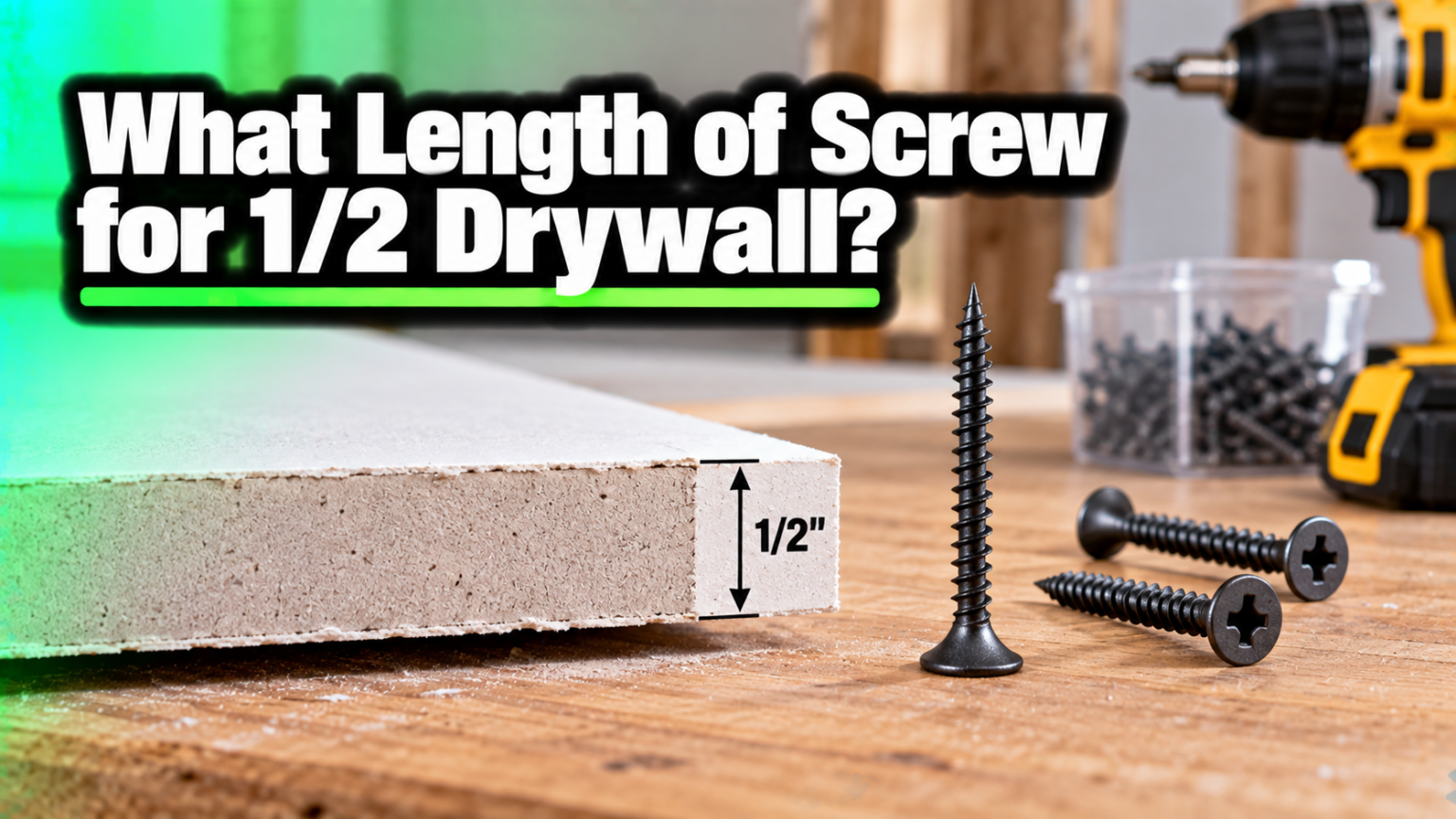

For 1/2 inch drywall on wood studs, use 1-1/4 inch #6 coarse-thread drywall screws. That is the size the panel is built for, and it works for almost every wall in a normal house. The screw passes through the half-inch board and bites about 3/4 inch into the wood, which is deep enough to pull the sheet in tight and hold it there for good.
The length only needs to change when the framing behind the drywall changes, or when you stack a second layer on top. The rest of this guide shows when 1-1/4 inch is right, when to go longer, and how to pick the thread and gauge so every screw grabs and sits flush.
The short answer
Here are the two setups you will hit most often:
- 1/2 inch drywall on wood studs: 1-1/4 inch, #6, coarse thread.
- 1/2 inch drywall on metal studs: 1-1/4 inch, #6, fine thread.
If you buy one box for a standard room, buy 1-1/4 inch coarse-thread screws. You will size up only for ceilings that need extra hold, double layers, or drywall going over an existing surface.
Why 1-1/4 inch is the right length?
The number that really matters is not the screw length. It is how far the screw reaches past the drywall and into the framing. A drywall screw needs to sink at least 5/8 inch into solid wood to hold a panel, and about 3/4 inch is the sweet spot for a firm, lasting grip.
Now do the quick math with a half-inch sheet. Take the 1-1/4 inch screw, subtract the 1/2 inch of drywall, and you are left with 3/4 inch of screw driving into the stud. That lands right on the ideal depth. A short rule of thumb helps here: pick a screw about 3/4 inch longer than the drywall is thick. Manufacturer guides like SENCO’s drywall guide land on the same 1-1/4 inch for half-inch board.
Going the other way shows why the size is not random. A 1 inch screw would reach only 1/2 inch into the wood, which is on the shallow side and can work loose over time. A 1-5/8 inch screw would push almost 1-1/8 inch into the stud, more depth than you need, and the extra length makes it easier to split a thin framing edge or blow past the stud entirely. Matching the length to the job keeps the hold strong and the work clean.
Depth matters because most of a screw’s holding power comes from the threads gripping wood, not from how far the tip travels. Once you pass that 3/4 inch mark, extra length adds very little strength and starts to cause problems instead. Wood framing also moves a little as it dries out and as the seasons change, and a screw with a solid 3/4 inch of thread in the stud rides out that movement without loosening. That is the real reason the half-inch panel and the 1-1/4 inch screw are such a common pair.
Rule to remember: aim for 5/8 to 3/4 inch of screw in the framing. For 1/2 inch drywall that means 1-1/4 inch screws on wood, and longer only when you add thickness behind or on top.
Screw length chart for 1/2 inch drywall
This table covers the common ways 1/2 inch drywall gets hung. Every length below assumes you want that 5/8 to 3/4 inch of solid grip in the framing.
| Setup | Screw length | Gauge and thread |
| 1/2″ drywall on wood studs | 1-1/4 inch | #6, coarse |
| 1/2″ drywall on metal studs (light gauge) | 1-1/4 inch | #6, fine |
| 1/2″ drywall on a ceiling | 1-1/4 to 1-5/8 inch | #6, coarse |
| Two layers of 1/2″ drywall | 2 inch | #6, coarse |
| 1/2″ drywall over existing drywall or plaster | 1-5/8 to 2 inch | #6, coarse |
For a wider breakdown across other panel thicknesses, a printable drywall screw size chart is handy to keep in the toolbox, but for half-inch board the rows above are all you need.
Coarse thread or fine thread?
Use coarse thread for wood and fine thread for metal. This choice matters as much as the length, because the wrong thread will not hold no matter how long the screw is.
Coarse-thread screws have wide, deep threads that dig into wood fibers and pull the panel in tight. They are the default for the wood-framed walls in most homes.
Fine-thread screws have more threads packed into the same length, and those cut cleanly into thin steel without stripping out. Put a coarse-thread screw in a metal stud and it tends to spin without grabbing; put a fine-thread screw in wood and it can strip the hole. Read the box, and match the thread to what is behind the drywall.
Screws for 1/2 inch drywall on metal studs
On light-gauge metal studs, the common size for 1/2 inch drywall is 1-1/4 inch, #6, with fine thread. The same penetration idea applies: the screw only needs to pass through the drywall and grab the steel, so a long screw buys you nothing behind a thin metal wall.
The one thing to check is the steel gauge. Standard fine-thread drywall screws are self-tapping and bite straight into light 25-gauge or 20-gauge studs. For heavier, thicker steel, switch to a self-drilling screw with a small drill-point tip so it can start its own hole instead of skating across the metal.
When you need a longer screw?
Step up from 1-1/4 inch whenever there is extra material to get through before the screw reaches solid framing. A few common cases:
- Ceilings. Gravity pulls on ceiling panels all day, so many installers move up to 1-5/8 inch screws for a deeper, more secure bite, especially with heavier board.
- Double layers. Two sheets of 1/2 inch drywall, used for soundproofing or fire rating, add up to a full inch of board. A 2 inch screw gets you back to that 3/4 inch of grip in the stud.
- Over an existing surface. Hanging new 1/2 inch drywall over old drywall or plaster means the screw crosses both layers first. A 1-5/8 to 2 inch screw makes up the difference, depending on how thick the old wall is.
In each case the method is the same: add up everything the screw must pass through, then add 5/8 to 3/4 inch for the framing. That total is your screw length.
Screw gauge, head, and coating
For 1/2 inch drywall, #6 gauge is the standard thickness and the right pick for a home project. It is strong enough to hold the panel and thin enough that the head sinks in neatly. Heavier #8 screws exist for special jobs, but #6 handles ordinary walls and ceilings.
Choose a bugle head. The head flares out like a small trumpet, so it dimples the paper and settles just below the surface without tearing through. For coating, phosphate-coated gray screws resist rust and are less likely to bleed a stain through paint later, which makes them a safe default over plain black screws in damp or painted rooms.
Screws or nails for 1/2 inch drywall?
Screws are the better fastener for 1/2 inch drywall, and they are what most walls get today. A screw threads into the framing and pulls the panel in, so it holds far better than a nail and almost never works its way back out. Nails can loosen as the wood moves, which is what causes a small round bump in the finished wall known as a nail pop.
The length rule stays the same either way. If you do use drywall nails on half-inch board, you want them long enough to sink about 3/4 inch into the wood, so a 1-1/4 to 1-3/8 inch ring-shank nail is the usual pick. For almost every job, though, a coarse-thread screw at 1-1/4 inch is the simpler, stronger choice, and it is easy to back out and reset if you drive one wrong.
Do you still need adhesive?
Construction adhesive is optional, but a bead of it along each stud makes the wall stronger and quieter and lets you use fewer screws. The glue carries much of the load across the face of the panel, while the screws hold everything in place while it dries and pin the edges down for good.
Adhesive does not change the screw length. You still run 1-1/4 inch screws into half-inch drywall on wood; you just place fewer of them in the middle of the sheet, since the glue is doing part of the work there. Keep the normal screw spacing around the edges of each panel, because glue is rarely run along the very edges where seams meet.
How far apart to place the screws?
Length holds each screw; spacing holds the whole sheet. On walls, drive screws about every 16 inches along each stud. On ceilings, tighten that to about every 12 inches, since the panel is fighting gravity. Keep screws roughly 3/8 inch in from the edges of the board so you do not crumble the edge, and stagger the field screws rather than lining them up in a tight cluster.
That spacing works out to a predictable count. A standard 4 by 8 foot sheet on 16 inch walls takes somewhere around 28 to 32 screws once you cover every stud it crosses plus the edges. Knowing the rough number helps you buy enough in one trip, since a one-pound box of 1-1/4 inch screws holds a few hundred and covers several sheets.
How to drive them so they hold?
The right screw still needs to go in right. The goal is a shallow dimple: the head sits just below the surface and presses the paper in without cutting through it. That little dip is what your joint compound fills later, so the wall finishes smooth.
A drywall screw setter makes this almost automatic. It is a cheap bit with a clutch that stops driving once the head reaches the right depth, so you get the same clean dimple every time instead of guessing.
If you work by feel with a regular drill, run it at a moderate speed and ease off the trigger the moment the head meets the paper. Drive the screw straight in, square to the wall, since a screw that goes in at an angle tears the paper on one side and never seats flush.
Mistakes that ruin a good screw
Even the right screw fails if it goes in wrong. Watch for these:
- Driving too deep. If the head breaks the paper face, the screw loses most of its hold. Aim for a shallow dimple, with the paper intact. A drywall screw setter or a bit with a depth stop makes this easy.
- Going too short. A 1 inch screw in half-inch board leaves too little in the wood, and the panel can pop loose as the framing dries and shifts.
- Wrong thread. Coarse in metal or fine in wood will spin or strip. Match the thread to the framing every time.
- Missing the stud. A screw that catches only air or edge does nothing. Mark your stud lines before you hang, and feel for solid resistance as the screw bites.
Conclusion
For 1/2 inch drywall on wood studs, reach for 1-1/4 inch #6 coarse-thread screws, and switch to fine thread on metal studs at the same length. The one rule that carries you through every other case is simple: get 5/8 to 3/4 inch of screw into the framing, and add length only for ceilings, double layers, or drywall over an old surface. Match the thread, sink each head to a clean dimple, and the wall will hold tight for years.
Frequently asked questions
Can I use 1-5/8 inch screws for 1/2 inch drywall?
You can, and many people do on ceilings for extra hold. On flat walls it is more length than you need and raises the chance of splitting a stud edge, so 1-1/4 inch is the cleaner choice there.
What size screw for 1/2 inch drywall on a ceiling?
Use 1-1/4 inch coarse-thread screws, or step up to 1-5/8 inch for a deeper bite against gravity. Space ceiling screws about every 12 inches so the panel cannot sag.
Coarse or fine thread for 1/2 inch drywall?
Coarse thread for wood studs, fine thread for metal studs. Coarse threads grip wood fibers, while fine threads cut into steel without stripping.
How far should a drywall screw go into the stud?
At least 5/8 inch, and about 3/4 inch is ideal. With 1/2 inch drywall and a 1-1/4 inch screw, you get roughly 3/4 inch of grip in the wood.
What gauge screw is best for 1/2 inch drywall?
#6 gauge is the standard for half-inch board. It holds the panel well and lets the bugle head sink flush without tearing the paper.
Related Articles
How Long Do Garage Door Springs Last? Complete Guide 2026
Why Is My Toilet Water Yellow? Causes, Fixes & When to Worry
What Is Roof Decking? A Complete Guide 2026
How to Remove Ink from Leather Sofa: Easy Step-by-Step Guide