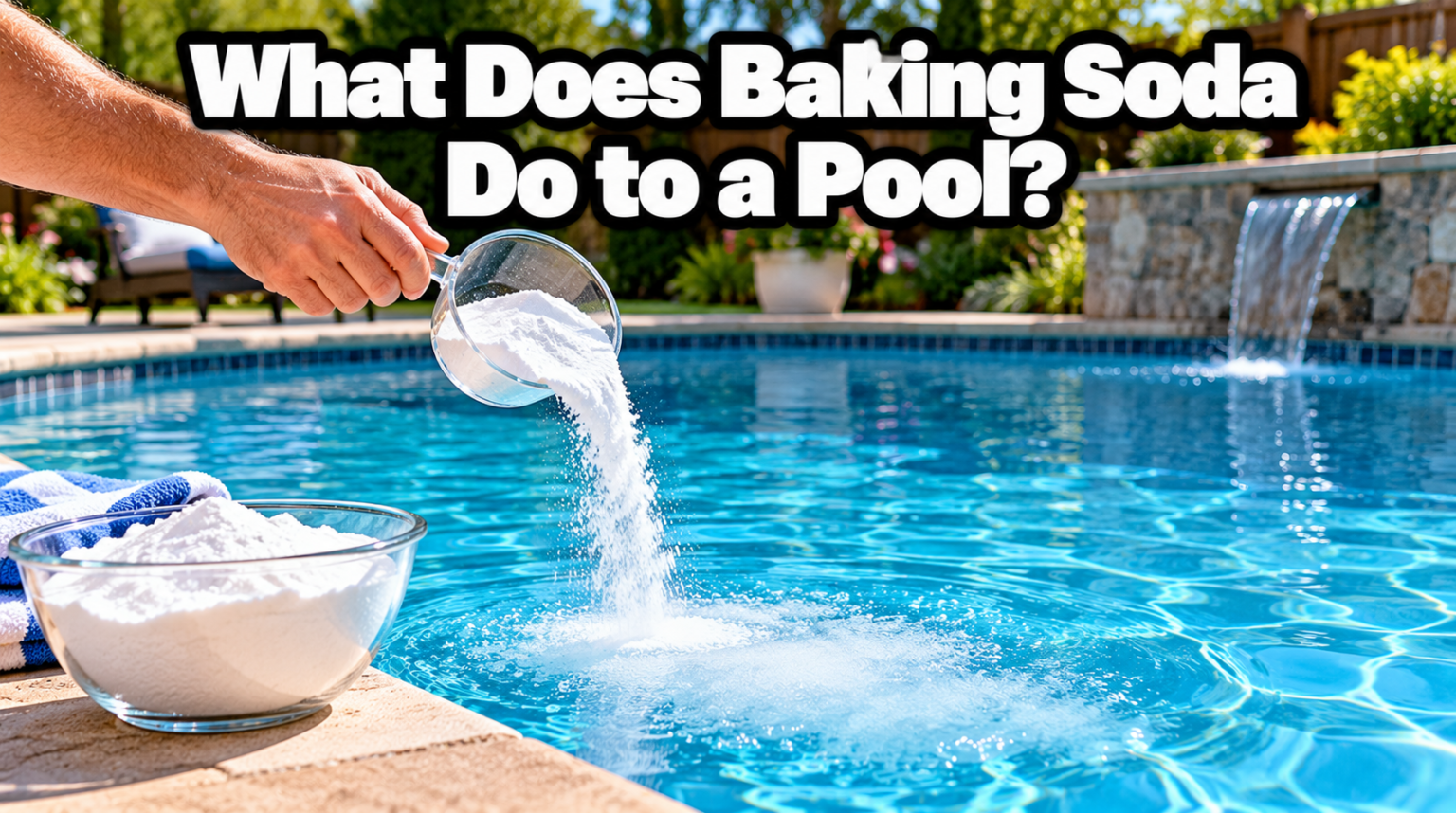

Baking soda raises the total alkalinity in your pool, and that is its main job. Total alkalinity is the thing that keeps your pH steady, so the water stays balanced instead of swinging high and low all season. Add the right amount and your pool feels softer, looks clearer, and holds its chemistry far better between tests.
This guide covers exactly what baking soda does, how much to add, when you actually need it, and the handful of jobs it simply cannot do. If the water has gone cloudy, your pH keeps drifting, or the pool just feels harsh on your skin, low alkalinity is often the reason, and baking soda is usually the fix.
What does baking soda do in a pool?
Baking soda is sodium bicarbonate, the same white powder sold for baking. In a pool it works as an alkalinity increaser. When you add it, it raises the total alkalinity of the water, which is a measure of how well the water can soak up acid without its pH changing.
Think of alkalinity as a cushion. When it sits in the right range, the pH stays put even as swimmers, rain, sunscreen, and chlorine all push on it. When alkalinity drops too low, that cushion is gone, and the pH starts bouncing around after every small change. That bouncing is what causes stinging eyes, itchy skin, and chlorine that stops working the way it should.
Baking soda is the cheapest and simplest way to put that cushion back. It is the same active ingredient found in most store-bought alkalinity increasers, so a plain box of Arm & Hammer baking soda does the same work for a lot less money than a branded pool product.
Total alkalinity and pH: how they work together
pH and total alkalinity are two different readings, and mixing them up is the most common pool mistake. pH tells you how acidic or basic the water is right now. Total alkalinity tells you how strongly the water resists a change in that pH.
The ideal total alkalinity for most pools is 80 to 120 ppm (parts per million). Keep it in that band and your pH tends to settle on its own in a healthy range, about 7.2 to 7.8, which sits inside the pH of 7.0 to 7.8 the CDC recommends for home pools. Fix pH first while alkalinity is still off and the pH will not hold, so you end up chasing it week after week.
Here is a simple example. Say your pH keeps dropping to 7.0 no matter how much pH increaser you add. The real problem is usually low alkalinity underneath it. Raise the alkalinity with baking soda first, let the water circulate, and the pH often climbs back into range on its own. So the right order is alkalinity first, pH second.
What changes when your alkalinity is balanced
Getting alkalinity into the 80 to 120 ppm range does more than fix a number on a test strip. It changes how the whole pool behaves day to day.
Your chlorine works harder for its money. When pH and alkalinity are steady, chlorine stays in its most active form and kills germs faster, so you spend less on sanitizer across a season. Your equipment lasts longer too, because water that is not swinging acidic stops eating at pump seals, heater parts, and metal fittings.
Swimmers feel the difference first. Balanced water does not sting eyes or dry out skin, and it loses that harsh chemical bite. The surfaces benefit as well, since stable water is far less likely to etch plaster or corrode a liner fitting. In short, a dose of baking soda protects your comfort, your chlorine budget, and your gear all at once.
Does baking soda raise pH as well?
Yes, but only a little. Baking soda has a pH of around 8, so adding it nudges your pool’s pH up slightly while it raises alkalinity a lot. For a pool with low alkalinity and low pH, that small lift is often all you need, because fixing the alkalinity pulls the pH up along with it.
If your pH is very low but your alkalinity already tests fine, baking soda is the wrong tool. It would push alkalinity too high before it moved the pH far enough. For that job you want soda ash, which is made to raise pH fast.
If both your pH and alkalinity read low, baking soda is usually the only product you need. Fix the alkalinity, give it a few hours to circulate, and retest the pH before you decide to add anything else.
Baking soda vs soda ash: which one do you need?
Baking soda and soda ash sound similar and even look alike, but they do different jobs. Soda ash is sodium carbonate, a stronger chemical that raises pH sharply and alkalinity a bit. Baking soda is sodium bicarbonate, which raises alkalinity strongly and pH only a touch. Picking the right one comes down to which reading is low.
| What you need | Use | Why |
| Low alkalinity, pH fine or slightly low | Baking soda (sodium bicarbonate) | Raises alkalinity a lot, pH only slightly |
| Low pH, alkalinity fine | Soda ash (sodium carbonate) | Raises pH fast, alkalinity a little |
| Both low | Start with baking soda | Fixing alkalinity usually lifts pH into range |
A simple way to remember it: baking soda is for alkalinity, soda ash is for pH. If both are low, start with baking soda, let it settle for a few hours, then check whether you still need soda ash at all. Often you will find you do not.
When should you add baking soda?
You add baking soda when your total alkalinity test reads below 80 ppm. The only way to know for sure is to test, so check the water with a liquid test kit or strips before you reach for the box. A liquid kit is more accurate if you have one.
A few signs point to low alkalinity even before you test. The pH keeps drifting and will not hold a steady number. Eyes sting and skin feels itchy after a swim. The water looks slightly dull or cloudy. Ladders, rails, and metal fittings start to show corrosion or staining. Chlorine seems to burn off quickly and never quite keeps up.
Low alkalinity is common after heavy rain, which dilutes the water, and after you add a lot of chlorine or acid. Test the alkalinity in the days after a storm or a shock treatment. In normal weather, testing once a week is plenty for most home pools, with a quick check after any big rain or a pool party.
How much baking soda should you add?
As a rule of thumb, about 1.5 pounds of baking soda per 10,000 gallons of water raises total alkalinity by roughly 10 ppm. So if your 20,000 gallon pool reads 60 ppm and you want to reach 90 ppm, that is a 30 ppm jump, which needs around 9 pounds.
Do not try to close a big gap all at once. Raising alkalinity by more than 30 to 40 ppm in a single dose can overshoot and cloud the water. For larger pools, add about 5 pounds at a time, wait, and retest before you add any more.
Small pools need tiny amounts, so measure rather than eyeball it. A 5,000 gallon above-ground pool that needs a 10 ppm bump takes only about three quarters of a pound. Tipping in a whole box would send the alkalinity far past where you want it and leave you reaching for acid to undo it.
- Test first. Measure your total alkalinity and note how far below the 80 to 120 ppm range you are.
- Work out the dose. Use the 1.5 pounds per 10,000 gallons rule, or an online pool calculator, to get your amount.
- Turn on the pump. The water needs to be moving so the baking soda spreads evenly.
- Broadcast it. Sprinkle the baking soda across the pool surface in a wide arc instead of dumping it in one spot. In deep or still water, pre-dissolve it in a bucket of pool water first.
- Wait and retest. Give it at least 6 hours with the pump running, then test again and add more only if you need to.
Tip: always add baking soda in stages. It is easy to add a bit more after a retest, but lowering alkalinity that has gone too high takes acid and extra time.
You can usually get back in the water within about 20 minutes to an hour of adding baking soda, once it has dissolved and circulated, since it is a mild and safe chemical. Even so, it is smart to wait for a full retest before you treat the water as balanced.
Does baking soda make the water softer and clearer?
Many pool owners notice the water feels softer and looks clearer after a baking soda dose, and there is a real reason for it. When alkalinity is balanced, the water is gentle on skin and eyes instead of harsh and acidic. The silky feel people describe is simply balanced water doing what it should.
Baking soda can also take a little edge off hard water. It reacts with some of the calcium and turns it into calcium bicarbonate, which does not add to the hardness you feel. It does not pull minerals out of the pool, so it is not a true water softener, but it does help the water feel smoother.
Clarity works the same indirect way. Baking soda is not a clarifier, but balanced alkalinity stops the pH swings that turn water dull and cloudy. Keep alkalinity steady and your filter and chlorine can keep the water clear with far less effort.
What baking soda will not do
Baking soda is useful, but it is not a cure-all, and a few jobs need other products.
It does not kill algae. Baking soda cannot clear an algae bloom. By keeping pH balanced it helps chlorine work better, which makes algae less likely, but green water that is already there needs a proper chlorine shock, a good brush, and a vacuum, not baking soda. Treating balanced water is about prevention, not cure.
It does not clean your pool. It can cut light grime on tiles if you scrub with a paste, but scale, metal stains, and heavy buildup need the right cleaner for the job.
It does not directly stop corrosion. Low pH eats at metal and plaster, so by holding pH steady baking soda protects your pool indirectly. It is not a rust remover or a sealant, and it will not fix damage that has already happened.
Can you add too much baking soda?
Yes, and it brings its own problems. Too much baking soda pushes total alkalinity above 120 ppm, which then drags pH above 7.8. High pH makes chlorine far less effective at killing germs, so your sanitizer stops pulling its weight even when the chlorine reading looks fine.
High alkalinity also leaves the water cloudy and can form calcium scale, the chalky crust you see on waterline tiles and inside pipes. Swimmers may notice stinging eyes and dry, itchy skin, the same complaints you get when alkalinity is too low.
If you overshoot, the fix is to lower alkalinity with a pool acid such as muriatic acid or sodium bisulfate, added in small steps with a retest in between. This is exactly why you add baking soda gradually in the first place. It is quick to add more, and a slower job to take it back out.
Conclusion
Baking soda raises your pool’s total alkalinity, which steadies the pH and keeps the whole system in balance. Test first, aim for 80 to 120 ppm, and add about 1.5 pounds per 10,000 gallons for every 10 ppm you need, in stages rather than all at once. Get the alkalinity right and a clear, comfortable pool with pH that actually holds usually follows on its own.
Frequently asked questions
Can I use regular baking soda from the grocery store in my pool?
Yes. Pool alkalinity increaser and baking soda are both sodium bicarbonate, so plain baking soda works the same way and usually costs less. Just make sure it is pure sodium bicarbonate with nothing added.
How long after adding baking soda can I swim?
You can usually swim within about 20 minutes to an hour, once the baking soda has dissolved and circulated with the pump running. It is a mild chemical, but wait for a full retest before calling the water balanced.
Will baking soda lower my pool’s pH?
No. Baking soda raises pH slightly as it raises alkalinity. To lower pH or alkalinity you need a pool acid such as muriatic acid or sodium bisulfate, not baking soda.
Does baking soda get rid of algae in a pool?
No. Baking soda does not kill algae. It helps prevent it by keeping chlorine working well, but an active green bloom needs a chlorine shock and a good brush and vacuum.
How much baking soda raises alkalinity by 10 ppm?
About 1.5 pounds of baking soda per 10,000 gallons of water raises total alkalinity by roughly 10 ppm. Add it in stages and retest, rather than dosing the full amount at once.
Related Articles
Do You Wax Laminate Floors? Here’s What Actually Works Instead
How Can You Make Saltillo Floors Shine? Complete Guide 2026
How Much to Add a Bathroom to a Basement?
Basement Drainage: Complete Guide to Systems, Costs & Solutions