

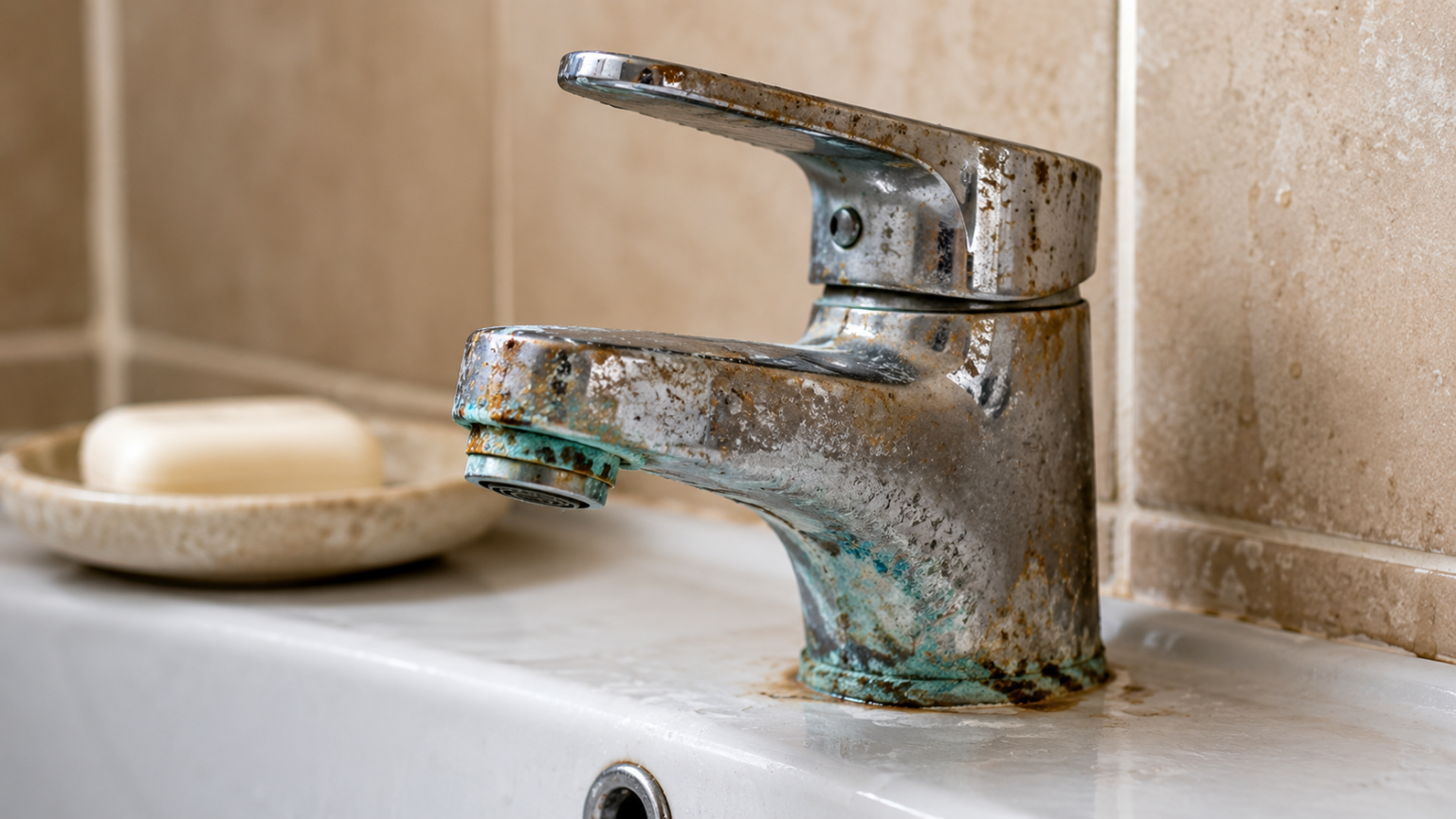

If your bathroom faucet has developed a dull, chalky film, greenish stains, or rust-colored spots around the handle, you’re not imagining things—and you’re not alone. Corrosion is one of the most common issues homeowners run into with bathroom fixtures, and understanding what causes bathroom faucets to corrode is the first step toward stopping it before it ruins a good-looking faucet or, worse, causes a leak inside your wall.
In this guide, we’ll break down the real causes (including a few that most articles skip), show you how to remove existing corrosion safely, and walk through the habits and upgrades that will keep your faucets looking new for years.
What Causes Bathroom Faucets to Corrode?
Corrosion is a chemical reaction, not random bad luck. It happens when a metal surface is repeatedly exposed to oxygen, moisture, and minerals, causing the metal to gradually break down at an atomic level.
In plain terms: water molecules and dissolved oxygen react with metal atoms on the faucet’s surface, stripping away electrons and forming new compounds—rust, verdigris, or white scale—that sit on top of (and eventually eat into) the original metal.
A bathroom is basically a corrosion accelerator: it’s humid, it sees standing water daily, and it’s full of cleaning chemicals. Here’s what specifically drives the process.
Hard Water and Mineral Deposits
Most homes in the United States have hard water, meaning it carries a higher-than-average concentration of dissolved calcium, magnesium, and sometimes iron. When that water evaporates on a faucet’s surface, it leaves behind a chalky white or gray residue called limescale.
This residue traps moisture against the metal underneath, and if it isn’t cleaned off, it creates a constant micro-environment where corrosion can take hold. Homes on well water often have it worse, since well water can also carry iron and manganese, which leave rust-colored (rather than white) stains.
Humidity and Poor Ventilation
Bathrooms trap steam every time someone showers or runs a hot bath, and that moisture doesn’t just disappear—it condenses on the coolest surfaces in the room, which are usually metal fixtures.
Without an exhaust fan or a cracked window to clear the air, that condensation lingers on the faucet for hours, giving oxidation plenty of time to work. Homeowners frequently notice corrosion first at the base of the faucet, exactly where water pools and airflow is weakest.
Harsh Cleaning Products and Chemicals
Not every cleaner that’s safe for tile is safe for a faucet. Ammonia-based glass cleaners, chlorine bleach, and abrasive scouring powders can strip the thin protective layer (chrome plating, a lacquer topcoat, or a PVD finish) right off a fixture.
Once that layer is compromised, the base metal underneath—often brass, zinc, or steel—is directly exposed to water and air. Even products that seem gentle can be a problem if they’re left to sit rather than rinsed off promptly.
Galvanic Corrosion Between Dissimilar Metals
This is one of the more overlooked causes. Many faucets combine several different metals—a brass body, a chrome or nickel plating, steel mounting hardware, and copper supply lines—all in one assembly. When two dissimilar metals stay in contact while wet, they can form a small electrochemical circuit, and the less “noble” (more reactive) metal corrodes faster as a result.
This is the same reaction that causes a galvanized pipe to deteriorate quickly where it connects to a copper fitting. A scratch in your faucet’s plating is often enough to expose the metal underneath and kick off this reaction at that single point.
Low-Quality Plating and Manufacturing Defects
Not all finishes are created equal. Thin, inconsistent chrome plating or poorly bonded coatings are far more vulnerable to pinholing—tiny gaps in the finish that let moisture reach the base metal. Budget faucets sometimes use lower-grade zinc alloys instead of solid brass, and these alloys corrode noticeably faster, even with normal care.
Trapped Moisture at the Base and Fittings
A faucet base that isn’t sealed properly against the sink or countertop allows water to seep underneath rather than draining away. That hidden moisture sits against the mounting hardware and the underside of the faucet, corroding screws, washers, and threads out of sight—often for months before it shows up as a wobble, a leak, or a stain on the counter below.
Plumbing System Issues (A Gap Most Guides Skip)
Sometimes the faucet itself isn’t the real problem—it’s what’s happening upstream in your plumbing. Old galvanized steel pipes shed rust particles as they deteriorate internally, and those particles travel through your water supply and settle on faucet components.
Sediment buildup inside a water heater can do something similar with hot-water fixtures. If only one faucet in the house is corroding unusually fast while the others look fine, it’s worth checking whether that fixture is fed by an older section of pipe or sits closest to the water heater.
Warning Signs You Have Faucet Corrosion (Not Just Buildup)
It’s easy to mistake ordinary hard-water spots for the early stages of real corrosion. Here’s how to tell the difference:
- Discoloration that won’t wipe off — greenish tints (copper), reddish-brown stains (iron), or a dull gray haze that persists after cleaning.
- Pitting or rough texture — small pits or a sandpaper-like feel on the metal, rather than a smooth surface under the stain.
- Flaking or peeling finish — chrome or nickel plating lifting away in small flakes, exposing the metal beneath.
- Stiff or sticking handles — corrosion inside the valve or cartridge can make the handle harder to turn or cause it to stick in one position.
- Water discoloration right at startup — a burst of rusty-looking water when you first turn on the tap, which usually points to corrosion inside the plumbing rather than the faucet itself.
- A metallic smell or taste — a sign that corrosion products are making their way into your water supply.
How to Remove Corrosion From a Bathroom Faucet
Light-to-moderate corrosion can usually be treated at home with a few affordable products already in your kitchen.
Natural, Low-Risk Remedies
White vinegar is mildly acidic and dissolves mineral deposits effectively without harming most finishes. Soak a cloth in undiluted white vinegar and wrap it around corroded areas for 30–60 minutes, then wipe and rinse thoroughly.
For aerators and showerheads, filling a small plastic bag with vinegar and securing it in place with a rubber band works even better, since it keeps the acid in constant contact with the buildup.
For actual rust spots (not just mineral scale), a paste of baking soda and water or lemon juice, left on for about 10 minutes and scrubbed gently with a soft cloth, is usually enough to lift light corrosion without scratching the finish.
Commercial Rust Removers
For tougher spots, a rust remover formulated for chrome or stainless steel can help, but always spot-test on an inconspicuous area first and follow the product’s dwell-time instructions closely—leaving these products on too long can do more harm than the corrosion itself.
Mistakes to Avoid When Cleaning (Rarely Covered Elsewhere)
- Don’t use steel wool or metal scouring pads on chrome, nickel, or PVD finishes. They create micro-scratches that expose bare metal and speed up future corrosion, even though they seem to “clean” the surface in the moment.
- Never mix bleach and ammonia-based cleaners. Beyond the serious health hazard from the toxic fumes this creates, the combination is also unusually aggressive on metal finishes.
- Don’t let any acidic cleaner (vinegar, lemon juice, commercial rust remover) sit longer than recommended. Acids that are helpful in small doses can etch and dull a finish if left too long.
- Avoid abrasive powders on brushed or matte finishes. These textured finishes show scratches more visibly than polished chrome, so stick to soft cloths and non-abrasive cleaners.
If corrosion has penetrated deep into the metal, is affecting the faucet’s function (a stuck handle, a persistent drip, low pressure), or keeps returning within weeks of cleaning, it’s a sign the damage has gone beyond a surface fix.
How to Prevent Bathroom Faucet Corrosion for Good
Build a Few Daily and Weekly Habits
The single most effective prevention habit is also the simplest: keep a microfiber cloth near the sink and wipe the faucet dry after each use, especially around the base and handle. This takes water out of the equation before minerals or moisture have a chance to settle. Once a week, a quick wipe-down with a mild, pH-neutral cleaner removes soap scum and early mineral film before it hardens into scale.
Treat Your Water Supply
Since hard water is the root cause behind a large share of corrosion cases, addressing water quality directly offers the best long-term payoff. A whole-house water softener (sized to your household’s grain-per-gallon hardness rating, typically in the 32,000–48,000 grain range for an average family) removes calcium and magnesium before they ever reach your fixtures. If a water test shows elevated iron—common with well water—a dedicated iron filter alongside your softener will handle the reddish staining that softeners alone don’t fully address.
Add a Protective Coating
Hydrophobic sealants and clear waxes, applied every one to two months, cause water to bead up and roll off rather than sitting on the surface. This is a small, inexpensive habit that meaningfully extends the life of an existing finish, particularly on faucets that already show light wear.
Choose Corrosion-Resistant Materials When You Replace or Upgrade
If you’re shopping for a new faucet, the base material and finish matter more than almost any other spec:
- Solid brass resists corrosion well on its own and holds up to polished, brushed, or matte finishes.
- High-grade (304 or 316) stainless steel resists rust and staining and is a strong choice for humid climates.
- PVD (Physical Vapor Deposition) coatings bond at a molecular level, making them significantly more scratch- and corrosion-resistant than standard chrome plating.
- DZR (dezincification-resistant) brass is engineered specifically to resist the type of corrosion that affects standard brass in aggressive water conditions.
- Avoid unlabeled “chrome-finish” faucets with no stated base metal—this is often a sign of a thin coating over a low-grade zinc alloy.
Don’t Forget the Aerator
The small mesh screen at the tip of the faucet traps sediment and mineral buildup out of sight, and over time it can also harbor bacteria if never cleaned. Unscrew and soak the aerator in vinegar every few months; if it’s damaged or heavily corroded, replace it outright rather than forcing it back into place, since a damaged aerator thread can itself become a new corrosion point.
Repair or Replace? A Practical Decision Framework
| Situation | Recommended Action | Typical Cost (US) |
|---|---|---|
| Light surface staining or scale, faucet functions normally | Clean and apply protective coating | $0–$20 (DIY supplies) |
| Corroded washer, cartridge, or O-ring causing a drip | Replace the specific part | $10–$60 |
| Pitting has spread across the visible finish, but the faucet still works | Deep clean now; plan to replace within 1–2 years | $0–$30 now |
| Handle sticks, water pressure has dropped, or corrosion is inside the valve | Replace the faucet | $100–$400+ installed |
| Rust-colored water at startup from multiple fixtures | Have your plumbing inspected—likely a pipe issue, not just the faucet | Varies; inspection typically $100–$250 |
As a rule of thumb: if you’re weighing a $40 repair against a faucet that’s already 10–15 years old and showing several of the warning signs above, replacement is usually the better long-term value, since newer faucets also bring water-saving aerators and more corrosion-resistant finishes to the table.
Frequently Asked Questions
Can corroded bathroom faucets make you sick? Corrosion itself isn’t typically hazardous, but it can allow lead or other metals to leach into water in older fixtures, and a heavily corroded aerator can harbor bacteria. If you notice a metallic taste, discolored water, or you have older plumbing, it’s worth having your water tested.
Is green corrosion on a faucet dangerous? Greenish-blue staining usually indicates copper oxidation (verdigris). It’s generally not an emergency, but it does signal that a protective finish has worn through and the fixture should be cleaned and monitored, or replaced if it keeps returning.
Why does my new faucet already have corrosion? This is often a sign of low-quality plating, galvanic corrosion between mismatched metal components, or an installation issue that’s letting water sit trapped at the base. It can also point to unusually hard or aggressive water in your area.
How often should I clean my bathroom faucet to prevent corrosion? A quick wipe-down after each use, plus a more thorough cleaning once a week, is enough for most households. Homes with hard water may need more frequent attention.
Does a water softener really stop faucet corrosion? It won’t eliminate every cause, but since hard water is one of the leading contributors, a properly sized softener meaningfully reduces mineral buildup and slows the corrosion process across every fixture in the house, not just faucets.
What’s the difference between corrosion and normal wear? Normal wear shows up as fading or minor scuffing that stays on the surface. Corrosion changes the metal itself—pitting, flaking, discoloration that won’t wipe away, and eventually a change in how the faucet functions.
Final Thoughts
Bathroom faucet corrosion isn’t caused by one single culprit—it’s usually a combination of hard water, humidity, cleaning habits, mismatched metals, and the quality of the faucet itself. The good news is that most of these factors are within your control. A quick daily wipe-down, the right cleaning products, occasional protective sealant, and addressing your home’s water quality will prevent the vast majority of corrosion before it ever starts.
And if a faucet is already showing pitting, sticking, or a persistent drip despite your best cleaning efforts, that’s your cue to stop treating the symptom and replace the fixture with a corrosion-resistant one.
Start with a simple inspection of your bathroom faucets today—wipe them down, check the base for hidden moisture, and take note of any warning signs from the list above—so you can catch corrosion early and keep your fixtures looking and working like new for years to come.
Related Articles
Can You Refinish Engineered Hardwood Floors? A Complete Guide 2026
Can You Line Your Garage in Plywood? Complete Guide 2026
How to Make the Basement Warmer: 8 Proven Fixes for a Cozy Space
How to Install a Ceiling Medallion: Complete Step-by-Step Guide (2026)