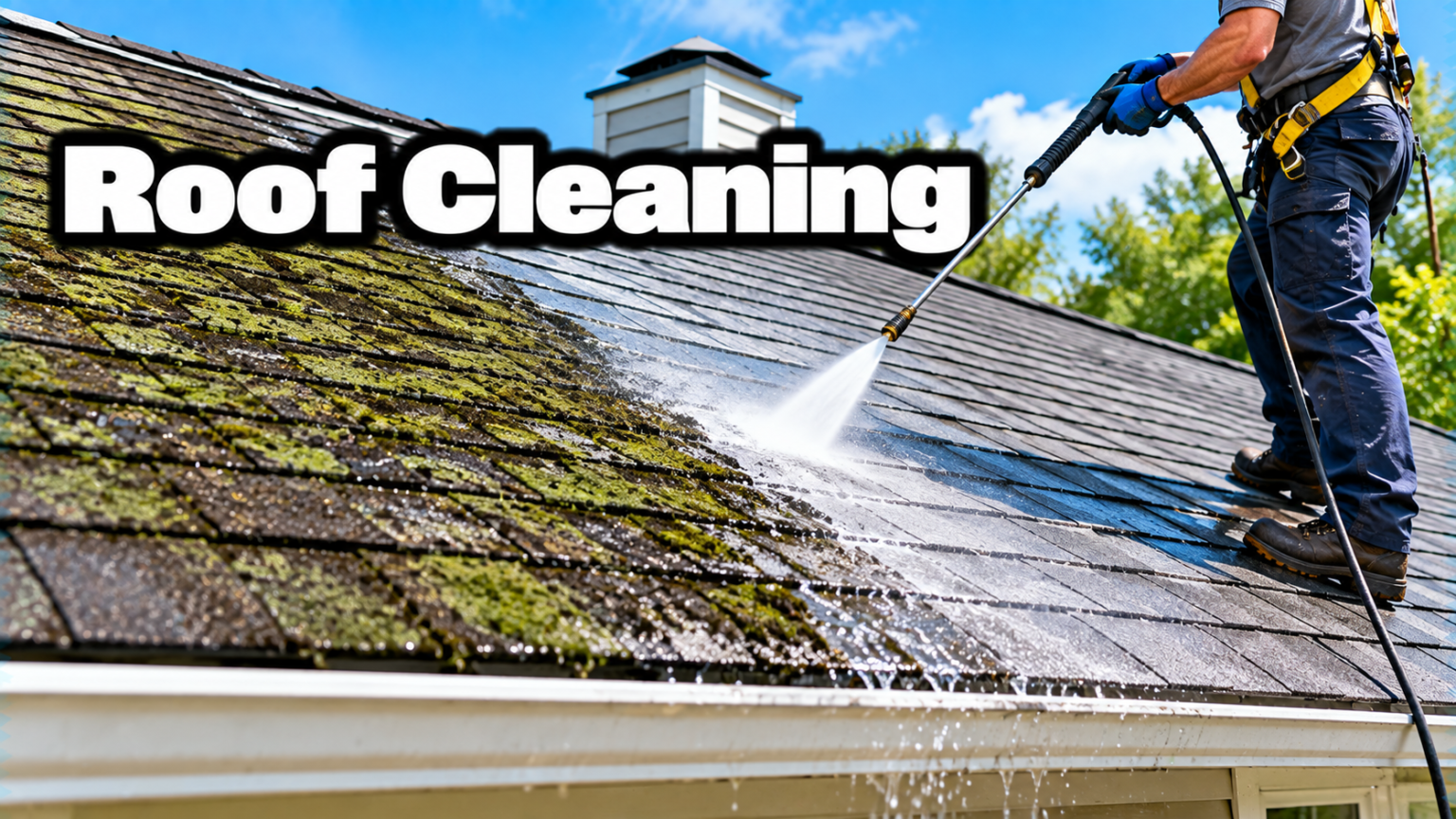

Roof cleaning is the removal of algae, moss, lichen, and built-up grime from your roof so it looks right and lasts longer. For most homes it costs about $250 to $600, takes a few hours, and should happen every one to three years. The safe way to do it is low-pressure soft washing with a cleaning solution, not a high-pressure blast. Here is what the job involves, what causes those stains, what it should cost, and how to keep your roof clean for longer.
What is roof cleaning?
Roof cleaning means washing off the living growth and dirt that collects on your shingles, tiles, or metal over time. On most roofs that growth is a mix of algae, moss, and lichen, sitting under a layer of dust, pollen, and rotting leaf debris. A proper clean lifts all of it off without harming the surface underneath.
The point is not just looks, though a clean roof does lift the whole house. The growth up there traps moisture against the surface and slowly breaks it down. Clearing it off keeps your roof doing its one real job, which is pushing water away from your home instead of holding it. A roof you keep clean tends to reach its full lifespan; one left to go green and black rarely does.
Different roofs ask for slightly different care. Asphalt shingles are the most common and the most prone to algae, tile and slate are heavy and brittle so they need a gentle touch, and cedar shake can soak up too much moisture if the growth is left too long. The method below works across all of them, but the one thing that never changes is keeping the water pressure low.
What those black streaks and green patches actually are
The dark streaks running down so many roofs are not dirt, and no amount of rain washes them off. They come from a type of cyanobacteria called Gloeocapsa magma, a tiny photosynthesizing organism that feeds on the limestone filler baked into modern fiberglass shingles. It took hold across much of North America over the last few decades, which is why older roofs that used to stay clean now streak.
As it spreads, the bacteria build a dark, protective coating to shield themselves from the sun. That coating is the black stain you see. The dark layer soaks up heat instead of reflecting it, so your attic runs hotter and your summer cooling bills creep up. Worse, the bacteria slowly eat the mineral granules off your shingles, and a roof losing its granules loses its ability to reflect sunlight and wears out early.
Moss and lichen are different problems with the same cause, which is damp and shade. Moss is the thick green cushion that grows in the gaps between shingles, almost always on the shaded, north-facing side. As it swells it lifts and curls the shingle edges, and it holds water right against the roof, which is how rot and leaks start. Lichen is the flat, crusty growth that bonds hard to the surface. It is the most stubborn of the three and the slowest to lift after a wash.
Soft washing vs pressure washing: which is safe?
Soft washing is the safe method for almost every roof, and it should be your default. It uses a low-pressure spray, about the force of a garden hose, to lay a cleaning solution onto the roof. That solution is usually sodium hypochlorite (ordinary household bleach) mixed with water, and it kills the algae, moss, and lichen at the root. The dead growth then rinses off or weathers away over the following weeks.
Pressure washing blasts the surface with high-pressure water instead. On a shingle or tile roof this is a costly mistake. The force tears the protective granules off asphalt shingles, cracks and chips tiles, and drives water up underneath the courses where it has no business going. High pressure belongs only on a solid metal roof, and even then a gentler touch is usually enough.
| Feature | Soft washing | Pressure washing |
| Pressure used | Low, like a garden hose | Very high |
| How it works | Solution kills growth at the root | Force blasts growth off |
| Safe for | Asphalt, tile, slate, wood, cedar | Solid metal only |
| Risk to shingles | Low | High, strips granules |
| How long results last | Longer, growth is killed off | Shorter, growth returns |
If your roof has shingles or tiles, insist on soft washing. One afternoon of pressure washing can take years off a roof that would otherwise have lasted decades.
How much does roof cleaning cost?
Most homeowners pay between $250 and $600 to have a roof cleaned by a professional, with a national average around $440. Priced by area, that lands at roughly $0.15 to $0.70 per square foot. The final number comes down to your roof size, its pitch, how high off the ground it is, and how much growth has built up.
The method shifts the price too. Soft washing runs about $0.15 to $0.60 per square foot. Pressure washing, where a metal roof allows it, runs about $0.20 to $0.70. Heavy moss removal is the dearest of the three, at roughly $0.20 to $0.75 per square foot, because someone has to loosen and clear the thick growth by hand before the wash can do its work.
A few things push you toward the top of the range: a steep or multi-story roof that needs ropes, harnesses, and extra time; a large footprint; and years of neglect that leave heavy black staining and deep moss. A small single-story roof with a light dusting of algae sits comfortably at the low end. Getting two or three quotes is worth it, since prices for the same job vary a lot by area and season.
To put real numbers on it, a common single-story home with about 1,500 square feet of roof usually lands somewhere between $300 and $500 for a standard soft wash with light algae. Add heavy moss on the shaded side, or a second story that forces the crew onto ropes, and the same roof can climb past $700. Knowing your roof’s rough square footage before you call makes the quotes easier to compare.
Can you clean your own roof?
You can, but think it through before you climb up. Roof work is one of the more dangerous jobs around the house, and a wet, sloped surface coated in bleach solution turns slick fast. If your roof is steep, high, or you are not steady on a ladder, this is a job worth paying a pro to do with proper safety gear.
If you do take it on, leave the pressure washer in the garage. Work from a ladder where you can, and only walk a roof that is low and gently pitched. The asphalt roofing industry’s own cleaning guidance sets out a simple, safe routine that keeps your shingles intact:
- Mix a cleaning solution of bleach and water, following the ratio your shingle maker states, since it varies by brand.
- Gently spray the solution onto the roof. Never run a power washer, brush, or broom across the surface.
- Let it sit for at least 15 minutes, but no longer than 20.
- Rinse it off with a gentle spray of plain water from the top down.
Soak the plants and shrubs around the house with water before you start and rinse them again when you finish, because the runoff carries bleach. Pick a cool, overcast day so the solution does not dry out before it has done its job, and keep pets and children clear of the runoff until it has washed away.
Signs it is time to clean your roof
Your roof usually tells you it needs attention well before any real damage sets in. The clearest signal is the first faint grey or black streaks appearing near the top of a slope and running downward, which is early algae. Patches of soft green in the shingle gaps mean moss has taken hold, and flat, crusty spots that look almost painted on are lichen.
A few other clues are worth a look from the ground. Granules collecting in your gutters or at the base of a downspout suggest the surface is wearing, and that is a reason to clean sooner rather than later. A roof that looks darker on one side than the other, or an upstairs room that has grown noticeably hotter in summer, often points back to growth soaking up heat. Any of these is a good moment to book a wash while it is still a quick job.
How often should you clean your roof?
Plan on a roof cleaning every one to three years for most homes. If your house sits under heavy tree cover, or in a damp and shaded spot where the roof rarely dries out, move that up to once a year. Shade and a steady drop of leaves and sap feed algae and moss, so those roofs green over much faster.
The better guide is the roof itself, not the calendar. The first faint grey streaks near the top of a slope are your cue to book a clean. Dealing with it then means a quick, cheap soft wash. Leaving it until the whole roof is black and the north side is carpeted in moss turns it into a slow, pricey removal job, and by then some shingle damage is already done.
How to keep your roof clean for longer
A freshly cleaned roof stays clean far longer with a little upkeep, and the upkeep costs almost nothing next to another full clean. Three habits make the biggest difference:
- Fit zinc or copper strips near the ridge. Each time it rains, the metal releases a trace of ions that wash down the slope and stop algae and moss from settling in.
- Cut back any branches that hang over the roof. Less shade and fewer dropped leaves mean a drier surface, and growth cannot get a grip on a roof that dries out in the sun.
- Keep the gutters clear so water drains away instead of pooling at the roof edge and wicking back up under the shingles.
When the day comes to reroof, ask for algae-resistant shingles. They carry copper mixed into the surface granules and hold off the dark streaking for years, which saves you cleaning the new roof anywhere near as often.
Conclusion
Roof cleaning clears the algae, moss, and lichen that stain a roof and cut its life short. For most homes it costs $250 to $600, is due every one to three years, and should be done with low-pressure soft washing, never a high-pressure blast on shingles or tile. Catch the first dark streaks early, add zinc or copper strips to slow the regrowth, and your roof will stay cleaner, work better, and last longer for far less money.
Frequently asked questions
Does roof cleaning damage shingles?
Soft washing does not. It uses low pressure and a cleaning solution, which is safe for asphalt, tile, and most other roofs. Pressure washing does damage shingles, because the high force strips off the protective mineral granules.
Will the black streaks come back after cleaning?
In time, yes, since the bacteria spores are always drifting in the air. Fitting zinc or copper strips near the ridge and keeping the roof sunny and dry slows the regrowth for years.
Is roof cleaning worth the money?
Usually, yes. A clean roof reflects heat better, which can trim cooling bills, and clearing moss early prevents the rot and shingle damage that lead to a far costlier repair or an early roof replacement.
Can I just use bleach from the store?
Yes, a diluted bleach-and-water solution is the standard roof cleaner. Apply it gently, let it sit 15 to 20 minutes, rinse it off, and protect the plants below from the runoff.
How long does a roof cleaning take?
Most jobs take two to four hours for an average home. Heavy moss or a large, steep roof can stretch it to a full day.
Related Articles
Roof Leaks in Heavy Rain: Causes, Signs & Fixes
Are Gutter Guards Worth It? The Complete Guide for Homeowners