


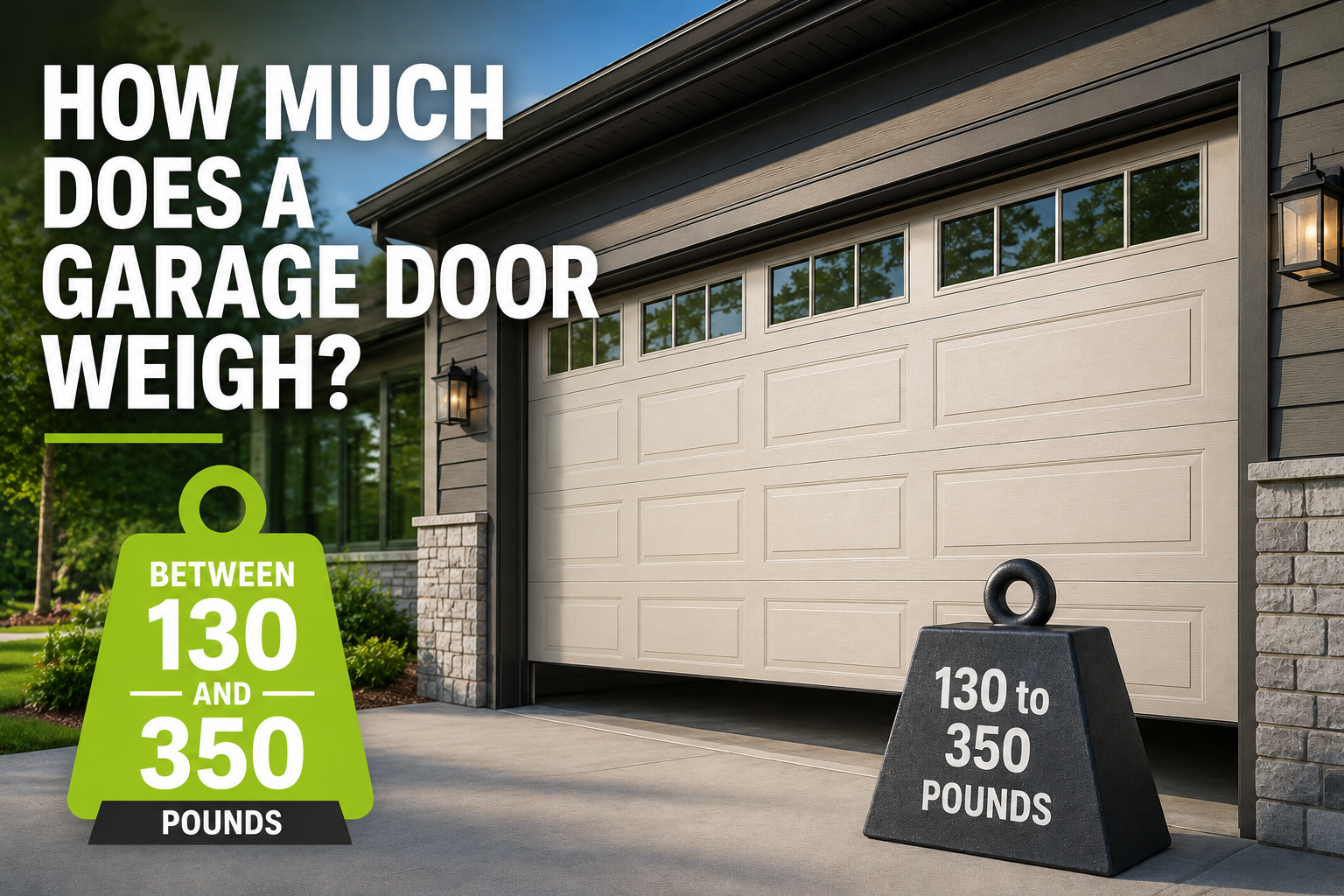

If you’re asking how much does a garage door weigh, the short answer is: most residential garage doors weigh between 100 and 400 pounds, depending on size, material, and insulation. A single-car steel door typically lands between 90 and 160 pounds, while a double-car wood or carriage-house door can weigh 350 pounds or more.
That’s a wide range, and the exact number matters a lot more than you might expect — it’s the single most important figure when you’re replacing torsion springs, upgrading your opener, or troubleshooting a door that suddenly feels too heavy to lift.
This guide breaks down real weight ranges by material and size, explains exactly why the number matters, and walks you through two safe ways to find your own door’s weight — even if your springs are still intact.
Why Garage Door Weight Actually Matters
It’s tempting to treat this as trivia, but garage door weight drives three practical decisions homeowners run into sooner or later.
Spring sizing. Torsion and extension springs are engineered to counterbalance a specific weight range. A spring rated for a 130-pound door won’t safely lift a 220-pound door — it will wear out fast, strain your opener, or snap under the added stress. Buying replacement springs without knowing your door’s actual weight is one of the most common reasons homeowners end up calling a technician twice.
Opener compatibility. Garage door openers are rated by horsepower, and that rating is tied directly to how much weight they’re designed to help move. A ½ HP chain-drive opener is generally fine for most steel doors up to roughly 300 pounds, but a solid wood or oversized insulated door often needs a ¾ HP or 1 HP unit, or a jackshaft-style opener mounted to the side of the door instead of overhead.
Safety. This is the one that matters most. When a spring breaks, the door stops being counterbalanced, and its full weight transfers to whoever is standing underneath it. A 200-plus-pound door falling freely is genuinely dangerous — it’s a leading cause of garage door-related ER visits. Knowing your door’s weight ahead of time helps you understand exactly what you’re dealing with if something goes wrong.
What Determines a Garage Door’s Weight?
Several variables stack together to produce the final number:
- Material. Steel, wood, aluminum, fiberglass, and vinyl all weigh differently for the same size door.
- Size. A single-car door (8 or 9 feet wide) will always weigh less than a double-car door (16 feet wide) in the same material and style.
- Insulation. Adding polystyrene or polyurethane foam insulation between steel panels adds anywhere from 10 to 45 pounds, depending on door size and insulation type.
- Panel thickness. Standard doors run about 2 inches thick, but thinner 1⅜-inch doors and thicker 3-inch commercial doors both shift the total weight.
- Windows and glass panels. Each inserted window section adds roughly 6 to 12 pounds; full-view glass doors (glass across every panel) can add hundreds of pounds compared to a solid door.
- Hardware and reinforcement. Struts, decorative hinges, and wind-load bracing for hurricane-rated doors all add incremental weight — sometimes 20 to 50 pounds total.
- Steel gauge. Thicker (lower-number) gauge steel is more durable but heavier. Most residential doors use 24- or 25-gauge steel.
Garage Door Weight by Material
Steel Doors (Most Common)
Steel is the standard choice for the vast majority of American homes because it balances durability, cost, and weight well.
- Single-car (8×7 or 9×7), non-insulated: 80–100 lbs
- Single-car, insulated: 100–145 lbs
- Double-car (16×7), non-insulated: 130–160 lbs
- Double-car, insulated: 155–225 lbs
Steel doors with double-sided steel skins and injected polyurethane foam (often called “sandwich” doors) sit at the heavier end of these ranges because the foam is denser than basic polystyrene panel insulation.
Wood Doors
Solid wood doors are the heaviest common option, which is why they’re increasingly reserved for high-end or historic homes rather than everyday use.
- Single-car: 250–300 lbs
- Double-car: 350–500+ lbs
Custom carriage-house wood doors with multiple struts and thick panel stock can exceed 500 pounds. If your home has an older wood door, don’t assume it matches a “typical” weight — age, panel thickness, and paint buildup all add pounds over time.
Aluminum Doors
Aluminum is mostly used in modern full-view glass-and-metal designs rather than solid panel doors.
- Double-car, full-view glass and aluminum: 200–280 lbs
The aluminum frame itself is light, but insulated glass panels add the weight back — sometimes enough that these doors weigh close to an insulated steel door of the same size.
Fiberglass and Vinyl Doors
Less common outside coastal regions (where they resist salt-air corrosion better than steel), these are generally the lightest option available.
- Single or double-car: 80–140 lbs
Overlay and Wood-Composite Doors
A hybrid category with a steel or composite base and a wood or wood-look overlay bonded to the surface.
- Single-car overlay: 220–260 lbs
- Double-car overlay: 300–400 lbs
- Wood-look composite (foam core, no real wood): 170–230 lbs, noticeably lighter than true overlay doors
Garage Door Weight Chart by Size
The table below shows approximate total weight (including standard hardware) for the most common residential door sizes and construction types.
| Size (W x H) | Non-Insulated Steel | Insulated Steel (Polystyrene) | Insulated Steel (Polyurethane) | Solid Wood |
|---|---|---|---|---|
| 8×7 (single) | 80–90 lbs | 90–105 lbs | 105–120 lbs | 260–300 lbs |
| 9×7 (single) | 85–100 lbs | 100–115 lbs | 115–135 lbs | 270–310 lbs |
| 10×7 (single/oversized) | 95–115 lbs | 110–130 lbs | 130–150 lbs | 290–330 lbs |
| 16×7 (double) | 130–160 lbs | 155–185 lbs | 185–225 lbs | 350–450 lbs |
| 18×7 (double, oversized) | 175–200 lbs | 195–225 lbs | 230–260 lbs | 400–500+ lbs |
These ranges assume a standard single reinforcement strut and average hardware. Add roughly 6–12 pounds per window section, and 15–50 pounds for wind/hurricane-rated bracing.
How to Find Your Exact Door Weight (Two Safe Methods)
Charts get you close, but if you’re about to order springs, “close” isn’t always good enough — a spring mismatched by even 20–30 pounds can cause premature failure. Here are two ways to get an accurate number.
Method 1: Check the Door’s ID Sticker (No Lifting Required)
Most manufacturers place a sticker on the end cap of the top or bottom section, near the vertical track, with the door closed. Look for:
- Manufacturer and model (CHI, Clopay, Amarr, Wayne Dalton, and similar).
- Size specifications for width, height, and section breakdown.
- Serial number or purchase order number.
With the model number and size, you can call the manufacturer or a local dealer and ask for the door’s specified weight — this is the most reliable number you’ll get without a scale.
Method 2: Weigh the Door Yourself
This works whether your springs are intact or already broken, though the setup differs slightly.
If the springs are still working (door lifts easily by hand):
- Fully close the door and disconnect the opener using the manual release cord.
- Get two bathroom scales rated for at least 300 lbs each.
- Lift the door about 12 inches and have a helper slide one scale under each bottom corner.
- Slowly lower the door onto both scales and read each one.
- Add the two readings together for the total door weight.
If a spring has already broken (door is heavy and won’t stay up):
- Disconnect the opener first — do not let the motor try to lift the door.
- With help, carefully lower the door until it rests flat.
- Place one scale under each bottom corner as above and read both.
- Never attempt this alone; an uncounterbalanced door is genuinely heavy and can drop suddenly.
If you’re not confident doing this safely, it’s worth paying a technician for a quick weight check rather than risking an injury over a number you could get in five minutes with professional help.
Matching Springs and Openers to Door Weight
Once you know your door’s weight, here’s roughly how it maps to equipment:
- Torsion springs are rated in inch-pounds of torque and matched to weight, wire size, and door height together — not weight alone. Always confirm the spring spec with a supplier rather than estimating from weight alone.
- ½ HP openers typically handle steel doors up to about 300 lbs comfortably.
- ¾–1 HP or jackshaft openers are recommended for solid wood, oversized, or heavily insulated doors above 300 lbs.
- Extension springs (mounted along the horizontal tracks rather than above the door) are generally used on lighter single-car doors and have their own separate weight ratings.
If you’ve recently added insulation, swapped in heavier composite panels, or installed a window kit, treat your door’s weight as changed — re-check it before assuming your existing spring is still correctly sized.
Frequently Asked Questions
How much does a standard 2-car garage door weigh? A standard 16×7 double-car steel garage door typically weighs between 130 and 225 pounds, depending on whether it’s insulated. Insulated steel doors sit toward the higher end of that range.
How much does a single-car garage door weigh? Single-car doors (8×7 or 9×7) generally weigh 80 to 150 pounds, with insulated steel doors weighing more than non-insulated ones.
Do insulated garage doors weigh more than non-insulated ones? Yes. Insulation adds anywhere from 10 to 45 pounds to a typical residential door, depending on whether it uses basic polystyrene panels or denser polyurethane foam injected between two steel skins.
How much does a wood garage door weigh compared to steel? Solid wood doors are significantly heavier — often two to three times the weight of a comparable steel door. A double-car wood door commonly weighs 350 to 500 pounds versus 130 to 225 pounds for insulated steel.
Can I lift a garage door by hand if the spring breaks? You can attempt it briefly to move the door out of the way, but doors over roughly 150 pounds are difficult and risky to lift without a working spring. Treat a broken spring as a repair to schedule immediately, not a DIY lifting challenge.
Does a garage door’s weight affect my opener choice? Yes. Most standard ½ HP openers are built for doors up to about 300 pounds. Heavier wood or oversized doors typically need a ¾ HP, 1 HP, or jackshaft-style opener to operate reliably without straining the motor.
How accurate are online garage door weight calculators? They’re a reasonable starting point but only approximate — the same nominal size and material can vary by 30 pounds or more between manufacturers. For spring replacement specifically, weighing the door directly or checking the manufacturer’s spec sticker is far more reliable than any general calculator.
Key Takeaways
Garage door weight isn’t just trivia — it’s the number that determines whether your springs, opener, and daily operation stay safe and reliable. Most steel doors fall between 100 and 225 pounds, wood doors often exceed 350 pounds, and factors like insulation, glass, and reinforcement can shift that number substantially in either direction.
If you’re planning a spring replacement or a new opener, don’t rely on a size chart alone — check your door’s ID sticker or weigh it directly using the steps above to get a number you can trust. And if a spring has already failed or your door suddenly feels too heavy to lift, treat it as a safety issue and call a licensed garage door technician before attempting to fix it yourself.
Related Articles
How Do You Wash Walls Before Painting? (Step-by-Step Guide)
How to Vent a Toilet: Complete Guide 2026