


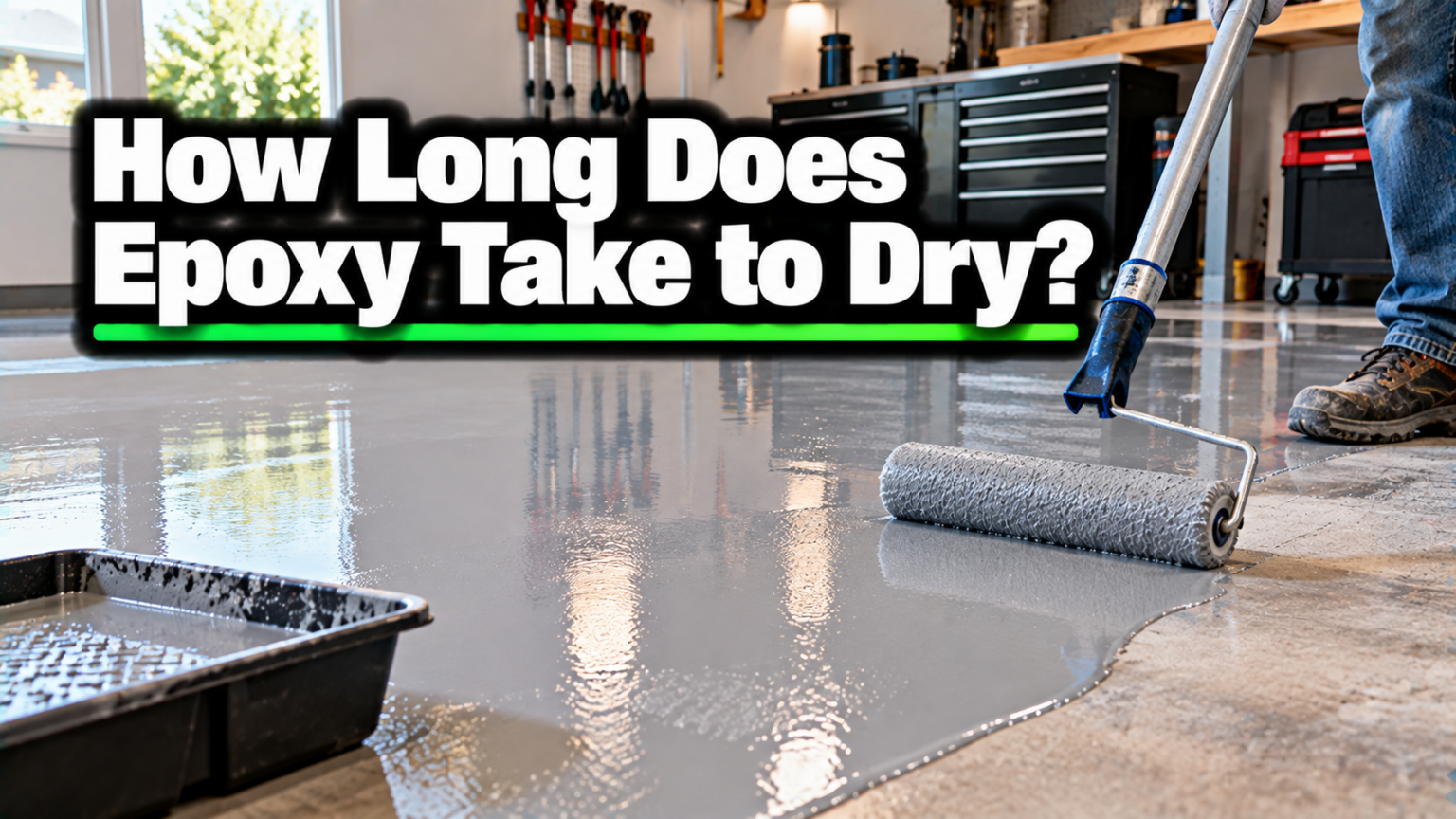

Most epoxy feels dry to the touch in about 12 to 24 hours, but it needs anywhere from 24 hours to 7 full days to cure hard and reach its real strength. The exact time comes down to two things: the type of epoxy you are using and how warm the room is. A five-minute repair glue and a deep resin river table are both epoxy, yet one is done before lunch and the other needs a week. So the useful answer starts with a question of your own: do you mean dry to the touch, or fully hardened and ready to use?
That gap matters more than any single number, so it is worth getting straight before you plan around it.
What does it mean for epoxy to “dry”?
Epoxy does not dry the way paint or water-based glue dries. Paint dries because the water or solvent leaves it. Epoxy has nothing to evaporate. It hardens through a chemical reaction between two parts, the resin and the hardener, that you mix together right before use. Once mixed, the two start linking up and slowly turn from liquid to solid. This is called curing, even though almost everyone says drying.
There are two moments you actually care about:
- Set, or “touch dry.” The surface is no longer sticky and holds its shape. It looks done, and you can stop worrying about dust or fingerprints landing in it.
- Cure. The epoxy has finished its reaction, reached full hardness, and can take weight, heat, water, and cleaning chemicals. It is actually done.
Set comes first and cure comes later, sometimes much later. A tabletop coating can feel dry overnight yet still dent under a warm coffee mug for two more days. Treating “touch dry” as “ready to use” is the single most common reason an epoxy project goes wrong, so keep the two apart in your head. When a label or chart gives you a drying time, it usually means set; when it says the piece is ready for full use, it means cure. Read which one the number refers to before you plan your day around it.
How long does each type of epoxy take to dry and cure?
Different epoxies are built for different jobs, and their timing reflects that. Below are the common types with their typical set and full cure times at normal room temperature, around 70 to 75°F.
| Epoxy type | Touch dry / set | Full cure |
| Quick-set adhesive (5-minute, fast repair) | 5 to 60 minutes | 12 to 24 hours |
| Standard two-part epoxy glue | 4 to 6 hours | 15 to 24 hours |
| Tabletop and craft coating resin | 12 to 24 hours | About 72 hours (3 days) |
| Deep-pour and casting resin (river tables) | 48 to 72 hours | 5 to 7 days |
| Floor and garage coating | Walk on in 24 hours | 5 to 7 days |
A few notes so you read that table the right way.
Quick-set glues are the sprinters. A product like J-B Weld’s Original formula sets in about four to six hours and reaches full strength in 15 to 24 hours, while its five-minute versions grab in minutes and are handle-strong within the hour. These are made for small repairs and bonds, not for filling or coating.
Coating and casting resins sit at the slow, patient end. A bar-top or table coating usually feels dry the next morning but wants about three days before you put real use on it. Deep pours, the thick clear layers used for river tables and mold casting, take the longest of all. They are designed to react slowly on purpose so they do not overheat, so five to seven days before the piece is truly ready is normal, not a sign that something is wrong.
Floor coatings split the difference in a handy way. You can often walk on a garage floor after about a day, park a car on it after roughly three days, and treat it as fully hardened after a week. Light foot traffic early is fine; dragging heavy tool chests across it is not. The full seven days matters most for a floor, because that is when the coating builds its resistance to hot tires, road salt, and spilled solvents, the very things a garage floor exists to shrug off.
One rule sits above the whole table: check the label on your exact product first. Brands tune their resins and hardeners differently, and the number printed on the can always beats a general chart.
How long can you work with epoxy before it starts to set?
Before any of those cure times begin to matter, you get a stretch of working time, and it is shorter than the drying numbers suggest. Working time, sometimes called open time, is the window after mixing when the epoxy is still liquid enough to pour, spread, and level. For a standard two-part resin at room temperature this is often around 20 to 45 minutes. A five-minute glue gives you barely two minutes. Slow and deep-pour formulas can stay workable for an hour or more.
Two things quietly shorten that window. Warmth speeds the reaction, so a hot day gives you less time than a cool one. And keeping the mixed batch in a tall, narrow cup lets it build heat on itself, which can cut a 40-minute open time down to 10 or 15 before it turns to jelly in the pot. Pour it out or spread it into a shallow, wider container soon after mixing, and it stays liquid and usable for longer.
What affects how fast epoxy cures?
Two batches of the same epoxy can cure at very different speeds depending on the conditions. Four things move the needle most.
Temperature
Heat is the biggest lever by far. Warm air speeds the reaction and cold air slows it, and the effect is stronger than most people expect. A well-known guide from epoxy makers is the 18-degree rule: every 18°F rise above 72°F roughly cuts the remaining cure time in half, and every 18°F drop roughly doubles it. You can see the reasoning laid out in WEST SYSTEM’s epoxy basics. So a coating that cures in three days at 72°F can stretch close to six days at 54°F. Below about 60°F many epoxies slow to a crawl, and some stay tacky and never fully harden. Keep your workspace warm and steady, and you avoid most timing problems before they start.
Humidity
Damp air works against a clean cure. Above about 60% relative humidity, epoxy takes longer to set and can turn hazy or cloudy on top, a milky film sometimes called blush that dulls an otherwise clear finish. Above roughly 85%, some epoxies will not cure properly at all. Dry, warm conditions give you the clearest and hardest result, so pick your day and your room with that in mind, especially for glossy coatings.
Mixing ratio and stirring
Epoxy only cures correctly when you measure the two parts to the exact ratio on the label, usually 1:1 or 2:1 by volume, and stir them long enough. Getting either wrong is the top cause of epoxy that stays soft or sticky for days. Plan to scrape the sides and the bottom of the cup as you go and stir for a full three to five minutes, so every bit of resin actually meets hardener. Guessing the amounts or rushing the mix is a false saving that can cost you the whole pour.
Pour depth and mass
Thickness changes how epoxy behaves as it cures. The reaction gives off heat, and a thick pour traps that heat, which speeds its own cure but can also overheat, yellow, or crack the epoxy if you use the wrong product. That is exactly why deep pours use special slow formulas rated for the depth. Thin coats cure more gently and evenly. The safe move is to match the epoxy to how deep you are pouring, rather than forcing a thin-coat resin into a thick pour.
How long before you can sand or add another coat?
Recoating has its own timing, separate from the full cure. Most coating epoxies have a recoat window, often somewhere between 4 and 24 hours, when the first layer is set enough to hold a second but still tacky enough for the two to bond chemically without sanding. Miss that window and the surface hardens too much, so you then have to scuff it with sandpaper to give the next coat something to grip.
If you want to sand for a smooth finish rather than to recoat, wait for the full cure first. Sanding half-cured epoxy gums up the paper and drags soft resin around instead of leveling it. Cured epoxy sands to a clean, even dust. As always, the product label gives the exact recoat window for your resin, and it is worth reading before you open the tin.
How can you tell when epoxy is fully cured?
Go by feel and by time together, not by looks alone. A cured surface is hard, cool, and smooth, with no tack anywhere. Press a fingernail into an out-of-the-way spot: if it leaves a dent or feels rubbery, the epoxy is still curing and needs more time. A fingerprint that stays put is another sign it is not there yet.
The safest habit is to wait out the full cure time on the label before you sand, stack weight, or put the piece to work, even when it felt ready a day early. If the surface is still sticky well past the stated time, the cause is almost always a bad mix ratio or a cold room, and gentle, steady warmth can sometimes rescue a slow batch.
How do you make epoxy cure faster, and what to avoid?
The clean way to speed a cure is warmth. Keep the room at 75 to 80°F, or aim a little gentle heat at the piece once it has set, and the reaction moves faster on its own. For jobs you know will be cold, buy a fast hardener instead of the standard one, since the hardener you pick sets the base speed more than anything you do later.
A few things are worth avoiding. Do not blast fresh epoxy with a hot heat gun or hair dryer to rush it, because sudden strong heat can thin the epoxy, create ripples, or trap bubbles under the surface. Do not add extra hardener hoping it will cure quicker, since that throws off the ratio and usually leaves the epoxy softer, not harder. And do not carry a fresh piece out to a cold garage overnight and expect the morning to look right. Moderate, steady warmth beats a quick blast every time.
Conclusion
Most epoxy is touch dry in 12 to 24 hours and fully cured in one to seven days, and the type of epoxy plus the room temperature decide where you land in that range. Fast repair glues are done in a day, coatings need about three, and deep pours and floors want a full week. Mix to the exact ratio, keep the space around 70 to 80°F, and wait for the full cure before you load or use the piece. Do that and you get a hard, clear, strong finish.
Frequently asked questions
Is epoxy fully hard once it feels dry? No. Feeling dry to the touch means it has set, not cured. Most epoxy still needs another one to six days to reach full hardness and strength, so wait for the label’s cure time before you use it.
Why is my epoxy still sticky after 24 hours? Usually the mix was off or the room was too cold. An incorrect resin-to-hardener ratio or under-stirring is the top cause, followed by temperatures under 60°F. Gentle, steady warmth can sometimes help a slow batch finish curing.
Does epoxy cure faster in heat or cold? Heat. Every 18°F above 72°F roughly halves the cure time, and every 18°F below it roughly doubles it. Keeping the space around 75 to 80°F gives a faster and more reliable cure than a cold room.
How long before I can walk on or use an epoxy floor? You can usually walk on a garage or floor coating after about 24 hours, drive on it after roughly 72 hours, and treat it as fully cured after 5 to 7 days. Check your product’s label to be sure.
Can I speed up epoxy with a heat gun or hair dryer? Only very gently, and it carries risk. Strong, direct heat can thin the epoxy, cause ripples, or trap bubbles. Warming the whole room is safer than aiming hot air at the surface.
Related Articles
Joist Tape for Decking: The Complete Guide to Protecting Your Deck’s Substructure
How Much Water Does a Toilet Use Per Flush? A Complete Guide
Why Is My Toilet Seat Turning Blue? Cause, Fixe & Prevention




