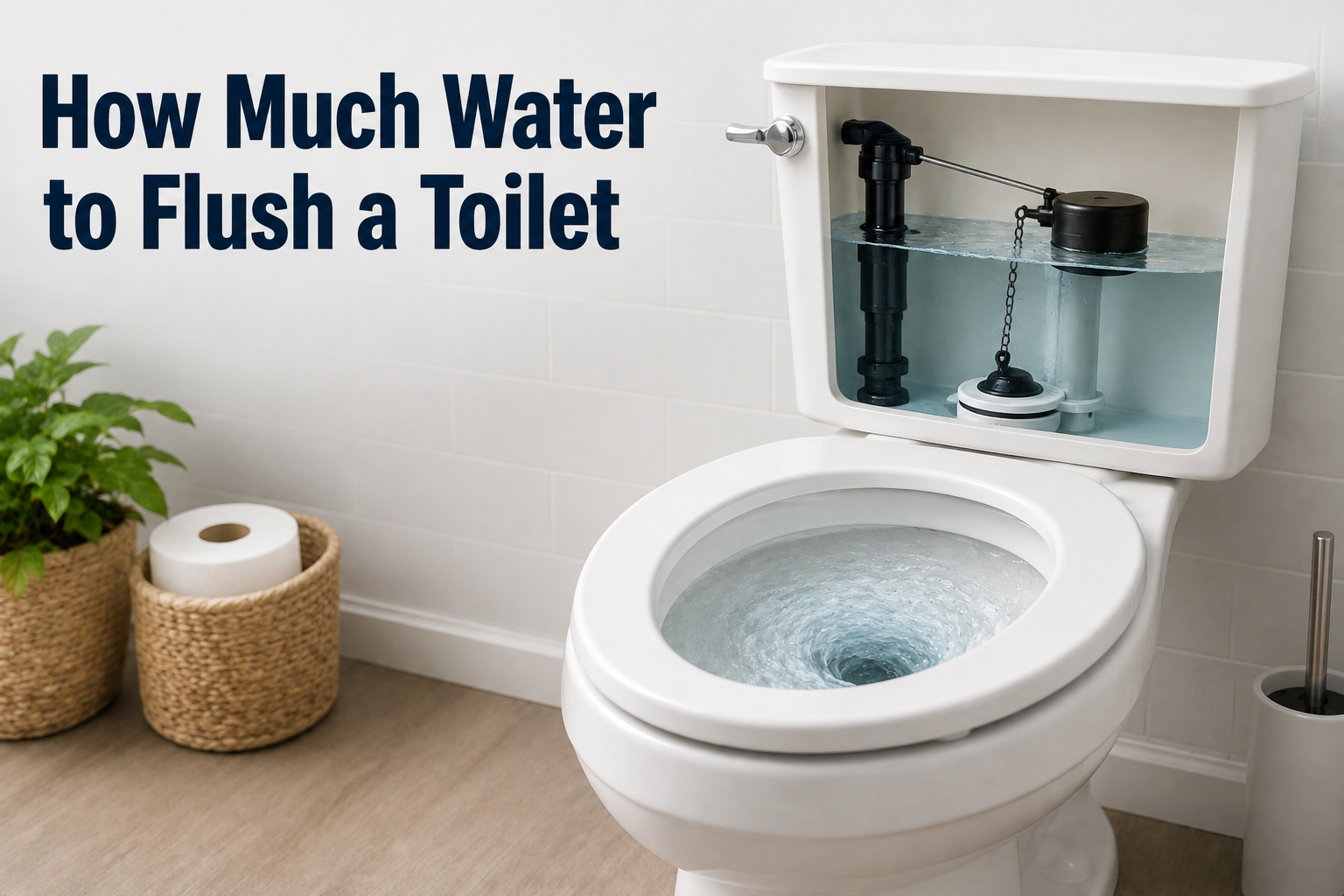

Every time you press that handle or button, a hidden number ticks upward on your water bill and, more broadly, on the planet’s freshwater budget. Most people never stop to think about how much water to flush a toilet actually requires, yet toilets are typically the single largest source of indoor water use in a home. Depending on the age and design of your fixture, one flush might use anywhere from under a gallon to nearly seven gallons.
Understanding this number isn’t just trivia. It affects your monthly utility costs, your home’s environmental footprint, and even whether your area’s water infrastructure can keep up during droughts. This guide breaks down exactly how much water different toilets use, what shapes that number, and practical steps you can take to flush smarter without sacrificing performance.
Quick answer: Modern toilets manufactured after 1994 use 1.6 gallons per flush (gpf) or less, while high-efficiency models use as little as 0.8 to 1.28 gallons. Older toilets built before the 1980s can use 5 to 7 gallons every time you flush.
Toilet Water Usage by Type
Not all toilets are created equal. The amount of water a toilet pulls from the tank depends heavily on when it was manufactured and what technology sits inside it. Here’s a clear breakdown.
| Toilet Type | Manufacture Era | Water Used Per Flush |
|---|---|---|
| Older gravity-fed models | Pre-1980s | 5–7 gallons |
| Early water-saving models | 1980–1994 | 3.5 gallons |
| Standard low-flow toilets | 1994–present | 1.6 gallons |
| High-efficiency toilets (HET) | 2000s–present | 1.28 gallons |
| Ultra-low-flow / WaterSense certified | Modern | 0.8–1.1 gallons |
| Dual-flush toilets | Modern | 0.8–1.1 gal (liquid) / 1.6 gal (solid) |
Older Toilets (Pre-1980s)
If your home still has its original bathroom fixtures from decades ago, there’s a good chance each flush is sending five to seven gallons down the drain. These toilets were built before water conservation became a design priority, relying on sheer volume rather than clever engineering to clear the bowl.
Toilets from 1980–1994
As awareness of water scarcity grew, manufacturers began trimming tank sizes. Toilets from this transitional period typically use around 3.5 gallons per flush — a meaningful improvement, though still far above today’s standards.
Standard Low-Flow Toilets (1994–Present)
A major turning point came when U.S. federal law mandated that new toilets use no more than 1.6 gallons per flush. This became the baseline for nearly every toilet sold in the country from the mid-1990s onward.
High-Efficiency Toilets (HET)
High-efficiency toilets push the envelope further, using just 1.28 gallons per flush while still relying on improved bowl geometry and flush mechanics to maintain strong performance.
Ultra-Low-Flow / WaterSense Certified
Toilets carrying the EPA’s WaterSense label use 1.28 gallons per flush or less, with some ultra-efficient models dipping to 0.8 gallons. These are independently tested to confirm they clear waste effectively despite the reduced volume.
Dual-Flush Toilets
Dual-flush systems give users a choice: a lighter flush (roughly 0.8–1.1 gallons) for liquid waste and a fuller flush (around 1.6 gallons) for solid waste. This flexibility can meaningfully cut average household water use over time.
How Flush Volume Is Regulated
Toilet water usage isn’t left entirely to manufacturer discretion — it’s shaped by law and voluntary certification programs.
U.S. Federal Standards
The Energy Policy Act of 1992 set a national maximum of 1.6 gallons per flush for all toilets manufactured or sold in the United States, a rule that reshaped the entire plumbing fixture industry.
EPA WaterSense Program
The EPA’s WaterSense program goes a step further, certifying toilets that use at least 20% less water than the federal standard while still meeting rigorous flush-performance testing.
International Standards
Other countries have their own benchmarks. The European Union, Australia, and Canada each enforce similar or stricter flush-volume limits, often paired with dual-flush requirements to encourage water savings at the consumer level.
Factors That Affect Water Usage
The gallon figure printed on a toilet’s specification sheet isn’t the whole story. Several real-world factors influence how much water actually gets used.
Toilet Age and Model
As covered above, age is the single biggest predictor of flush volume. A toilet’s manufacture date is often the fastest way to estimate its water use without any guesswork.
Flush Mechanism Type
Gravity-fed toilets rely on the weight of water falling from the tank, while pressure-assisted toilets use compressed air to force water through with more force. Pressure-assisted models can sometimes achieve strong performance with less water, though they tend to be noisier.
Bowl Design and Trapway Size
A wider trapway (the channel that carries waste out of the bowl) allows water to move more efficiently, meaning well-designed low-flow toilets can outperform older, poorly engineered high-volume models.
Leaks and Running Toilets
A silent but costly factor is water waste from leaks. A toilet with a worn flapper valve can leak dozens to hundreds of gallons per day without ever triggering a visible overflow, quietly inflating your water bill far beyond what any single flush would suggest.
How to Find Your Toilet’s Flush Volume
If you’re unsure how much water your own toilet uses, there are a few reliable ways to check.
- Check the manufacture date stamp — Most toilets have a date stamped inside the tank or underneath the bowl rim, which lets you estimate flush volume based on the era it was made.
- Read the label inside the tank — Many toilets manufactured after the 1990s have a printed gallons-per-flush label directly on the inside tank wall.
- Try the manual bucket test — Fill a bucket with a known volume of water, pour it into the tank up to the fill line, and measure how much was needed. This gives you a hands-on, accurate figure when labels are missing or worn away.
Daily and Annual Water Usage Estimates
Understanding flush volume becomes even more useful when you scale it up to real-world usage.
Per-Person Daily Usage
The average person flushes a toilet roughly five times per day. At 1.6 gallons per flush, that adds up to about 8 gallons daily per person just for toilet use.
Household Annual Comparison
A household with an older 5-gallon toilet flushing five times daily per person could use well over 9,000 gallons a year more than a household with a 1.28-gallon high-efficiency model, depending on occupancy. Multiply that across a neighborhood or city, and the difference becomes enormous.
Cost Savings
Because water utilities typically charge per unit of usage, switching from an older high-volume toilet to a modern low-flow one can meaningfully reduce monthly water bills, often paying back the cost of a new toilet within a few years.
How to Reduce Toilet Water Usage
Whether or not you’re ready to replace your toilet, there are several ways to cut down on water use.
- Upgrade to a WaterSense-labeled toilet — This is the most effective long-term fix, often cutting flush volume by 60% or more compared to older fixtures.
- Install a dual-flush converter kit — These affordable retrofit kits let you add dual-flush functionality to an existing single-flush toilet.
- Try the DIY tank displacement method carefully — Placing a sealed, weighted plastic bottle in the tank can reduce water volume slightly, though this should be done cautiously since it can sometimes affect flush performance.
- Fix leaks and worn flappers promptly — Replacing a cheap rubber flapper is one of the fastest, lowest-cost ways to stop ongoing water waste.
Common Myths and Misconceptions
Older Toilets Flush Better
This is one of the most persistent myths in home plumbing. While early low-flow toilets in the 1990s did sometimes struggle with clogging, modern engineering — including improved bowl shapes and pressure-assist technology — has largely eliminated this problem.
The Brick-in-Tank Method
Some older advice suggests placing a brick in the tank to displace water and reduce flush volume. This is now widely discouraged, since bricks can crumble over time and damage internal tank components or clog the plumbing.
Low-Flow Means Weak Flush
Many assume less water automatically means a weaker flush. In reality, WaterSense-certified toilets are independently tested to ensure they clear waste as effectively as older, higher-volume models.
Environmental and Cost Impact
Water Conservation at Scale
Because toilets account for such a large share of indoor water use, even small efficiency gains multiplied across millions of households can meaningfully ease pressure on regional water supplies, especially in drought-prone areas.
Utility Bill Savings
Lower flush volumes translate directly into lower monthly water and sewer charges, since most utilities bill based on metered usage.
Rebate and Incentive Programs
Many municipalities and water utilities offer rebates for replacing old toilets with WaterSense-certified models, which can offset a significant portion of the upgrade cost.
Conclusion
So, how much water to flush a toilet really takes depends almost entirely on your fixture’s age and design. Older toilets can guzzle 5 to 7 gallons per flush, while modern high-efficiency and WaterSense-certified models sip as little as 0.8 to 1.28 gallons. If your toilet was installed before the mid-1990s, checking its flush volume — and considering an upgrade — is one of the simplest ways to lower your water bill and reduce your household’s environmental footprint.
FAQs
Q: How much water does a toilet use per flush on average? A: Most modern toilets use 1.6 gallons per flush, while high-efficiency models use as little as 0.8 to 1.28 gallons.
Q: How can I tell how much water my toilet uses? A: Check the manufacture date stamp inside the tank, look for a printed gallons-per-flush label, or measure it manually using the bucket-fill method.
Q: Do low-flow toilets clog more often? A: Not typically. Modern low-flow and WaterSense-certified toilets are engineered and tested to flush as effectively as older high-volume models.
Q: Is it worth replacing an old toilet just to save water? A: Often yes — many households recoup the cost of a new WaterSense toilet within a few years through lower water bills, especially with available utility rebates.
Related Articles
How Long Does a Home Inspection Take? Complete Time Guide (2026)
What Is an Asbestos Stucco Ceiling? Learn the risks and stay safe.
Crack in Basement Wall: Everything You Need to Know
What Are Styrofoam Ceiling Tiles? Discover their benefits & tips.