


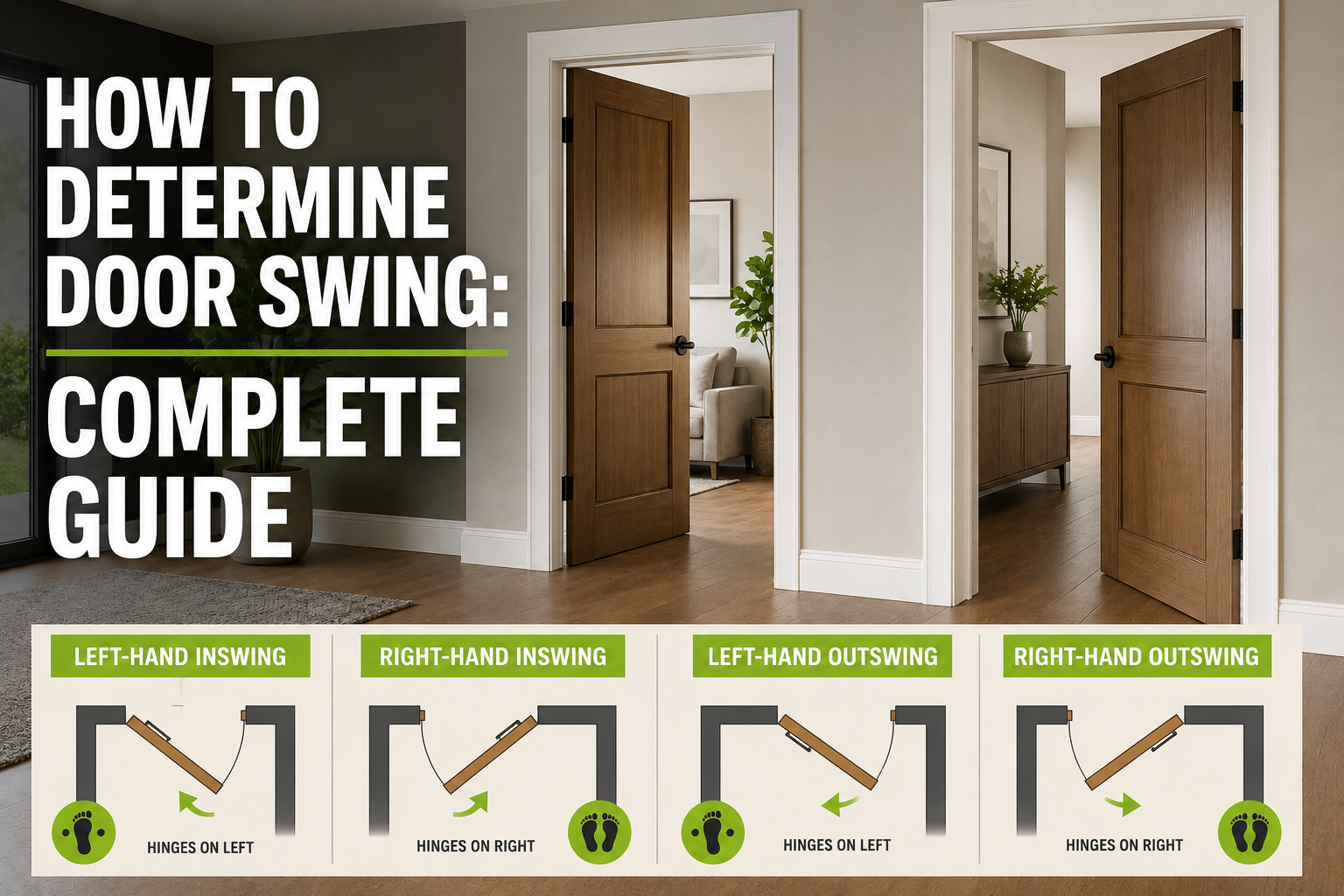

If you’ve ever stood in front of a door trying to figure out whether it’s “left-handed” or “right-handed,” you already know how confusing door terminology can get. Knowing how to determine door swing correctly is essential before you order a new door, replace hinges, install a lockset, or hang a storm door — get it wrong, and you’ll end up with hardware that doesn’t fit or a door that swings into a hallway, appliance, or piece of furniture.
The good news is that once you understand the one simple test professionals use, you’ll never second-guess a door’s handing again. This guide walks you through that test step by step, explains every handing term in plain English, and covers the practical mistakes that trip up even experienced DIYers.
What Does “Door Swing” Actually Mean?
Door swing (also called door handing) describes two things at once: which side of the door frame the hinges are mounted on, and which direction the door moves when you open it — toward you or away from you. Combine those two details and you get a door’s “hand,” such as left-hand, right-hand, left-hand reverse, or right-hand reverse.
This isn’t just industry jargon for the sake of it. Manufacturers build hinges, locksets, closers, thresholds, and weatherstripping to fit a specific handing. A left-hand door and a right-hand door use mirror-image hardware, so ordering the wrong one means parts that physically won’t install correctly.
Why Getting Door Swing Right Matters
- Hardware compatibility: Hinges, latches, deadbolts, and closers are often handed. The wrong hand means holes that don’t line up and hardware you can’t return once it’s been installed.
- Safety and egress: Building codes frequently require exit doors to swing in the direction of travel during an emergency, so people can push their way out without fumbling with the door.
- Space planning: A door that swings the wrong way can block a hallway, hit a light switch, collide with furniture, or eat up usable floor space in a small bathroom or closet.
- Weather performance: In regions with heavy wind-driven rain, an outswing exterior door typically seals tighter against the frame than an inswing door, reducing drafts and leaks.
- Resale and renovation planning: Contractors and door suppliers need the correct handing to quote, fabricate, and prehang a replacement door accurately, so mistakes here can delay a project by weeks.
The Simple Test: How to Determine Door Swing in Under a Minute
Professionals in the door and hardware industry use one consistent method. Here’s how to do it correctly, without the contradictions you’ll find in a lot of online guides.
Step 1: Stand on the Correct Side of the Door
This is where most people go wrong. You need to stand on the secure side of the door — the side where a key is used to lock it, or, for an interior door, the side from which someone would normally approach and open it. For exterior doors, that means standing outside, facing the door as if you’re about to walk in.
Step 2: Face the Door with Your Back to the Hinges
Once you’re on the correct side, position yourself so the hinges are behind you and you’re facing the door squarely, as though you’re about to open it.
Step 3: Look at Which Side the Hinges Are On
With your back to the hinge side, check whether the hinges are on your left or your right as you face the door.
- Hinges on your left → it’s a left-hand door
- Hinges on your right → it’s a right-hand door
Step 4: Determine Which Way the Door Swings
Now note whether the door swings toward you (into your space) or away from you (into the next room or outside).
- Swings toward you → inswing
- Swings away from you → outswing
Step 5: Combine the Two Results to Get the Full Handing
Put the hinge side and swing direction together, and you’ll land on one of four standard handings for a single door:
| Hinge Side | Swing Direction | Resulting Handing |
|---|---|---|
| Left | Swings away from you (into the room beyond) | Left-Hand (LH) |
| Right | Swings away from you (into the room beyond) | Right-Hand (RH) |
| Left | Swings toward you | Left-Hand Reverse (LHR) |
| Right | Swings toward you | Right-Hand Reverse (RHR) |
A quick memory trick: if the door swings away from you when you’re standing on the secure side, it’s a “standard” hand (LH or RH). If it swings toward you, it’s “reverse” (LHR or RHR).
Inswing vs. Outswing: What’s the Difference and Why It’s Used
Inswing doors open into the room or building. They’re common for interior doors and for exterior doors in regions without extreme weather, because they’re easier to seal against forced entry from outside and don’t need extra exterior clearance.
Outswing doors open away from the room or building. They’re common on commercial exits (for code-required emergency egress), storm doors, and homes in coastal or high-wind areas, since an outswing door pushes tighter into its frame during a storm rather than being pulled loose.
Neither is universally “better” — the right choice depends on the space, local codes, and climate.
Determining Swing for Double Doors
Double doors (also called French doors or pairs) work the same way, but with one extra step: identifying the active leaf, which is the door you use most often, versus the inactive leaf, which usually stays closed and secured with flush bolts until you need the full opening.
- Stand on the secure side, as with a single door.
- Determine hinge side and swing direction for the active leaf using the same method above.
- Note whether the inactive leaf swings the same direction (both doors open the same way) or the opposite direction (one in, one out — sometimes called a “paired” configuration).
- If both leaves swing open away from each other simultaneously, that’s known as double egress, common in hospital corridors and school hallways.
Determining Swing on a Door That’s Already Installed and Closed
If the door is currently closed and you can’t easily see the hinges or watch it swing, use these two shortcuts instead:
- Check the hinge barrel. Walk around to each side of the door frame. Whichever side shows the hinge barrels (the cylindrical part the pins sit in) is the hinge side.
- Check the doorknob and strike plate. The doorknob or lever is always on the opposite side of the frame from the hinges. If you can see the strike plate on the frame (where the latch catches), that tells you which side is the latch side — and the hinge side is the other one.
How Door Swing Affects the Hardware You Buy
Handing isn’t just a description — it determines which physical products will actually fit your door:
- Hinges: Most standard butt hinges are non-handed and reversible, but spring hinges, some heavy-duty commercial hinges, and continuous (piano) hinges can be handed.
- Locksets and deadbolts: Many modern locksets are reversible in the field, but older mortise locks and some commercial exit devices are handed and must be ordered to match.
- Door closers: Surface-mounted closers are almost always handed, since the arm and mounting position depend on which way the door swings.
- Prehung door units: When you order a prehung door (a door already mounted in its frame), you must specify the exact handing, or the unit will arrive built for the wrong opening.
- Weatherstripping and thresholds: Outswing doors typically use different threshold and sweep profiles than inswing doors to shed water correctly.
Always confirm handing before placing an order — most suppliers can’t accept returns on a prehung door or handed lockset once it’s been cut or finished for a specific configuration.
Common Mistakes People Make When Determining Door Swing
- Standing on the wrong side. Checking handing from inside when the industry standard is to check from the secure (usually exterior) side is the single most common error, and it flips the entire result.
- Confusing “which way it opens” with “which side the knob is on.” The doorknob location is a helpful confirmation, but hinge side and swing direction are what actually define the hand.
- Assuming all doors in a house use the same convention. Interior doors, closet doors, and exterior doors can each have their own logic depending on layout — check each one individually.
- Forgetting to account for the active leaf on double doors. Only the active leaf’s handing typically matters for hardware ordering, but installers still need to know both leaves’ behavior.
- Mixing up inswing and outswing terminology with left/right. These are two separate variables — a door can be left-hand and inswing, or left-hand and outswing (reverse) — so keep them distinct when describing a door to a supplier.
Frequently Asked Questions
How do I tell if a door is left-hand or right-hand from outside? Stand outside facing the door with your back to the hinges. If the hinges are on your left, it’s a left-hand door; if they’re on your right, it’s a right-hand door.
What is the difference between left-hand and left-hand reverse? A left-hand (LH) door has hinges on the left and swings away from you when you’re standing on the secure side. A left-hand reverse (LHR) door also has hinges on the left, but swings toward you instead.
Does door swing direction matter for exterior doors? Yes. In addition to affecting hardware fit, exterior door swing direction can be dictated by local building codes for emergency egress, and outswing doors generally seal better against wind-driven rain in storm-prone regions.
Can I change a door’s swing direction without replacing the whole door? Sometimes. If the door slab is symmetrical, you may be able to re-hang it on the opposite side of the frame and flip the hardware. However, prehung units, doors with pre-cut hinge mortises, or doors with a beveled edge for the latch usually cannot be reversed without replacing the frame or slab.
What’s the difference between door handing and door swing? The terms are often used interchangeably. “Door swing” typically refers to the direction the door moves (inswing or outswing), while “door handing” refers to the complete classification (left-hand, right-hand, and so on) that combines hinge side and swing direction.
Do storm doors and screen doors use the same handing rules? Yes, the same hinge-side-plus-swing-direction method applies. Just remember that storm doors are almost always outswing by design, mounted on the exterior side of the main entry door.
Conclusion
Determining door swing comes down to one reliable test: stand on the secure side, note which side the hinges are on, and note which direction the door moves. From there, you can confidently identify whether a door is left-hand, right-hand, or one of their reverse configurations — and avoid the costly mistake of ordering hardware or a prehung door that doesn’t fit your opening.
Whether you’re replacing a single interior door or specifying a full set of exterior entries, taking sixty seconds to confirm handing before you buy will save you time, money, and a frustrating return process. If you’re still unsure about your specific door or project, reach out to a local door and hardware supplier — they can walk through your measurements and handing with you before you place an order.
Related Articles
How to Measure for a Sink: Complete Step-by-Step Guide
How Deep Are Upper Kitchen Cabinets: Complete Guide 2026