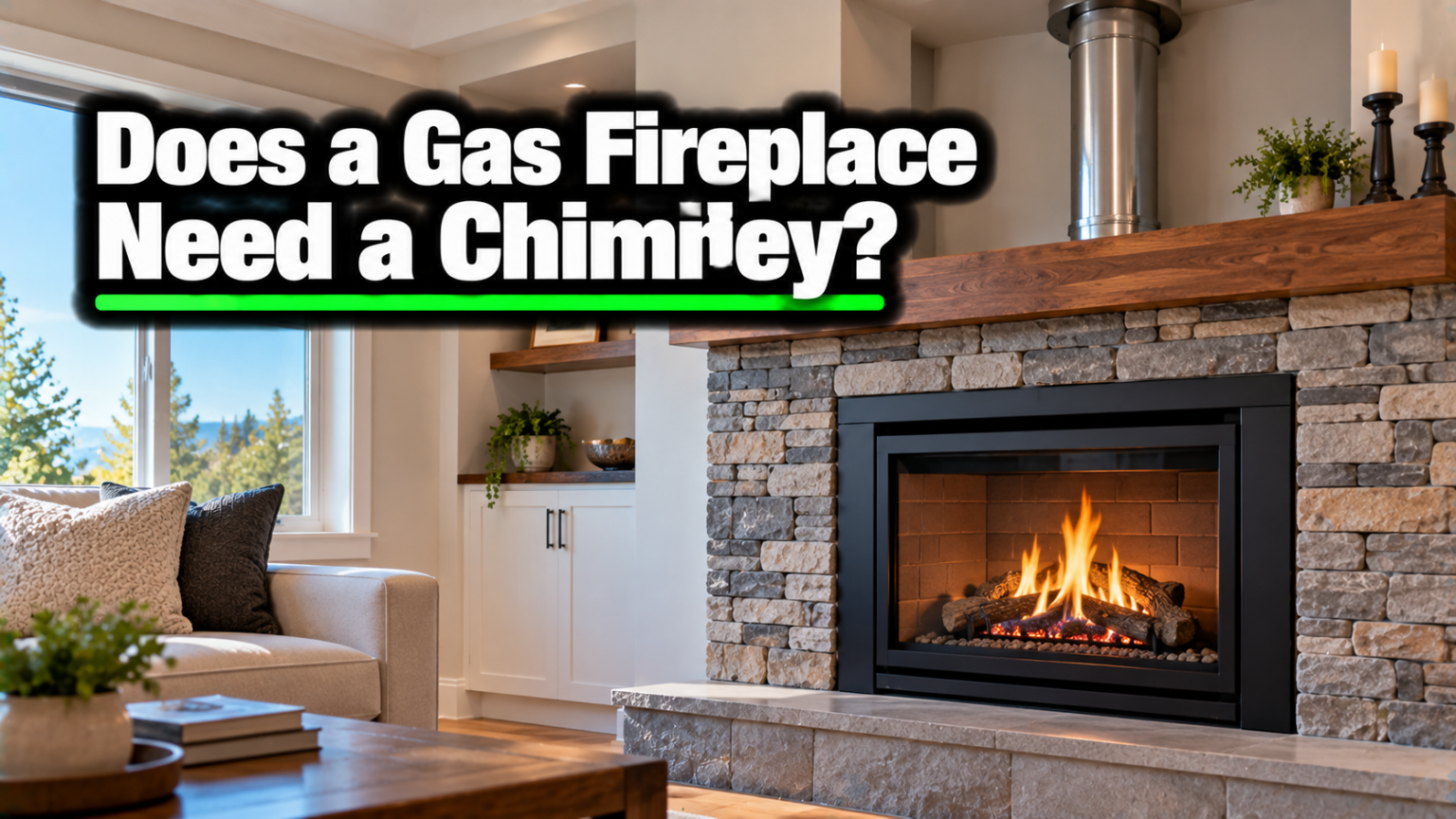

No, most gas fireplaces do not need a chimney. They do need a safe way to send exhaust outside, but a tall masonry chimney is only one way to do that, and often it is not the one installers reach for. A modern gas fireplace usually vents through a small metal pipe that runs out a side wall or up through the roof. Some models vent nothing at all.
So the real question is not whether you need a chimney. It is how your particular fireplace deals with the air it burns and the gases it makes. That depends entirely on the type you buy. Below is how each kind vents, which ones can skip the chimney, and how to choose the right setup for your home.
How a gas fireplace gets rid of exhaust?
A gas flame makes water vapor, carbon dioxide, and small amounts of other gases, including a little carbon monoxide. That is a short list compared to wood. A wood fire throws off heavy smoke, soot, and creosote, which is exactly why wood needs a big open chimney to carry it all away and a yearly sweep to keep it clear.
Gas burns much cleaner, so it needs far less venting, and the venting itself can be much smaller. The size difference tells the story. A wood chimney is often a foot or more across to handle smoke and draft. A gas vent pipe is usually only three to eight inches wide, small enough to hide inside a wall or a slim chase.
This is where your options open up. Instead of one large vertical chimney, a gas fireplace can push its exhaust out through a narrow pipe, and that pipe can often run sideways through an outside wall. A few feet of pipe can do the job a two-story stack used to do. Once you understand that, the rest of the choices make sense.
Direct vent gas fireplaces: the most common choice
Direct vent is the type most people buy today, and it does not use a chimney. It runs on a sealed pipe that does two jobs at once. The pipe is built as one tube nested inside another. The outer channel pulls fresh air in from outside to feed the flame, and the inner channel pushes the exhaust back out the same way. This is called sealed combustion, because the firebox is closed off from your room behind a fixed glass front.
That sealed design is the whole point. The fire never touches the air you breathe, and none of the exhaust comes back into the house. You can see how the twin pipe is built on Heat and Glo’s direct vent explainer. Because the pipe is short and flexible, a direct vent unit can go almost anywhere. It can exit straight out a nearby wall, which is called horizontal venting, or run up and out through the roof, which is vertical venting.
There are limits to that flexibility. Vent runs have a maximum length and a set number of elbows, laid out in the maker’s manual, so a very long or twisting route may not pass. Most rooms sit well within those limits, but an installer will map the path before quoting the job.
The wins go beyond skipping the chimney. You keep more of your heat, because the fireplace is not pulling warm room air up a flue the way an open fire does. The glass front stays sealed, so drafts, dust, and outside noise stay outside. And since combustion air comes from outdoors, the unit works well even in a tightly built, well-insulated home. For a house with no chimney at all, this is usually the default recommendation.
Vent-free gas fireplaces: no chimney and no vent
Vent-free fireplaces, also called ventless, take it one step further. They have no pipe and no chimney at all. The burner is tuned to burn very cleanly, and the heat, along with the combustion gases, goes straight into the room. Because nothing escapes outdoors, these units run close to 99 percent efficient, and that number is their main selling point.
The trade-off is what stays inside with you. Along with heat, a vent-free unit puts water vapor and a small amount of combustion gas into your living space. The extra moisture can fog up windows and, over time, feed mold in a tight home. To manage the risk, every vent-free unit sold today includes an oxygen depletion sensor, a safety device that shuts the fireplace off automatically if the oxygen level in the room falls too low.
Local rules matter a lot here. Vent-free units are not allowed everywhere. California and Massachusetts ban them, the federal housing agency HUD bans them in HUD-financed housing, and many cities and counties restrict where they can go, such as keeping them out of bedrooms and bathrooms. Before you buy one, check your local code, because a unit you cannot legally run is no bargain. The home inspectors’ association InterNACHI has a clear rundown of the safety concerns with ventless fireplaces that is worth reading first.
Quick rule of thumb: if you want a fireplace and have no chimney, a direct vent model is the safe, widely legal default. Look at vent-free only after you confirm it is allowed where you live and you are comfortable with the moisture and air-quality trade-off.
Natural vent and B-vent fireplaces: these do need a vertical path
Some gas fireplaces do need a vertical vent, even when it is not a full masonry chimney. Natural vent units, usually called B-vent, work a bit like an old chimney in miniature. They pull air for the flame from inside the room, and they let the warm exhaust rise on its own up a metal flue that runs through the roof.
Because that exhaust rises on natural draft, this type cannot vent out through a side wall. It needs the upward path, so it only suits homes that already have, or can add, a vertical run to the roof. B-vent fireplaces are less common in new homes now, mainly because they are less efficient than direct vent. They send a fair share of your heated room air up the flue along with the exhaust, so you lose warmth you paid for. If you already have a suitable vertical flue, though, a B-vent unit can be a straightforward fit.
Using a chimney you already have: inserts and gas logs
If your home already has a wood-burning fireplace and chimney, you can absolutely use it, but you do not have to leave it the way it is. Two upgrades put that existing structure to work.
A gas insert is a sealed firebox that slides into your existing masonry opening. It runs its own venting up through the chimney using a slim stainless steel liner, so you get direct vent style efficiency inside the old brick. In this setup the chimney is no longer an open flue. It becomes a protected chase that holds the new pipe, and the sealed glass front keeps your heat in the room.
A gas log set is the simplest option of all. These are decorative burners you set inside your existing wood fireplace, and they use the chimney the traditional way, with the damper open, to carry off exhaust. They give you the flame and look with very little work. The downside is efficiency, since an open damper lets a lot of heat drift up and out. Log sets are best when you want the ambiance more than the heat.
A quick comparison of venting types
The table below lines up the main options so you can match one to your home.
| Type | Needs a chimney? | How it vents | Best for |
| Direct vent | No | Sealed pipe out a wall or roof | Most homes, new installs |
| Vent-free | No | Nothing; heat stays in the room | Where it is legal, top efficiency |
| Natural vent (B-vent) | Needs a vertical flue | Room air rises up a metal flue | Homes with a vertical run to the roof |
| Gas insert | Uses existing chimney | Liner up the old chimney | Upgrading a wood fireplace |
| Gas logs | Uses existing chimney | Open damper and flue | A quick, low-cost look |
Can you add a gas fireplace to a house with no chimney?
Yes, and this is exactly why gas has become so popular in homes that never had a fireplace. A direct vent model can be added to almost any room, because the venting only needs to reach an outside wall or the roof. The most common install puts the unit against an exterior wall and runs the pipe straight out behind it, a job a professional can usually finish in a day or two.
Interior walls are workable too. The vent pipe can travel up through the ceiling and out the roof, or route sideways through a chase to reach an outside wall. A vent-free unit gives you the most placement freedom of all, since it needs no pipe run whatsoever, but again, only where local code allows it.
One detail worth knowing is where the vent can end. Building codes set minimum clearances for a vent terminal, keeping it a safe distance from windows, doors, soffits, decks, and the ground, so exhaust cannot drift back inside or pool near people.
This rarely blocks an install, but it can decide which wall the fireplace goes on. The full cost depends on the model, the gas line, and how far the venting has to travel, so it pays to get an in-home quote rather than a phone estimate. Either way, you are not stuck building a masonry stack just to enjoy a fire.
Staying safe and keeping it maintained without a chimney
Skipping the chimney does not mean skipping safety. Any gas appliance can produce carbon monoxide if something goes wrong with the burner or the venting, so fit a carbon monoxide alarm in the same room and test it on a schedule. Have the fireplace and its venting checked once a year by a qualified gas technician, who will look over the burner, the glass seal on a direct vent, the vent pipe, and the gas connection for leaks.
The upside is that gas is far lower maintenance than wood. There is no creosote to scrub and no ash to shovel out, so the yearly service is quicker and cheaper than a full wood chimney sweep. Keep the glass clean per the maker’s instructions, watch for any soot or a lazy yellow flame, which can signal a problem, and call a pro if the fire ever looks or smells off. Simple habits keep a ventless or direct vent unit running safely for years.
Conclusion
Most gas fireplaces do not need a chimney. Direct vent models, the common choice, vent through a small sealed pipe out a wall or roof, and vent-free models need no vent at all where they are allowed. Only natural vent units, inserts, and log sets rely on a vertical flue or an existing chimney. Pick the type that fits your home and your local code, add a carbon monoxide alarm, and book a yearly checkup. Do that and you get clean, easy heat without a masonry stack.
Frequently asked questions
Can I install a gas fireplace without any venting?
Yes. A vent-free (ventless) model needs no chimney and no pipe, and it heats the room directly. It has to be legal where you live, though. California, Massachusetts, and many cities restrict or ban them, so check your local code before buying.
Does a direct vent gas fireplace need a chimney?
No. A direct vent unit uses a sealed two-in-one pipe that pulls in outside air and pushes exhaust back out, usually through a side wall. It works fine in a home with no chimney at all.
Can I put a gas fireplace in a house that never had one?
Yes. A direct vent fireplace can go on almost any wall, since the vent only needs to reach the outside. A professional can usually install one in a day or two without building a chimney.
Do gas fireplaces need a chimney sweep?
Not in the traditional sense. Gas leaves no creosote or ash, so there is nothing to sweep. You do still need a yearly check of the burner, venting, and gas line by a qualified technician.
Are vent-free gas fireplaces safe?
They come with an oxygen depletion sensor that shuts the unit off if room oxygen drops too low. Even so, they add moisture and some combustion gas to the room, so good airflow and a carbon monoxide alarm matter, and they are banned in some states.
Related Articles
How Much Cost to Do Water Remediation in Small Bathroom
Acid Staining Concrete Floor: Complete Guide