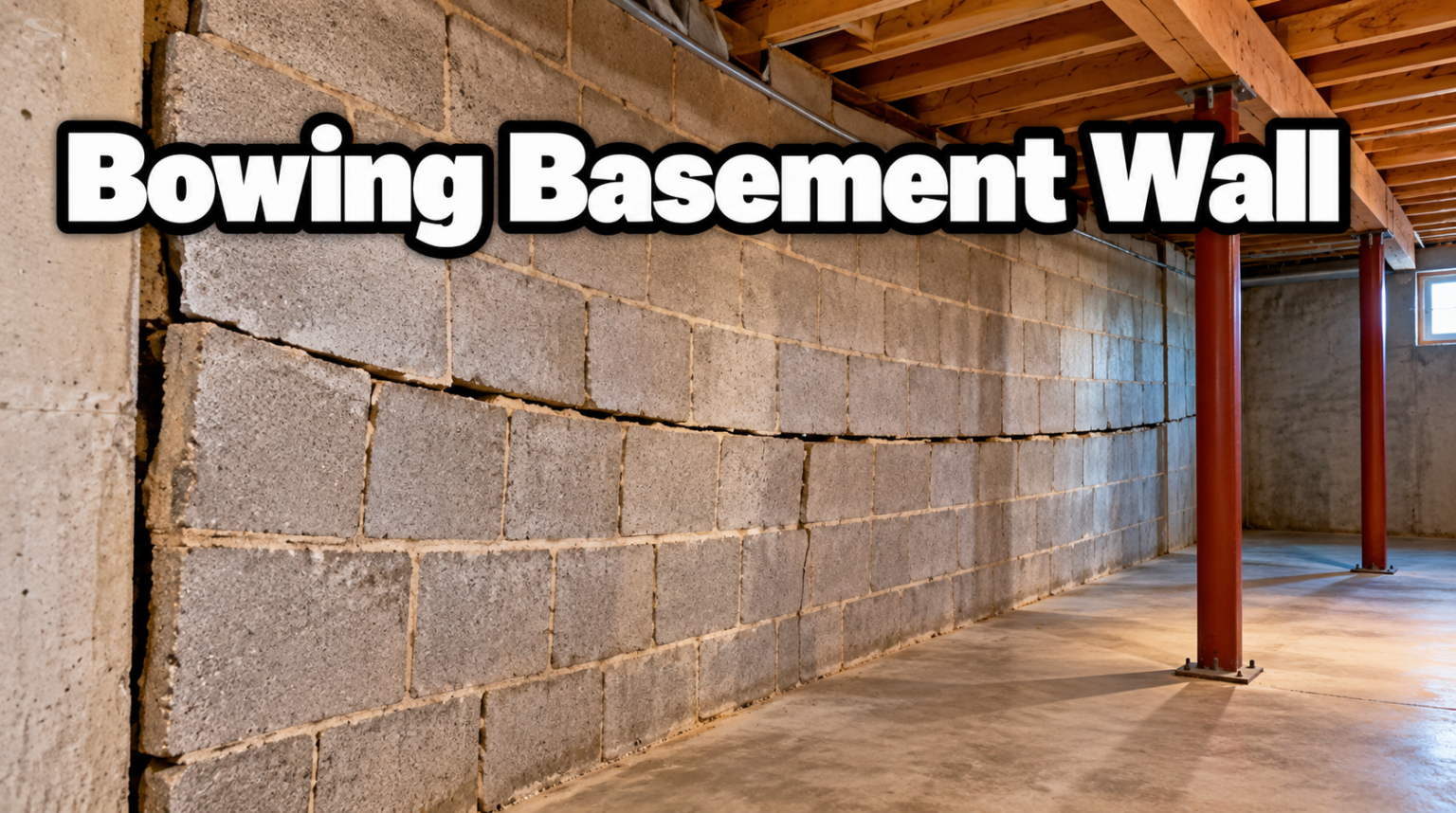

A bowing basement wall is a foundation wall that has started to curve or lean inward because something outside is pushing on it harder than it was built to hold. Most of the time that something is wet soil. The wall will not fall in overnight, but a bow almost never fixes itself, and it tends to get a little worse each wet season. Once the inward movement passes about two inches, you are past the point of watching and waiting, and the wall needs a real repair.
This guide covers what makes a wall bow, the warning signs worth checking for, how to tell how serious yours is, and the repair methods and costs you can expect.
What makes a basement wall bow?
The main cause is pressure from the soil outside. When the ground around your foundation holds water, it gets heavy and pushes sideways against the wall. This sideways push is called hydrostatic pressure, and it is behind most bowing walls. A concrete or block wall is strong straight up and down, but it is far weaker against a steady sideways load.
Several things make that pressure worse:
- Poor drainage. Downspouts that empty right next to the house, or a yard that slopes toward the foundation instead of away from it, keep the surrounding soil soaked. Wet soil pushes harder than dry soil.
- Expansive clay soil. Some soils are full of clay soils that swell with water and shrink again as they dry. That swelling alone can shove a wall inward, and the repeated swell-and-shrink loosens the ground year after year.
- Freeze and thaw. In cold climates, water in the soil freezes, expands, and presses on the wall, then melts and lets go. Over many winters this slow back-and-forth works a wall loose.
- Tree roots. Big trees planted close to the house push on the foundation as they grow. A rough rule is to keep small trees at least 10 feet away and large ones at least 50 feet.
- Uneven settling. Every house settles a little. When one part drops more than another, the shift can load a basement wall from an angle it was never built for.
- A weak original build. Thin walls, too little steel inside them, or low-grade block all give way sooner under pressure a stronger wall would shrug off.
Signs your basement wall is bowing
The clearest sign is a horizontal crack running across the wall, usually somewhere near the middle where the bending is strongest. That crack is the wall hinging under pressure, and it is the one to take seriously.
Other things to look for:
- A visible inward lean or curve, easiest to spot by standing at one end and sighting down the length of the wall.
- Stair-step cracks climbing the mortar joints of a block wall, often near the corners.
- A wall that bulges in the middle while tipping in at the top or kicking in at the bottom.
- Water stains, damp patches, or active seepage along the cracks.
- Doors or windows on the floor above that suddenly stick or will not latch.
- Crumbling mortar or flaking concrete where the wall is under strain.
One sign on its own may be minor. A horizontal crack plus a visible bow together means the wall is already moving, and that is your cue to measure it.
Does the wall type matter?
Yes, and it changes both how a wall bows and how you fix it. Poured concrete walls tend to crack in a long horizontal line and tip inward in one piece, almost like a door swinging on a hinge. They are solid, so they often hold longer before they move, but once they crack they can shift fast.
Concrete block walls behave differently. They are hollow and held together with mortar joints, so pressure tends to crack the joints first and push the courses of block inward in a stair-step or belly shape. Block walls usually start bowing at lower pressure than poured walls, which is why many older block basements are the ones that need bracing. Both types respond to the same repairs, but a badly broken block wall is more likely to need a full rebuild than a cracked poured wall of the same age.
How much bowing is too much?
A plumb line gives you a quick answer. Tape a string with a small weight to the top of the wall and let it hang free. Measure the gap between the string and the wall at the top, the middle, and the bottom. The biggest difference between those points is roughly how far the wall has moved inward.
| Inward bow | What it means | Typical fix |
| Under 2 inches | Mild. Can be stabilized before it worsens | Carbon fiber straps |
| 2 to 4 inches | Moderate. Real structural risk | Steel beams or wall anchors |
| Over 4 inches | Severe. The wall is failing and unsafe | Rebuild or full straightening |
Under about two inches, a wall can usually be locked in place and stopped. Between two and four inches, it needs stronger bracing and often some straightening. Past four inches, the wall is close to failing and usually has to come down and be rebuilt. Treat these as guides, not hard lines. A wall that is moving fast matters more than one that bowed a little years ago and has sat still since.
Speed is the real test. Mark the end of a crack with a pencil and write the date next to it, or measure the bow and note the number, then check again in a month or two. A line that stays put buys you time to plan. A line that keeps opening means the wall is active and the repair should not wait.
Is a bowing wall an emergency?
Usually not a same-day emergency, but it is never safe to leave alone. A bow of an inch or two that is not changing can wait for a planned repair. What calls for a quick call to a structural engineer or foundation contractor is a wide horizontal crack, a bow that grows from week to week, chunks of concrete breaking loose, or the wall shifting at its base. If a wall is badly bowed and you can see it moving, keep people out of that part of the basement until a pro has looked at it.
How bowing basement walls are repaired
The right repair depends on how far the wall has moved and how much room you have inside and outside. Here are the main methods, from the lightest fix to the heaviest.
- Carbon fiber straps. These are thin, very strong strips glued to the wall with epoxy and anchored to the floor and the sill plate at the top. They lock a wall in place so it cannot bow any further. They are the usual fix for walls under about two inches, they sit nearly flat so you lose almost no space, and they do not rust or stretch. The catch is that they hold a wall where it is; they do not pull it back straight.
- Wall anchors. A steel plate goes in your yard a short way from the house, a rod runs through the soil to a plate on the inside of the wall, and the two are tightened together. Anchors hold the wall, and over time careful tightening can draw it back toward straight. They need open yard space and some digging outside.
- Steel I-beams. Vertical steel beams are bolted to the floor and the floor joists above and pressed tight against the wall. They are a strong choice for bows over two inches or when the wall is shearing at the bottom. The downside is they stick a few inches into the room, and fitting them usually means cutting into the concrete floor.
- Helical tiebacks. These are steel shafts screwed deep into solid soil well beyond the foundation, then tied back to the wall. Because they anchor in ground that is not moving, they suit severe bowing. They cost more owing to the equipment and the depth involved.
- Rebuilding the wall. When a wall has bowed past about four inches or is badly broken up, bracing is not enough. The soil outside is dug away, the wall is straightened or taken down and rebuilt, the drainage is fixed, and the ground is filled back in. This is the priciest route and the one you most want to avoid by catching trouble early.
A good contractor picks the method by measuring the bow, checking whether it is still moving, and looking at the access you have. Two inches and stable with a finished basement points to carbon fiber. The same bow with an open yard and a goal of straightening points to anchors. A severe, active bow points to tiebacks or a rebuild. Ask for the measurement and the reasoning in writing, not just a price.
What bowing basement wall repair costs
Most repairs run from about $1,600 to $11,000, and the method sets the price more than anything else. Light bracing is a few thousand dollars, while a full rebuild runs into five figures. Cost is usually quoted per linear foot of wall, so a longer wall costs more.
| Method | Cost per linear foot | 20-foot wall |
| Wall anchors | $80 to $150 | $1,600 to $3,000 |
| Carbon fiber or steel straps | $85 to $280 | $1,700 to $5,600 |
| Helical tiebacks | $300 to $360 | $6,000 to $7,200 |
| Wall straightening or rebuild | $340 to $550 | $6,800 to $11,000 |
A few things push the number up or down: the length of wall being treated, how severe the bow is, whether the crew can reach the outside of the wall or has to work around a deck, patio, or tight lot, and how much finished space has to be removed and put back. Fixing the water problem that caused the bow, such as regrading the yard, extending downspouts, or adding a drain, is usually a separate cost, but it is what keeps the repair from failing. A repair that ignores the drainage is one you may end up paying for twice.
How to keep a wall from bowing
Most bowing traces back to water in the soil, so most prevention is about keeping that soil dry. Point downspouts a few feet away from the house. Make sure the ground slopes away from the foundation, not toward it. Keep gutters clear so water does not spill down the wall. If your basement takes on water, a perimeter drain and sump pump lower the pressure on the walls. It also helps to know whether your area sits on expansive soil before you plant large trees close to the house. None of this reverses a bow that has already happened, but it protects a wall that is still straight, and one you have just paid to fix.
Conclusion
A bowing basement wall is the wall giving way to pressure from the soil outside, and that pressure almost always comes down to water. Measure the bow with a plumb line: under two inches can usually be stabilized with carbon fiber straps or anchors, while anything past four inches often means a rebuild. Fix the drainage that caused it so the repair lasts. Catch it early and you spend a few thousand dollars. Wait, and you risk a five-figure job.
Frequently asked questions
Can a bowing basement wall be fixed without digging up the yard?
Often yes. Carbon fiber straps and steel I-beams go in from inside and need no outdoor digging. Wall anchors and helical tiebacks do need some excavation. The bigger the bow, the more likely outside work is part of the job.
Will a bowing wall collapse?
It can if it is ignored long enough. A small, stable bow is not an immediate danger, but a wall that keeps moving, cracks wide open, or sheds concrete is heading toward failure and needs a pro soon.
Can carbon fiber straps straighten a wall?
No. They hold a wall in its current spot so it stops moving. To pull a wall back toward straight you need wall anchors tightened over time, or excavation and straightening for larger bows.
How long does bowing basement wall repair take?
A carbon fiber or beam job is often done in a day or two. Anchors and tiebacks take a few days once the outdoor work is counted. A full rebuild can run one to two weeks depending on the wall and the weather.
Do I need a structural engineer?
For a minor bow, a reputable foundation contractor can assess and fix it. For a severe bow, fast movement, or an independent opinion before you spend, a structural engineer’s report is worth the cost.
Related Articles
Are Rain Gutters Needed? When Your House Does and Doesn’t
How to Fix a Leaky Rain Gutter?