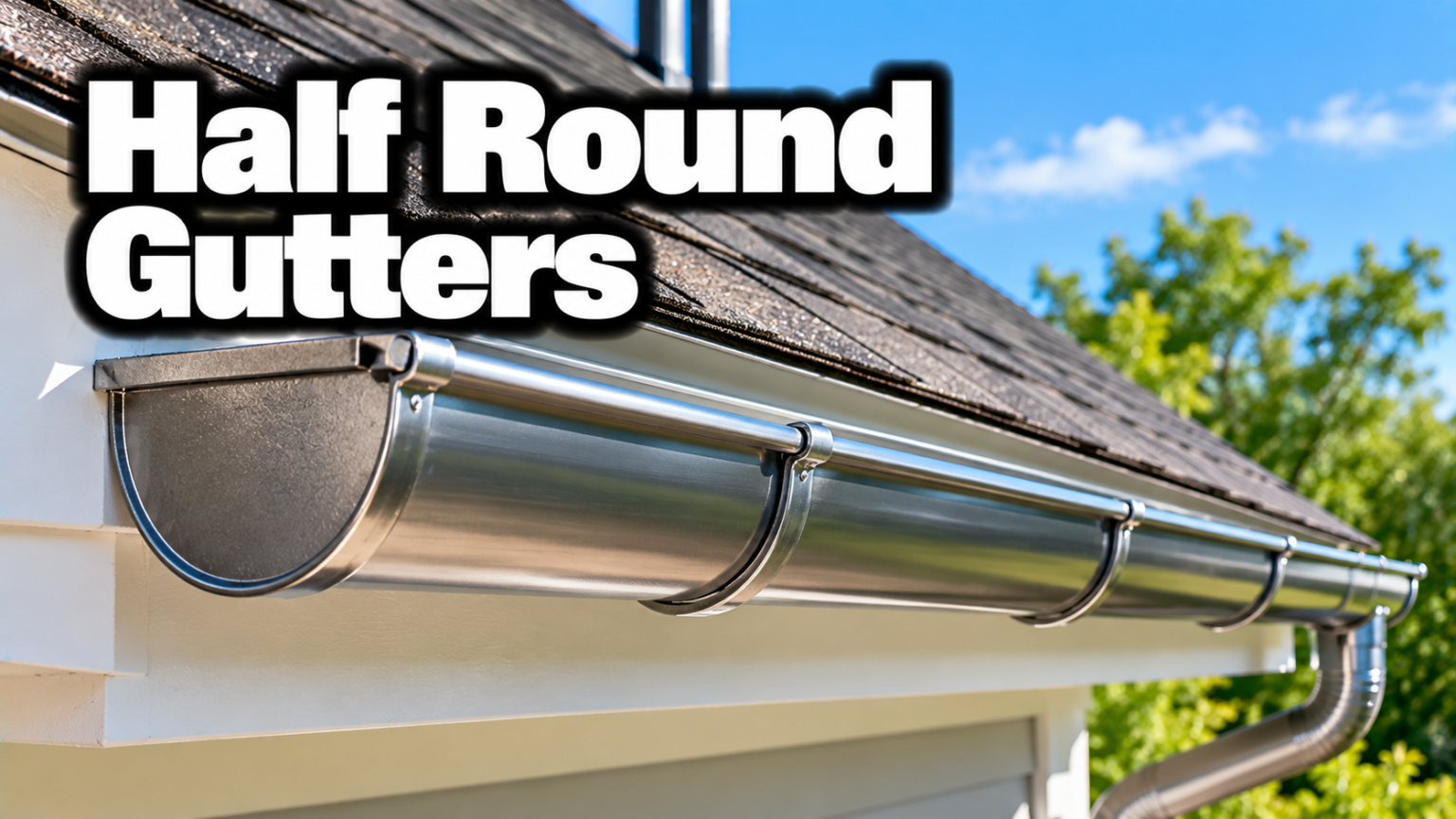

Half round gutters are open troughs shaped like a pipe sliced in half down its length. That rounded, U-shaped channel carries roof runoff to the downspouts with no sharp inside corners for grit to settle in. You see them most on older and higher-end homes, usually in copper, aluminum, or steel. Here is how they work, what they cost, and how to tell if they suit your house.
How half round gutters work?
The shape does the work. Water follows the curve of the trough and drains almost fully, so very little sits at the bottom between storms. With fewer flat spots and no crimped corners, less grit collects and the metal stays drier, which slows rust and corrosion.
Because the trough is shallow and open, a half round gutter holds less water than a K-style gutter of the same width. In most of the country that is fine. On a steep roof, or in an area with heavy downpours, you make up the difference by going one size larger or adding more downspouts.
Two details set half round apart on the roofline. The front edge is rolled into a bead, a curled lip that stiffens the metal and gives it a finished look. And the downspouts are round rather than rectangular, which keeps the whole system looking consistent.
What materials can you get?
Half round gutters come in more metals than any other gutter style, and the metal you pick sets both the price and how long the system lasts. Aluminum is the everyday choice. Copper is the premium one. Steel and zinc sit in between.
Here is how the common options compare:
| Material | Typical lifespan | Notes |
| Aluminum | 20 to 30 years | Light and rust-proof, sold painted or in a mill finish. Usually about .032 inch thick. |
| Galvanized steel | 15 to 20 years | Stronger than aluminum, but the coating wears and it can rust. Often 26 gauge. |
| Zinc | About 50 years | Weathers to a soft gray patina and needs almost no upkeep. |
| Copper | 100 years or more | Ages to a green patina, outlasts the roof, costs the most. |
| Vinyl | 10 to 15 years | Cheapest and DIY-friendly, but brittle in cold and limited in size. |
Colors and finishes
Half round gutters give you real choice in how they look, and the finish usually follows the metal. Aluminum is the most flexible. It comes in a bare mill finish or in baked-on paint colors, from white and bronze to black, so you can match the trim or the roof. Some aluminum is even coated to mimic the look of copper at a lower price.
Copper is left bare and ages on its own, shifting from bright penny to brown and finally to the familiar green patina over years. If you want that gray-green look sooner, pre-weathered and coated copper options skip the wait. Zinc follows a similar path to a soft matte gray. Whatever metal you pick, match the downspouts and hangers to it so the system reads as one piece.
What size do you need?
Most homes need a 6 inch half round gutter, and that is the size to default to unless you have a reason to go smaller. A 5 inch gutter can handle a small roof in a dry climate, but 6 inch moves noticeably more water and clogs less often. Bigger 7 and 8 inch profiles exist for large roofs and commercial buildings, usually in copper.
To size it right, look at three things: the square footage of roof draining into that run, how steep the roof is, and how hard it rains where you live. A steeper roof throws water into the gutter faster, so it acts like a bigger roof. Add downspouts and space them evenly to keep any single run from overloading.
Round downspouts come in 3 inch and 4 inch. Pair a 5 inch gutter with a 3 inch downspout, and a 6 inch gutter with a 4 inch one. Undersized downspouts are a common reason a gutter overflows even when the trough itself is big enough.
Rule of thumb: pick 6 inch and a 4 inch round downspout for an average home, then size up only if your roof is steep or your rainfall is heavy.
Seamless or sectional?
Most half round gutters are sectional, not seamless. They come in straight lengths that join at connectors, corners, and outlets, and on copper and zinc those joints are soldered into one continuous, watertight run. K-style is often rolled seamless on-site from a machine, but that gear does not fit the round shape as easily, so half round leans on skilled joining instead.
The joints are where a gutter tends to fail first, so the quality of the seam matters more than with seamless K-style. A well-soldered copper joint can last as long as the metal around it. A poorly sealed one drips and stains the wall below. This is a big reason half round rewards a careful installer, and why cutting corners on labor rarely pays.
Bead styles and hangers
The bead is the rolled front edge of the gutter, and a few versions change how it looks and mounts. A single bead rolls the front lip outward and is the standard, plain profile. A double bead rolls both the front and back edges for a heavier, traditional look, common in copper. A reverse bead curls the front lip inward so hidden hangers can grip it from inside.
Hangers hold the gutter to the house, and half round uses more of them than K-style. The classic option is a circle or shank hanger, a metal band that wraps under the trough and screws to the fascia or roof. Hidden internal hangers clip inside the gutter for a clean look with no visible hardware. On homes with no fascia board, roof-mounted brackets fasten to the sheathing under the shingles. Plan on a hanger every 24 to 36 inches, closer together in snow country.
If you want to see the actual profiles, hangers, and finishes side by side, Gutter Supply’s half round catalog is a good place to start.
Half round vs K-style: which fits your home?
Choose half round for looks and clean draining, and K-style for capacity and cost. That is the trade in one line. Here is the fuller picture:
| Half round | K-style | |
| Shape | Rounded, open trough | Flat back, angled front like the letter K |
| Water capacity | Lower | Higher for the same width |
| Clogging | Less, smooth interior | More, water pools in the corner |
| Cost | Higher | Lower |
| Best for | Older, historic, high-end homes | Most modern homes |
Half round suits houses built before the 1950s, homes with rounded or traditional lines, and roofs in slate or clay tile. The soft curve fits that architecture in a way the angular K-style does not, and some historic districts require a round profile.
K-style earns its popularity on modern homes. It holds more water for its width, bolts flat to the fascia with fewer parts, and costs less to buy and install. If your only goal is to move a lot of water cheaply, K-style wins.
How much do half round gutters cost?
Half round gutters run higher than K-style, mostly because of the metals people choose and the extra hangers each run needs. Installed prices swing with your region and the weight of the metal, but these per-foot ranges are a fair guide:
| Material | Installed cost per linear foot |
| Aluminum | $12 to $25 |
| Galvanized steel | $20 to $30 |
| Zinc | $25 to $45 |
| Copper | $35 to $50 or more |
For a typical single-story home with about 150 to 200 feet of gutter, aluminum lands in the low thousands, while a full copper system can reach five figures once downspouts and fittings are added. The round downspouts, elbows, and hangers all add up, so price the whole system rather than the trough alone.
Copper costs the most up front and the least over time. Spread across a 100 year life, it often works out cheaper per year than aluminum you replace twice.
Three things drive the price beyond the metal itself. Soldered joints take skilled labor, half round needs a hanger every couple of feet, and the round downspouts and fittings cost more than stamped rectangular ones. When you compare quotes, check that all three are included so you are comparing whole systems.
Installation and upkeep
Half round gutters are best left to a professional. The curved trough will not sit flush against a flat fascia on its own, the hangers are fussier than K-style clips, and the seams have to be soldered or sealed cleanly to stay watertight, which matters most on copper and zinc. A crew also sets the slope, about a quarter inch of fall for every 10 feet, so water runs to the downspouts instead of pooling.
Upkeep is light. Clean the gutters twice a year, in late spring and late fall, and the smooth trough rinses out far more easily than a cornered one. Check the hangers and downspout connections at the same time. Copper and zinc need no coating or paint, aluminum needs only the odd touch-up, and steel is the one to watch for rust at scratches and seams.
Add gutter guards if you have trees nearby, and choose a guard made for a round profile. For a plain-English overview of the styles and how they age, This Old House’s half round guide is a solid primer.
Are half round gutters worth it?
For the right home, yes. If you own an older or high-end house, or one with slate, tile, or rounded lines, half round gutters look correct where K-style looks out of place, and they clog and corrode less along the way. In copper or zinc they can last the life of the building, which is hard to match.
For a plain modern home in a wet climate on a tight budget, the math is different. You pay more up front, you get less water capacity per inch of width, and the visual payoff is smaller. There, K-style aluminum does the same job for less. The honest test is simple: if the look matters to you or your house calls for it, half round earns its price, and if you just need to move water cheaply, it does not.
Conclusion
Half round gutters give you a clean, low-maintenance system that drains fast and lasts, which is why they belong on older, high-end, and traditionally styled homes. Default to a 6 inch size, match the metal to your budget and how long you plan to stay, and let a pro handle the install. Aluminum is the safe everyday pick, and copper costs more now but can outlast the house. Get the downspouts sized right and the gutters will do their job for decades.
Frequently asked questions
Are half round gutters better than K-style?
Not better, just different. Half round clogs and corrodes less and looks right on older homes, while K-style holds more water and costs less. Pick by your roof, your rainfall, and the style of the house.
What size half round gutter do I need?
Six inch handles most homes. Drop to 5 inch only for a small roof in a dry climate, and step up to 7 or 8 inch for large or steep roofs that shed a lot of water fast.
Do half round gutters clog easily?
Less than K-style. The smooth, round trough has no inside corners for debris to catch on, so leaves and grit rinse through more easily. Guards and twice-yearly cleaning keep them clear.
How much do half round gutters cost?
Expect roughly $12 to $25 per foot installed for aluminum and $35 to $50 or more for copper, with steel and zinc in between. Downspouts, elbows, and hangers add to the total.
Can I install half round gutters myself?
It is not recommended. The curved trough, specialty hangers, and soldered or sealed seams make a clean, watertight job hard without the right tools. Most homeowners get a better result hiring a pro.
Related Articles
Carbon Fiber Straps for Basement Walls: Complete Guide 2026
What Is Roof Decking? A Complete Guide 2026
How to Remove Ink from Leather Sofa: Easy Step-by-Step Guide
Can You Stain Wood Cabinets If They’ve Been Painted Complete Guide 2026