


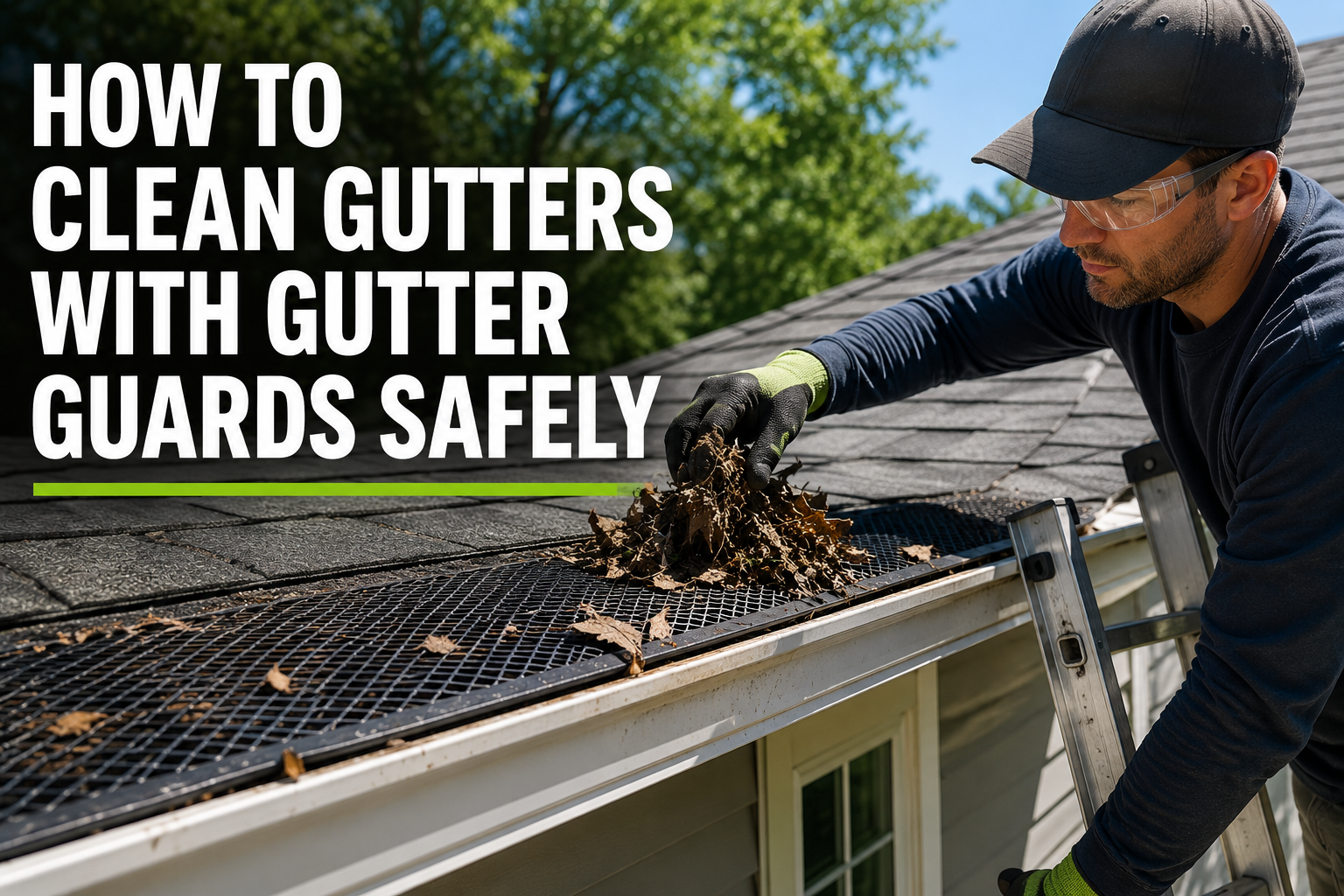

If you’re wondering how to clean gutters with gutter guards safely, the short answer is: yes, gutter guards still need occasional maintenance, but the process is far quicker and safer than cleaning bare gutters — as long as you use the right tools, avoid climbing onto the roofline, and match your cleaning method to the type of guard you have installed.
Gutter guards are excellent at blocking large debris like leaves and twigs, but fine particles such as pollen, shingle grit, seed pods, and dirt can still settle on top of them over time. Left unchecked, this buildup can slow water flow and, in rare cases, cause overflow during heavy rain.
This guide walks you through exactly how to clean gutter guards without unnecessary risk, what tools actually work best, how your cleaning method should change depending on the guard type you have, and how to know when it’s time to call in a professional instead.
Why Gutter Guards Still Need Cleaning
Gutter guards reduce gutter maintenance — they don’t eliminate it. Micro-mesh and screen-style guards, in particular, are designed with openings small enough to stop shingle grit and helicopter seeds, which means those same small particles can accumulate on the surface instead of washing through. Over several seasons, this buildup can form a thin layer that repels water rather than letting it drain, especially on roofs with heavy pine, oak, or maple coverage.
The good news is that surface debris on a gutter guard is far easier and faster to remove than the wet, compacted sludge that builds up inside unguarded gutters. Most guard cleaning can be done from the ground or with minimal ladder time, which is exactly why safety-first techniques matter here.
Safety First: Ladder and Roofline Precautions
Before you touch a single tool, safety needs to come first. Roof and ladder falls are among the most common home-maintenance injuries in the U.S. every year, and gutter cleaning is a leading cause.
- Choose the right ladder type. Use a sturdy extension ladder rated for at least 250 lbs. (Type I or Type IA) with rubber non-slip feet. Avoid stacking ladders or using furniture to gain height.
- Follow the 4-to-1 rule. For every 4 feet of ladder height, the base should sit 1 foot away from the wall. This keeps the ladder at a safe climbing angle.
- Set up on level, solid ground. Never place a ladder on grass, mulch, gravel, or uneven pavement without a stabilizing plate.
- Extend the ladder 3 feet above the roofline if you need to step onto the roof, and never stand above the third rung from the top.
- Have a spotter. Ask someone to hold the base and stay nearby whenever you’re on the ladder.
- Check the weather. Skip gutter maintenance on wet, windy, or icy days — damp gutter guards and ladders are a major slip hazard.
- Wear the right gear. Rubber-soled shoes, work gloves, and safety glasses (to protect against flying grit when brushing or blowing debris) are non-negotiable.
- Avoid overreaching. Move the ladder rather than leaning or stretching sideways. A good rule of thumb: keep your belt buckle between the ladder rails at all times.
Whenever possible, choose ground-based or pole-based cleaning tools first. They eliminate most of the fall risk entirely and are usually sufficient for guard maintenance.
Tools You’ll Need
You don’t need professional equipment for most gutter guard cleaning. Gather these before you start:
- Extension-pole gutter brush (telescoping, 6–24 ft.) — the primary tool for sweeping debris off guard surfaces from the ground
- Garden hose with a spray nozzle attachment — for rinsing pollen, dust, and light grit
- Leaf blower with a gutter attachment or curved extension tube — fast and effective for dry debris
- Handheld gutter vacuum (optional but useful for two-story homes or heavy tree coverage) — pulls debris out through a long tube without climbing
- Soft-bristle brush — for hand-cleaning small sections or stubborn spots
- Plumbing snake or downspout cleaning tool — to clear clogs below the guard, inside the downspout itself
- Work gloves and safety glasses
- A stable ladder (only if pole tools can’t reach or you need to inspect fasteners up close)
Avoid pressure washers set above 1,500–2,000 PSI directed at gutter guards. High pressure can dislodge foam inserts, warp plastic mesh, pop clip-style guards out of their brackets, and in some cases void the manufacturer’s warranty. If you do use a pressure washer, keep the nozzle at a low setting and angle it away from shingles and fascia boards.
How to Clean Gutters With Gutter Guards Safely: Step-by-Step
Step 1: Inspect From the Ground First
Walk the perimeter of your house and look up at the gutter line. Check for visible sagging, standing water pooling on top of the guards (a sign of a clog), guards that look bowed or separated from the gutter, and any granules or leaf litter piled along the edges. Binoculars can help you spot problem areas without climbing anything yet.
Step 2: Clear Loose Surface Debris With a Pole Tool
Attach a gutter brush or blower extension to a telescoping pole and work along the guard surface from the ground, moving in the direction of water flow toward the downspout. This clears leaves, seed pods, and twigs sitting on top of the mesh or covers.
Step 3: Rinse Fine Debris and Pollen
Switch to a hose with a fan-spray nozzle and rinse the length of the guard. This flushes dust, pollen, and fine grit that a brush or blower can’t fully remove, and lets you visually confirm water is draining properly instead of pooling.
Step 4: Check and Clear the Downspouts
Guards keep debris out of the gutter channel, but downspouts can still clog, especially at elbows and turns. Run water from the hose and watch for backup at the top. If water isn’t draining freely, use a plumbing snake fed from the bottom of the downspout to break up the blockage, or detach the lower elbow to flush it out.
Step 5: Spot-Clean Stubborn Areas by Hand (If Needed)
If pole tools and rinsing don’t clear everything — common near valleys, dormers, or areas under heavy tree cover — this is the one point where ladder access may be necessary. Follow every safety precaution above, use a soft-bristle brush to gently work debris loose, and never pry at the guard itself with a hard tool, which can bend or crack the material.
Step 6: Do a Final Water Test
Once you’ve finished, run the hose along the full gutter run one more time. Water should flow evenly into the downspouts with no pooling on the guard surface. If certain sections still hold water, mark them for a closer inspection or a call to a professional.
Cleaning Tips by Gutter Guard Type
Not all gutter guards respond to the same cleaning approach. Matching your method to the guard style prevents damage and gets better results.
- Micro-mesh guards: Most prone to fine debris buildup because the openings are so small. Best cleaned with a soft brush and hose rinse; avoid stiff wire brushes that can distort the mesh.
- Reverse-curve (surface tension) guards: Debris tends to slide off naturally, but leaves can catch in the curved lip. A pole brush works well to sweep the curve clean.
- Foam-insert guards: Debris sits on top of the foam and can be lifted off by hand or with a leaf blower. Avoid pressure washing, since forceful water can push debris into the foam rather than off it.
- Screen/perforated guards: Similar to mesh but with larger holes; a hose rinse combined with occasional brushing is usually enough.
- Brush-style (bottle brush) guards: Debris nests in the bristles, so pulling loose debris out by hand or with a leaf blower’s suction attachment is more effective than rinsing alone.
How Often Should You Clean Gutter Guards?
Frequency depends mainly on the trees around your home and your regional climate:
- Light or no tree coverage: Once a year, typically in early fall
- Moderate deciduous tree coverage: Twice a year — spring and fall
- Heavy pine, oak, or evergreen coverage: Every 3–4 months, since pine needles and small leaves are notorious for slipping through larger guard designs
- After major storms: A quick visual check after any severe wind or hail event is worth the five minutes it takes
Homeowners in the Midwest and Northeast should also plan a late-fall cleaning before the first freeze, since clogged guards combined with freezing temperatures are a common contributor to ice dams along the roofline.
When to Call a Professional Instead
DIY cleaning is usually enough for single-story homes, homes with light tree coverage, or guards that are easy to reach with pole tools. Consider hiring a professional gutter cleaning service if:
- Your home is two stories or taller, or has a steep roof pitch
- You notice sagging gutters, loose brackets, or guards pulling away from the fascia
- Water is overflowing or pooling despite following the steps above
- You’re uncomfortable on a ladder or don’t have someone available to spot you
- Your gutter guards are still under a manufacturer warranty that requires professional maintenance to stay valid
A professional visit once every one to two years, even if you handle routine cleaning yourself, is a reasonable way to catch structural issues (like loosening fasteners or hidden clogs) before they become expensive repairs.
Frequently Asked Questions
Can you pressure wash gutter guards? You can, but only at low pressure (under roughly 1,500–2,000 PSI) and angled away from shingles and fascia. High-pressure washing can dislodge foam inserts, bend mesh, or pop clip-in guards loose, and it may void some manufacturers’ warranties, so check your product documentation first.
Do gutter guards eliminate the need for gutter cleaning? No. Gutter guards significantly reduce how often you need to clean and largely eliminate the need to scoop out wet leaf sludge, but fine debris like pollen, grit, and small seeds can still collect on top and require occasional maintenance.
How do you clean gutter guards without a ladder? A telescoping pole fitted with a brush attachment, combined with a hose or leaf blower extension, can clean most single- and two-story homes entirely from the ground, which is the safest approach for the majority of routine cleanings.
What’s the best tool for cleaning gutter guards? For most homeowners, a telescoping pole brush paired with a garden hose nozzle covers the majority of cleaning needs. A gutter vacuum is a worthwhile upgrade for larger homes or heavy tree coverage, since it removes debris through a long tube without any climbing.
How do I know if my gutter guards need cleaning? Visible debris sitting on top of the guards, water pooling instead of draining after rain, or water spilling over the gutter edge during a downpour are all signs it’s time for a cleaning.
Conclusion
Cleaning gutters with gutter guards installed is a far lighter task than cleaning bare gutters, but “lower maintenance” doesn’t mean “no maintenance.” The safest and most effective approach combines ground-based pole tools for routine debris removal, a hose rinse to clear fine particles, regular downspout checks, and guard-specific techniques that protect the material you’ve invested in.
Prioritize ladder safety on the rare occasions you do need to get closer, match your cleaning frequency to your local tree coverage and climate, and don’t hesitate to bring in a professional for taller homes or persistent drainage problems. Put a cleaning reminder on your calendar for spring and fall today, and you’ll spend a lot less time worrying about clogged gutters and water damage down the road.
Related Articles
Acid Staining Concrete Floor: Complete Guide
Roof Repairs Worcester: Your Complete Local Guide to a Safe and Lasting Roof
How Long Does It Take for Bathroom Caulk to Dry? Complete Guide
Why Is My Toilet Seat Turning Blue? Cause, Fixe & Prevention