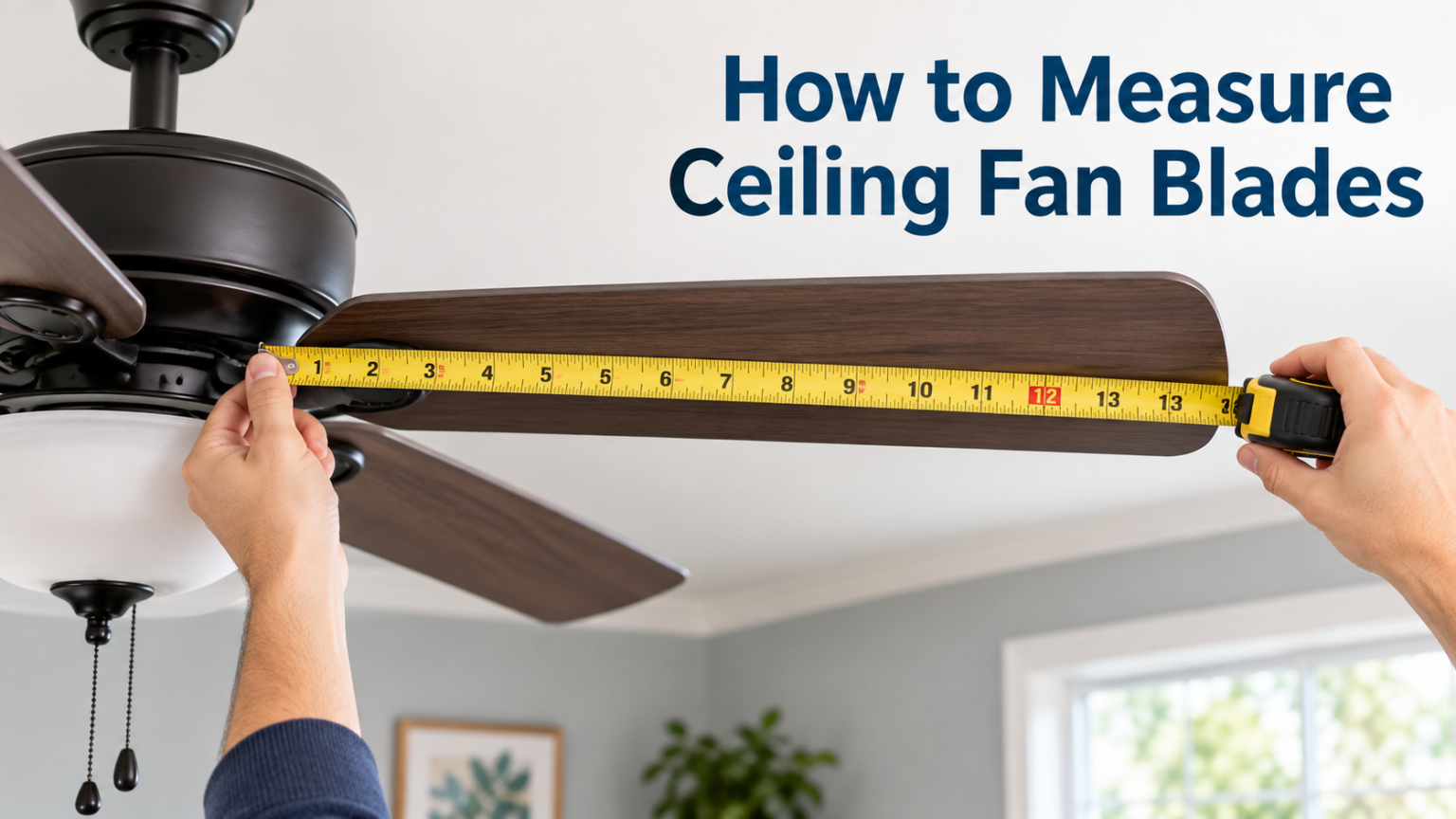

If you are asking yourself how do I measure ceiling fan blades, the process is actually straightforward once you understand what manufacturers mean by “fan size.” In most cases, you are not measuring a single blade in isolation but calculating the full blade span, which is the diameter created when all the blades rotate together.
This number is what determines whether a fan will look proportionate in a room and whether it will move enough air to keep the space comfortable. To get an accurate measurement, you need a simple tape measure, access to the fan itself, and a basic understanding of whether your fan has an even or odd number of blades, since the measuring method changes slightly depending on that detail.
Once you know the blade span, you can also measure individual blade length and width if you are replacing damaged blades or ordering a matching set. The sections below walk through every method in detail, along with common mistakes people make and how to pick the right size for your specific room.
Key Takeaways
- Fan size, also called blade span, is the diameter of the full circle the blades create while spinning, not the length of a single blade.
- For fans with an even number of blades, you can measure directly from the tip of one blade straight across to the tip of the opposite blade.
- For fans with an odd number of blades, the correct method is measuring from the center of the motor housing to one blade tip, then doubling that number.
- Individual blade length and width matter separately when you are replacing or reordering blades rather than buying a whole new fan.
- Choosing the correct blade span for your room size directly affects airflow efficiency and visual balance in the space.
What “Fan Size” Actually Means
Fan size refers to the blade span, which is the full diameter measured across the circle that the blades trace out while spinning, and this is different from the length of any single blade on its own.
Blade Span vs. Diameter
Blade span and diameter are essentially the same measurement described in two different ways, and both refer to the distance across the entire circle formed by the rotating blades. When a retailer lists a fan as “52 inch,” they are referring to this full span, not the length of one individual blade from base to tip. Understanding this early prevents a common and frustrating mistake where someone measures a single blade, assumes that number is the fan size, and ends up ordering a fan or replacement parts that are the wrong dimensions for their ceiling or room.
Why Do Manufacturers List Fans This Way?
Manufacturers use blade span because it reflects the actual coverage area the fan will create once installed, which relates directly to airflow and room suitability.
A single blade’s length does not tell a buyer how much air the fan can circulate or how the fixture will look once mounted, whereas the full span gives a practical, comparable number across different brands and models. This is also why fan sizing charts and buying guides almost always reference span rather than individual blade dimensions, keeping the measurement standardized industry-wide.
Tools You’ll Need to Measure Ceiling Fan Blades
Before starting, gather a few basic tools so the process goes smoothly and safely, especially since most ceiling fans are mounted well above normal reach.
| Tool | Approximate Price | Purpose |
| Retractable tape measure (10-16 ft) | $6 – $12 | Measuring blade span, length, and width accurately |
| Sturdy stepladder | $30 – $70 | Safely reaching the fan without overextending |
| Painter’s tape or marker | $3 – $5 | Marking blade tip positions for precise readings |
| Notepad or phone notes app | Free | Recording measurements for each blade to compare consistency |
Having these items ready beforehand means you will not need to climb up and down the ladder repeatedly, which also reduces the risk of an inaccurate measurement caused by rushing.
Step-by-Step: How to Measure Blade Span
Measuring blade span short-answer is simple in concept, but the exact technique depends on whether your fan has an even or odd number of blades, so the three methods below cover every common fan configuration you are likely to encounter.
Method 1 — Center to Blade Tip x2
Position your ladder so you can safely reach the center of the fan where the motor housing meets the blades. Measure in a straight horizontal line from that exact center point out to the very tip of one blade, then multiply that number by two. This method works reliably regardless of how many blades the fan has, which makes it the most universally recommended approach for most households.
Method 2 — Blade Tip to Opposite Blade Tip (Even Blade Count)
If your fan has an even number of blades, typically four or six, you can measure directly from the tip of one blade straight across to the tip of the blade positioned directly opposite it. This single measurement already represents the full blade span without any need for doubling, making it a quicker option when the fan configuration allows for it.
Method 3 — Measuring Odd-Numbered Blade Fans
Fans with three or five blades do not have a blade positioned perfectly opposite another one, so the tip-to-tip method will not give an accurate reading. In this case, always fall back on Method 1, measuring from the true center point to a single blade tip and doubling the result, since this approach accounts for the uneven spacing between blades.
How to Measure Individual Blade Length and Width?
Individual blade measurements become important mainly when you are replacing a cracked or warped blade rather than buying an entirely new fan, and this section covers both length and width separately for clarity.
Measuring Blade Length
To measure a single blade’s length, run your tape measure from the point where the blade attaches to the motor bracket all the way out to the outer tip. Keep the tape flat and straight along the blade’s surface rather than following any curve, since fan blades are often slightly angled for airflow purposes. Recording this number is essential if you plan to order a replacement blade that needs to match the existing set exactly.
Measuring Blade Width/Pitch
Blade width is measured across the widest part of the blade, usually near the outer half rather than close to the mounting bracket. Pitch, on the other hand, refers to the angle at which the blade is tilted, which affects how much air it pushes with each rotation. While width is measured with a simple straight tape reading, pitch is usually described in degrees and is typically listed in the product manual rather than measured manually at home.
Common Mistakes When Measuring Fan Blades
Several avoidable errors come up repeatedly when people measure ceiling fan blades on their own, and being aware of them in advance saves time and prevents ordering the wrong size fixture or replacement part.
- Measuring only one blade and assuming that number is the full fan size, rather than calculating the complete span.
- Forgetting to account for the light kit or decorative housing, which can slightly extend the fan’s visual footprint even though it does not count toward the blade span itself.
- Using a curved or bent tape measure reading instead of keeping the tape straight and taut across the blade.
- Measuring blades that are already warped or damaged without noting the distortion, leading to inconsistent results between blades on the same fan.
- Skipping the center-point verification, especially on fans where blades may not be perfectly symmetrical after years of use.
Choosing the Right Fan Size for Your Room
Room size short-answer directly determines which blade span will look proportionate and perform efficiently, so it helps to compare your room’s square footage against standard sizing recommendations before making a purchase.
Room Size to Blade Span Chart
The table below offers a general starting point, though ceiling height and room layout can shift these recommendations slightly.
| Room Size (sq ft) | Recommended Blade Span |
| Up to 75 sq ft | 29 – 36 inches |
| 76 – 144 sq ft | 36 – 42 inches |
| 145 – 225 sq ft | 44 inches |
| 226 – 400 sq ft | 50 – 54 inches |
| Over 400 sq ft | 56 inches or larger, or multiple fans |
Matching the room size to the correct span on this chart helps avoid both an undersized fan that struggles to circulate air and an oversized fan that overwhelms a smaller space visually.
Ceiling Height Considerations
Standard ceiling fans are designed for ceilings around 8 to 9 feet high, and blade span recommendations generally assume this range. In rooms with vaulted or higher ceilings, a downrod is often needed to lower the fan closer to the ideal height of 8 to 9 feet from the floor, since a fan mounted too high loses much of its cooling effectiveness regardless of how accurately the blade span was measured.
Replacing or Reordering Blades — Why Exact Measurement Matters
When ordering replacement blades, even a half-inch discrepancy in length or a mismatched width can throw off the fan’s balance, leading to wobbling or uneven airflow once the fan is running.
Manufacturers typically require the exact blade length, width, and sometimes the mounting hole pattern to ensure a proper fit, so taking the time to measure each blade individually, rather than relying on the fan’s overall listed size, prevents costly reordering.
This step is especially important for older or discontinued fan models where finding an exact match already narrows the available options.
Frequently Asked Questions
Do I measure fan size with or without the light kit? Blade span is measured without including the light kit or decorative housing, since those attachments do not count toward the fan’s official size rating.
Is fan size always an even number? Most commercial fan sizes are listed in even numbers like 42, 44, or 52 inches, though the actual measured span can occasionally fall slightly outside these standard figures.
How do I measure blades with unusual or asymmetric shapes? For non-standard blade shapes, measure from the center point to the farthest outer edge of the blade rather than following the blade’s irregular contour.
Can I mix blade sizes on one fan? Mixing blade sizes is not recommended, since it creates an imbalance that leads to wobbling, noise, and uneven wear on the motor over time.
What is the standard blade span for a bedroom versus a living room? Bedrooms typically suit a 36 to 44 inch span depending on square footage, while larger living rooms often require a 50 to 56 inch span or more for adequate air coverage.
Conclusion
Measuring ceiling fan blades correctly comes down to understanding that blade span, not individual blade length, is the number that matters most for sizing and replacement purposes. By using the center-to-tip method or the tip-to-tip method depending on your blade count, and by cross-checking against room size recommendations, you can confidently choose or replace a fan that fits both your space and your airflow needs.
Related Posts
How to Install a New Basement Window: Complete Step-by-Step Guide
Burnished Slate Metal Roof: Complete Guide to Beauty &Cost
Should You Insulate Basement Ceiling? Complete Guide (Pros, Cons & Tips)