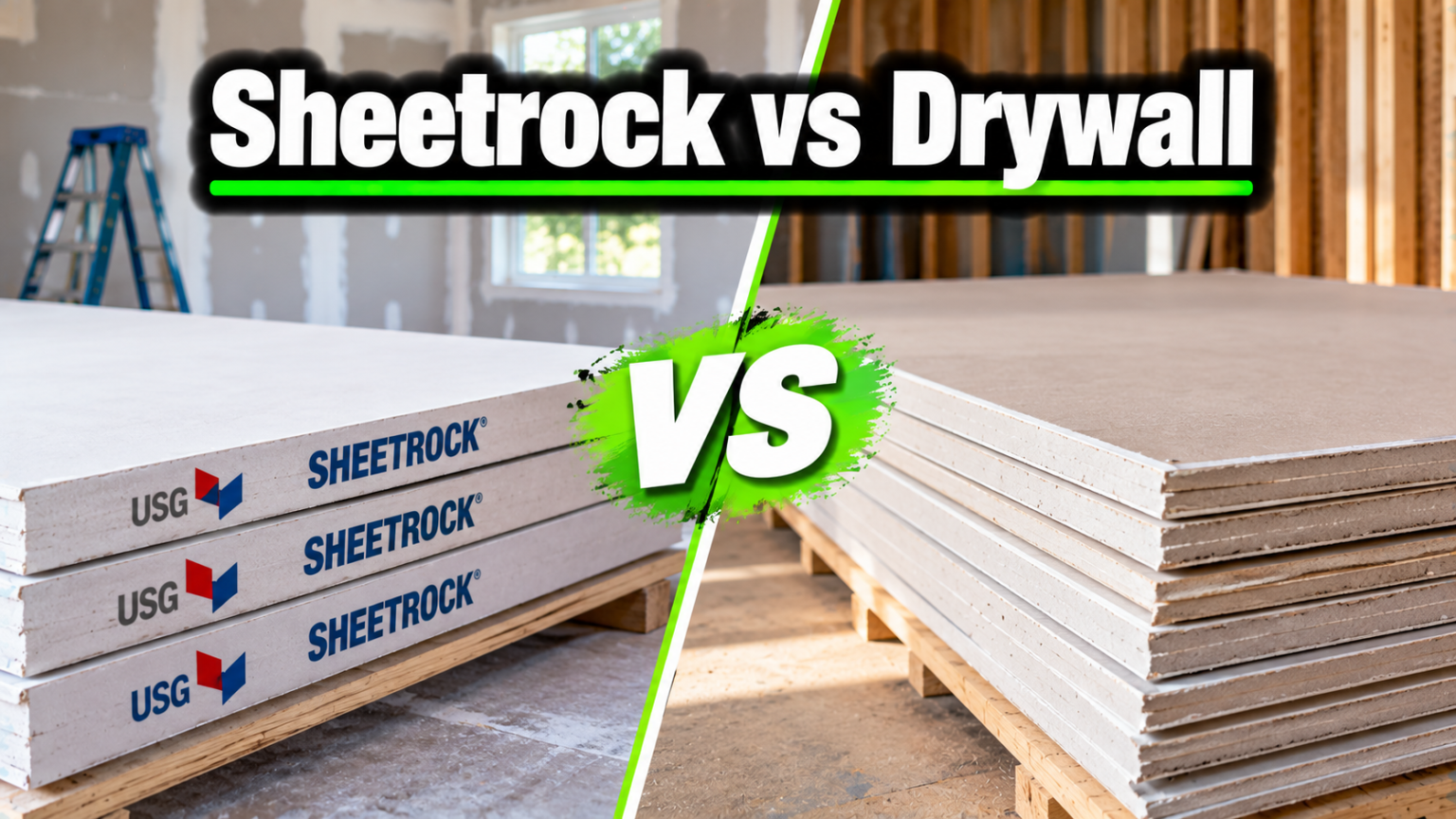

Sheetrock is a brand of drywall. Drywall is the general name for the flat panels used to build interior walls and ceilings, and Sheetrock is one company’s version of it. So when you compare the two, you are really comparing a brand name to the product it belongs to, a bit like Kleenex and tissues. That one fact answers most of the question. A few things are still worth knowing before you buy panels, hang them, or ask a contractor for either one.
What is drywall?
Drywall is a building panel made of a gypsum core pressed between two layers of paper. Gypsum is a soft, chalky mineral that resists fire and holds its shape once it sets. The panels arrive flat and ready to hang, which is where the name comes from. You build the wall dry, with screws and panels, instead of the older wet method of spreading plaster by hand over thin wood strips.
You will also hear drywall called gypsum board, wallboard, or plasterboard. These all mean the same panel. A standard sheet is 4 feet wide and 8 feet long, though longer 10 and 12 foot sheets exist for bigger walls. Thickness usually runs from 1/4 inch up to 5/8 inch, and 1/2 inch is the common pick for interior walls.
Drywall took over interior building for a simple reason: it is fast. A crew can hang and finish a room in a day or two, where wet plaster needed days to dry between coats. The gypsum core also resists fire on its own, since the mineral holds water that turns to steam and slows heat before the panel gives way. That mix of speed, safety, and low cost is why nearly every home built in the last several decades uses it.
What is Sheetrock?
Sheetrock is a registered brand of drywall made by USG, the United States Gypsum Company. The company has sold gypsum panels under the Sheetrock name for more than a hundred years, and the brand became so common on job sites that many people now say “Sheetrock” to mean any drywall at all.
That habit is why the two words get mixed up. Calling every panel Sheetrock is like calling every soda a Coke. It works fine in conversation, but it is not exact. Sheetrock is drywall, yet not all drywall is Sheetrock. Other companies make their own panels under their own names, such as Gold Bond from National Gypsum and ToughRock from Georgia-Pacific.
So what is the actual difference?
For everyday use, there is no real difference between Sheetrock and generic drywall. Both are gypsum panels that install the same way, take the same joint compound and tape, and finish to the same smooth wall. A painted room built with Sheetrock looks and performs like a room built with any other quality brand.
The differences that do exist are small and come down to each maker’s recipe and quality control. The core formula and paper facing can change how a panel feels to cut and hang. Some installers find that premium panels sand a little cleaner or resist cracking slightly better. These are refinements, not category gaps, and they rarely show up in the finished wall.
| Feature | Drywall (generic term) | Sheetrock (USG brand) |
| What it is | Any gypsum panel | A specific brand of gypsum panel |
| Made by | Many companies | USG only |
| Core material | Gypsum | Gypsum |
| Installs with | Screws, tape, joint compound | The same |
| Typical use | Walls and ceilings | Walls and ceilings |
| Price | Baseline | Often a little higher |
Does the brand change quality or price?
Price is the one place you may notice a gap. Sheetrock often costs a small amount more than a store’s basic drywall, about the same as any name brand sitting next to a generic. For a single sheet the difference is usually a dollar or two. Across a whole house that can add up, so large jobs sometimes mix brands to keep costs down.
Quality between trusted brands is close enough that most homeowners will never tell them apart once the walls are painted. What matters far more than the label is the type of panel you pick and the skill of the person taping and finishing it. A careful installer with generic board beats a rushed job with premium board every time.
Quick tip: choose your panel by type and thickness first, then by brand. The right moisture or fire rating protects your home far more than the name printed on the paper.
Other drywall brands worth knowing
Sheetrock is the best known name, but it is not the only one, and the others are just as capable. National Gypsum sells Gold Bond, Georgia-Pacific sells ToughRock, and CertainTeed makes its own line as well. Each brand offers the same core range: standard board, moisture and mold-resistant panels, and fire-rated Type X. Prices and small handling traits vary between them, but a wall built with any of these will finish and last the same way.
This matters because a supplier may stock one brand and not another. If your store carries Gold Bond instead of Sheetrock, you are not settling for less. You are buying the same product from a different maker. Focus on the panel type and thickness on the label, and treat the brand as a secondary choice.
The types matter more than the brand
Both Sheetrock and other brands come in several types, each built for a job. Picking the right one is the real decision. The common options are:
- Standard panels for ordinary walls and ceilings in dry rooms like bedrooms and living rooms.
- Moisture-resistant panels, often green, for bathrooms, laundry rooms, and other damp spots.
- Mold-resistant panels that add extra protection in humid areas.
- Fire-resistant panels, known as Type X, with a denser core that slows the spread of fire. Code requires them in places like garages, near furnaces, and on shared walls.
- Soundproofing panels built to cut noise between rooms.
Type X fire-rated board shows why type beats brand. A 5/8 inch Type X panel is required in many spots by building code, and every major maker produces one to the same tested standard set by groups like the Gypsum Association. So the fire rating comes from the type of panel, not from whether the paper says Sheetrock.
Thickness is the other choice that sits alongside type. Half-inch board handles most walls and ceilings. Go up to 5/8 inch for Type X fire panels and for ceilings that need to resist sagging, especially with joists spaced wider apart. Drop down to 1/4 inch or 3/8 inch for curved walls or to add a fresh skin over an old surface. These sizes are the same across every brand, so the number on the label means the same thing whether it says Sheetrock or not.
How drywall gets installed?
The install process is identical no matter which brand you buy, and knowing the steps helps you judge a quote. First the panels are screwed to the wall studs or ceiling joists, cut to fit around outlets and windows. Then the seams and screw holes are covered with paper or mesh tape and a layer of joint compound, often called mud.
After the first coat dries, the finisher adds two or three more coats, each one wider and thinner than the last, sanding smooth between them. This taping and sanding stage is the real craft.
Done well, the seams vanish and the wall looks like one flat surface. Done poorly, you see ridges and bumps under the paint no matter how good the panel was. Once the surface is smooth and dust-free, it gets a coat of primer and is ready for paint.
When the brand actually matters?
There are a few cases where reaching for a specific brand makes sense. Lightweight panels are the clearest one. USG sells a Sheetrock UltraLight version that weighs noticeably less than standard board, which makes ceilings easier to lift and hang alone. Other makers offer their own lighter lines too, so the feature, not the brand, is what you are really after.
Specialty jobs are the other case. If you need strong sound control, high moisture resistance, or a particular fire assembly, it can help to stay within one brand’s system so the panels, tapes, and rated details are tested to work together. For a plain bedroom wall, none of this applies, and any quality board is a safe pick.
Cost: what you actually pay
Drywall is priced per sheet or per square foot, and the numbers move with the market. A standard 4 by 8 panel usually runs from a few dollars up to around twenty, depending on type and thickness, with fire and moisture panels costing more than plain board. Sheetrock tends to sit at the higher end of its class.
For a full room or house, labor usually costs more than the panels themselves. Hanging, taping, sanding, and finishing take time and skill, and that is where most of your budget goes.
On a typical project the panels are only a small slice of the total, while the finishing work makes up the bulk. Choosing generic board over a premium brand saves a little on materials, but it will not move the labor bill, which is the part that really decides your cost.
Which one should you choose?
Choose based on the job, not the name. For most walls, any quality drywall from a trusted maker will do the work well. Match the panel type to the room: moisture-resistant board in wet areas, Type X where code calls for fire protection, and standard board everywhere else.
If a contractor quotes you “Sheetrock,” ask whether they mean the USG brand or are just using it as a general word for drywall. Most of the time they mean drywall in general. If you want a certain brand, say so, and expect a small price bump. Beyond that, put your attention on the type, the thickness, and the quality of the finishing work, because those are what you will live with for years.
A few habits make the buying part easier. Read the label for the type and thickness rather than the brand, and confirm it suits the room. Buy a sheet or two more than your measurements call for, since cuts and mistakes eat into a stack fast.
If you are patching an existing wall, measure the old panel first and match its thickness, or the repair will sit proud or sunken. And check that the panels are stored flat and dry at the store, because warped or damp board is hard to hang no matter whose name is on it.
Conclusion
Sheetrock and drywall are the same kind of product: gypsum panels for interior walls and ceilings. Drywall is the general name, and Sheetrock is USG’s brand of it, so the choice between them is really brand versus generic.
For a good result, pick the right panel type for each room, moisture-resistant or fire-rated where needed, use standard board elsewhere, and hire a careful finisher. The label matters far less than the type and the workmanship.
Frequently asked questions
Is Sheetrock better than regular drywall?
Not in any way most people would notice. Sheetrock is a brand of drywall, so once the walls are finished and painted, it performs like other quality panels. Panel type and finishing skill matter far more than the brand name.
Why do people call all drywall “Sheetrock”?
USG’s Sheetrock brand has been widely used for over a century, so the name became a stand-in for drywall itself, the way “Band-Aid” stands in for bandages. It is casual shorthand, not a technical term.
Does Sheetrock cost more than generic drywall?
Usually a little. Expect a small premium per sheet, similar to any name brand beside a generic. On a big job the gap can add up, but it is minor next to the labor cost of hanging and finishing.
Can I mix Sheetrock and other drywall brands in one house?
Yes. Panels from major makers share the same sizes and install the same way, so mixing brands is fine. Just match the correct panel type, such as moisture or fire-rated, to each room.
What thickness of drywall should I use?
Half-inch board is standard for most interior walls. Use 5/8 inch Type X where fire codes require it, such as garages and ceilings, and 1/4 inch for curved surfaces or a skim layer.
Related Articles
How to Attach Crown Molding to Cabinets: Complete Guide 2026
How Much Does a Plumber Cost? 2026 Complete Pricing Guide
How to Install Glue Down Vinyl Plank Flooring: Step-by-Step DIY Guide
How Long Do Garage Door Springs Last? Complete Guide 2026