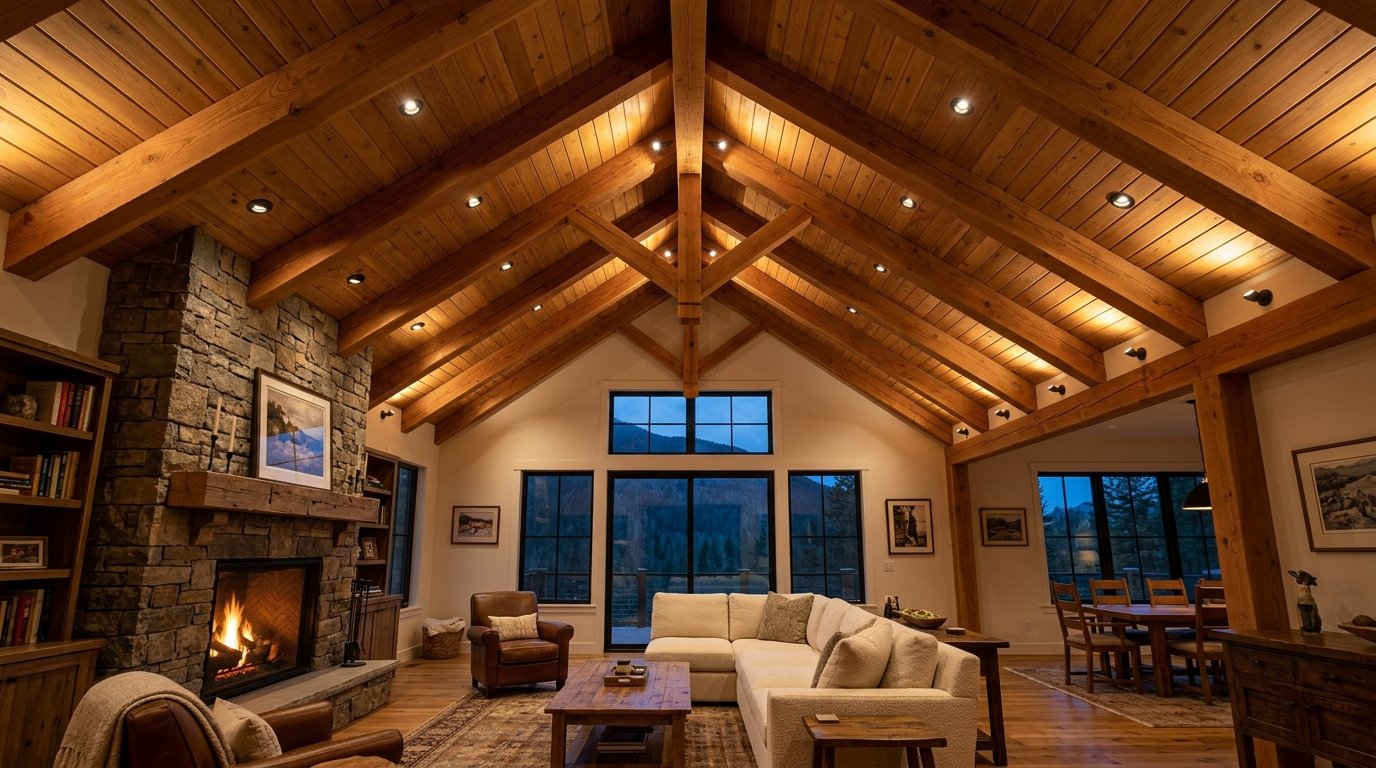

Pot lights in a cathedral ceiling have to work harder than they do on a flat ceiling, since the steep angles and extra height change how light spreads through the room. Getting the placement, spacing, and fixture type right is the difference between a room that feels evenly lit and one with awkward shadows climbing up the slope. This guide walks through everything worth knowing before adding pot lights to a cathedral ceiling, from how they perform on an angle to what installation actually involves.
What Makes Cathedral Ceilings Different for Pot Lights
A cathedral ceiling has two sloped sides that rise to meet at a central peak, which means light from a fixture mounted on the slope travels at an angle rather than straight down.
This changes both how far the light spreads and how shadows form across the room compared to a standard flat ceiling.
Why a Sloped Surface Changes Light Behavior
On a flat ceiling, a pot light aims straight down and the light spreads in a fairly predictable, even cone across the floor below it.
On a sloped surface, that same fixture pointed straight down from its housing ends up throwing light at an angle, often missing the area directly underneath while overlighting a spot further down the slope.
This is exactly why standard, fixed-aim pot lights tend to perform poorly on a cathedral ceiling unless the fixture itself is built to compensate for the angle.
Why Height Adds Another Layer of Complexity
Cathedral ceilings are almost always taller than standard flat ceilings, sometimes reaching well beyond the typical eight to nine feet, and that added distance means light has to travel further before it reaches eye level or the floor.
The further a fixture sits from the living space below, the more its beam spreads out and weakens by the time it reaches the room, which can leave a space feeling dimmer than the wattage alone would suggest.
Combining a steep slope with significant height means a single layer of pot lights is rarely enough on its own to light the room evenly.
Choosing the Right Type of Pot Light for a Cathedral Ceiling
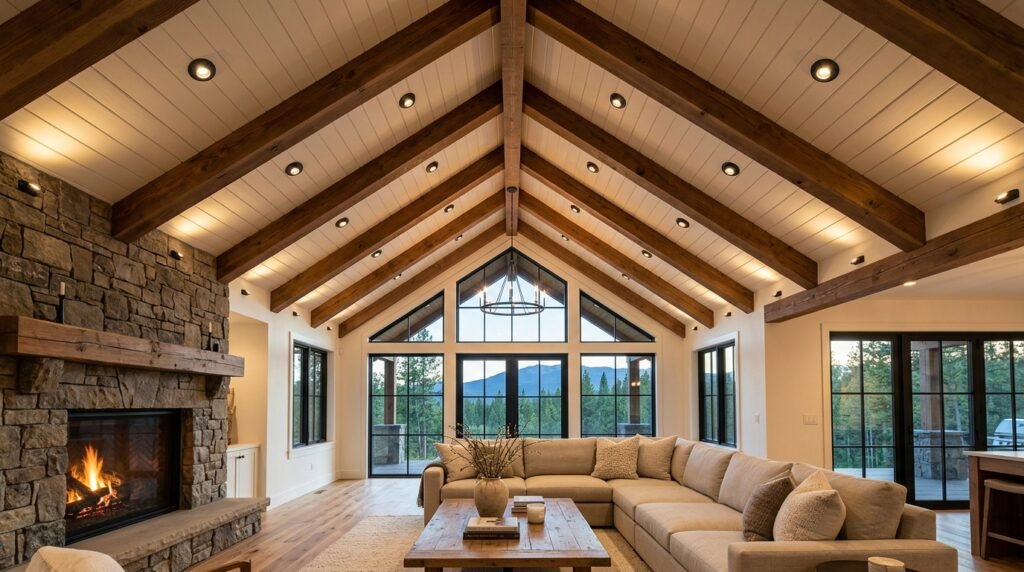
Not every pot light fixture is designed to handle an angled ceiling, and picking the wrong type is one of the most common mistakes homeowners make in this kind of space.
Adjustable or Gimbal Trim Fixtures
Gimbal trim pot lights have a housing that can be tilted within the fixture itself, allowing the beam to be aimed straight down toward the floor even though the ceiling around it is sloped. This makes them the most practical choice for cathedral ceilings, since they correct for the angle without needing a specialized mounting bracket.
Most manufacturers rate these fixtures for a specific range of tilt, so checking that the angle matches the ceiling’s slope before buying is an important step.
Fixed Trim Fixtures with Sloped Housings
Some manufacturers produce pot lights specifically built with a sloped housing designed to sit flush in an angled ceiling while still directing light straight down.
These fixtures tend to look cleaner once installed, since there is no visible tilt mechanism, but they generally cost more and come in a narrower range of slope angles than adjustable gimbal models. They work best when the ceiling slope is already known and consistent across the area being lit.
Standard Pot Lights with Angle-Correcting Trim Kits
In some cases, a standard pot light housing can be paired with an aftermarket angle-correcting trim kit that redirects the beam without replacing the entire fixture.
This option can save money on a renovation where some of the housings are already in place, though the trim kits themselves are limited in how much angle they can correct. Beyond a certain slope, a true gimbal or sloped-housing fixture becomes the more reliable choice.
Comparing Pot Light Options for Cathedral Ceilings
| Fixture Type | Handles Steep Slopes | Visible Hardware | Typical Cost |
| Gimbal Trim | Well | Slightly visible tilt mechanism | Moderate |
| Sloped Housing | Well | Flush, minimal hardware | Higher |
| Angle-Correcting Trim Kit | Limited range | Varies by kit | Lower |
Planning Pot Light Spacing on a Cathedral Ceiling
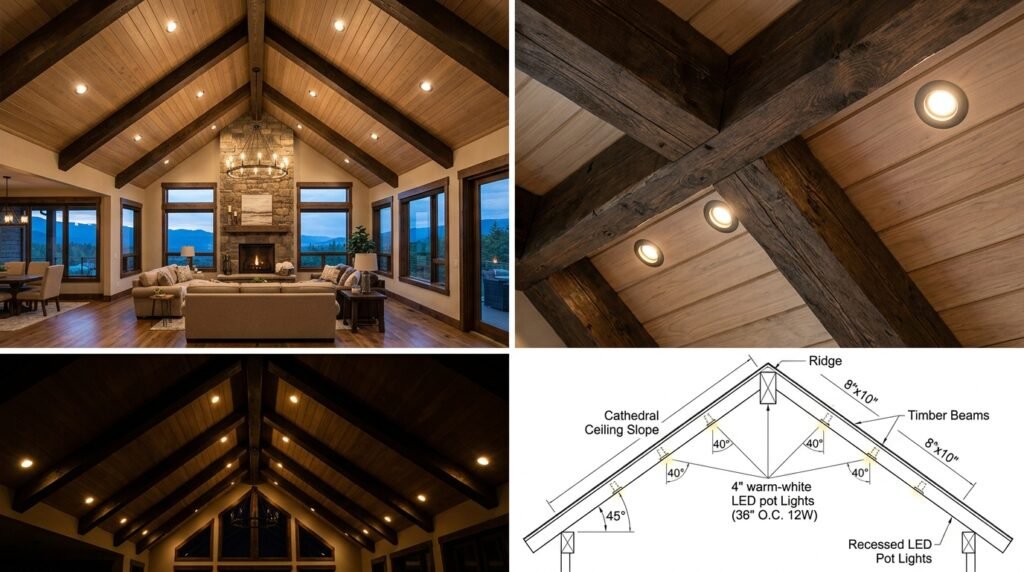
Spacing decisions on a cathedral ceiling need to account for both the horizontal floor area and the added vertical distance the light has to travel.
Adjusting Standard Spacing Rules for Height
A common starting point for flat-ceiling pot light spacing is somewhere around four to six feet between fixtures, but cathedral ceilings often need tighter spacing because the increased height weakens the beam by the time it reaches the floor.
Rather than relying purely on a fixed measurement, it helps to think in terms of overlapping coverage, where each fixture’s light slightly overlaps its neighbor’s to avoid gaps. Rooms with a particularly high peak may need an extra row of lighting lower on the slope to compensate for the distance.
Positioning Lights Relative to the Slope
Placing pot lights too close to the peak of a cathedral ceiling often results in light traveling a long way before reaching the floor, which spreads the beam thin and reduces overall brightness in the room.
Positioning fixtures further down the slope, closer to where the walls begin to rise, generally produces more usable light at a more practical distance from the living space below.
A mix of placements, some closer to the peak for general ambient fill and some lower on the slope for stronger task lighting, tends to produce the most balanced result.
Layering Pot Lights with Other Fixtures
Pot lights alone rarely create a fully balanced lighting scheme in a cathedral ceiling room, since their downward-focused beams leave the upper walls and corners comparatively dim.
Pairing with Pendant or Chandelier Fixtures
A central pendant or chandelier hung from the peak of a cathedral ceiling adds a layer of light at a lower, more usable height while pot lights handle the broader general illumination. This combination also helps visually anchor a tall room, since pendants draw the eye upward in a way that recessed lighting alone cannot achieve.
Pot lights and a central hanging fixture working together typically cover both the practical and decorative sides of the lighting plan.
Adding Wall Lights for Shadow Reduction
Because pot lights are mounted high and aimed downward, the walls and corners of a cathedral ceiling room can end up darker than the center of the floor, creating an uneven feel. Wall-mounted fixtures placed at a lower, more consistent height fill in those shadows and soften the contrast between the high ceiling lighting and the rest of the room.
This is particularly useful in living rooms or bedrooms where a softer, more even glow is preferred over strong downlighting alone.
Installing Pot Lights in a Cathedral Ceiling
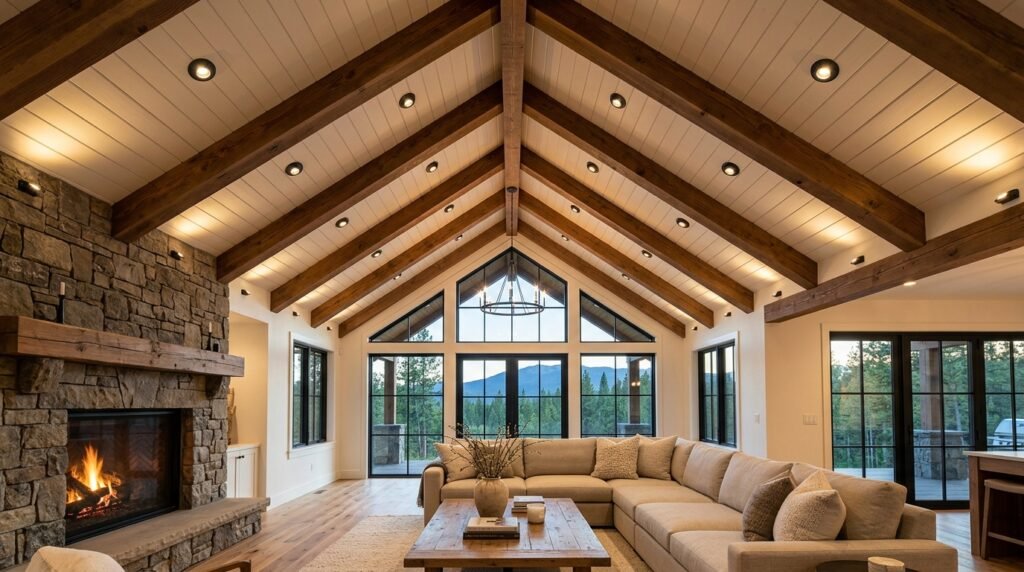
Installation on a sloped ceiling involves a few extra considerations beyond what a flat-ceiling pot light project would require.
Working with the Roof Structure Above
Cathedral ceilings typically have less clearance between the ceiling surface and the roof structure compared to a flat ceiling with open attic space above, which limits the depth of housing that can be used for certain fixtures.
Low-profile or shallow-housing pot lights are often necessary in these situations to avoid conflicting with rafters, insulation, or roof decking. This is a detail worth confirming with an electrician or contractor before purchasing fixtures, since not every model is built for tight clearance spaces.
Running Wiring Across an Angled Surface
Wiring a cathedral ceiling generally takes more time than a flat ceiling because the angle changes how cable runs need to be routed and secured along the slope. Access can also be more limited if the ceiling was finished without leaving a service gap above it, sometimes requiring sections of drywall to be opened and patched afterward.
Because of this added complexity, pot light installation in a cathedral ceiling is usually best handled by a licensed electrician rather than attempted as a simple do-it-yourself swap.
Pot Lights vs. Track Lighting vs. Pendant-Only Schemes
Each of these approaches handles a cathedral ceiling differently, and the right choice often depends on how much flexibility and ambient coverage the room needs.
Pot lights provide clean, unobtrusive general illumination that does not interrupt the visual line of the ceiling slope, which makes them a popular default choice for cathedral ceilings. Track lighting offers more flexibility to redirect light toward specific features or areas after installation, but the visible track itself can compete with the architectural lines of a vaulted space rather than blending into it.
Relying on pendants alone, without any pot lights, tends to leave large sections of the room underlit, since a single hanging fixture or small cluster cannot replace the even spread that multiple recessed lights provide across a larger floor area.
Common Mistakes to Avoid
A few recurring errors show up often enough in cathedral ceiling lighting plans that they are worth addressing directly.
Using Standard Fixed-Aim Housings on a Slope
Installing a standard, non-adjustable pot light on a sloped ceiling without accounting for the angle is one of the most frequent mistakes, since the beam ends up pointed at an angle instead of straight down.
\This often goes unnoticed until after installation, when the lighting pattern on the floor looks uneven or shifted to one side. Choosing a gimbal or sloped-housing fixture from the start avoids this problem entirely.
Spacing Fixtures Too Far Apart
Applying flat-ceiling spacing rules directly to a cathedral ceiling without adjusting for the added height frequently results in dim patches between fixtures. Because the light has further to travel before reaching the floor, gaps that would be barely noticeable on a standard ceiling become more obvious in a taller room.
Planning for slightly tighter spacing, or adding a supplementary row of lighting lower on the slope, helps close these gaps.
Skipping a Layered Lighting Plan
Relying entirely on pot lights without considering pendants, wall lights, or lamps often leaves a cathedral ceiling room feeling flat and clinical despite having plenty of light. Layering different fixture types at different heights creates a more balanced, comfortable atmosphere than recessed lighting alone can provide.
This is especially worth planning early, since ceiling fixtures are far easier to wire correctly before drywall and finishing work are complete.
Frequently Asked Questions
Can regular pot lights be installed in a cathedral ceiling?
Standard fixed-aim pot lights can technically be installed, but they will throw light at an angle rather than straight down, so gimbal trim or sloped-housing fixtures are generally the better choice for even illumination.
How many pot lights are needed for a cathedral ceiling room?
The number depends on the room’s square footage and ceiling height, but cathedral ceilings often need closer spacing or an extra row of fixtures lower on the slope compared to a flat ceiling of the same floor area.
Do pot lights work well with a chandelier in a cathedral ceiling?
Yes, pairing pot lights for general illumination with a central chandelier or pendant at the peak is a common and effective approach, since each fixture type covers a different part of the lighting need.
Is it expensive to install pot lights in a cathedral ceiling?
Costs tend to run higher than a flat-ceiling installation due to the need for angle-correcting fixtures, more complex wiring across the slope, and often more labor time, though exact pricing varies by room size and contractor.
Final Thoughts
Pot lights in a cathedral ceiling can light a room beautifully when the fixture type, spacing, and placement are matched to the slope and height of the space rather than treated like a standard flat-ceiling project. Choosing gimbal or sloped-housing fixtures, spacing them with the extra height in mind, and layering in pendants or wall lights all help avoid the uneven, shadow-heavy result that comes from underplanning.
Taking the time to map this out before installation, ideally with an electrician familiar with sloped ceilings, makes the difference between a room that simply has light and one that feels properly and evenly illuminated.
Related Articles
How to Clean Vinyl Floors: The Complete Step-by-Step Guide
Garage Door Bottom Seal Replacement: Complete Guide for Homeowners
Factors Affecting Door Installation Cost: What You Need to Know
Roof Leaks in Heavy Rain: Causes, Signs & Fixes
18 Inch Deep Base Cabinets: A Smart Storage Solution for Every Kitchen