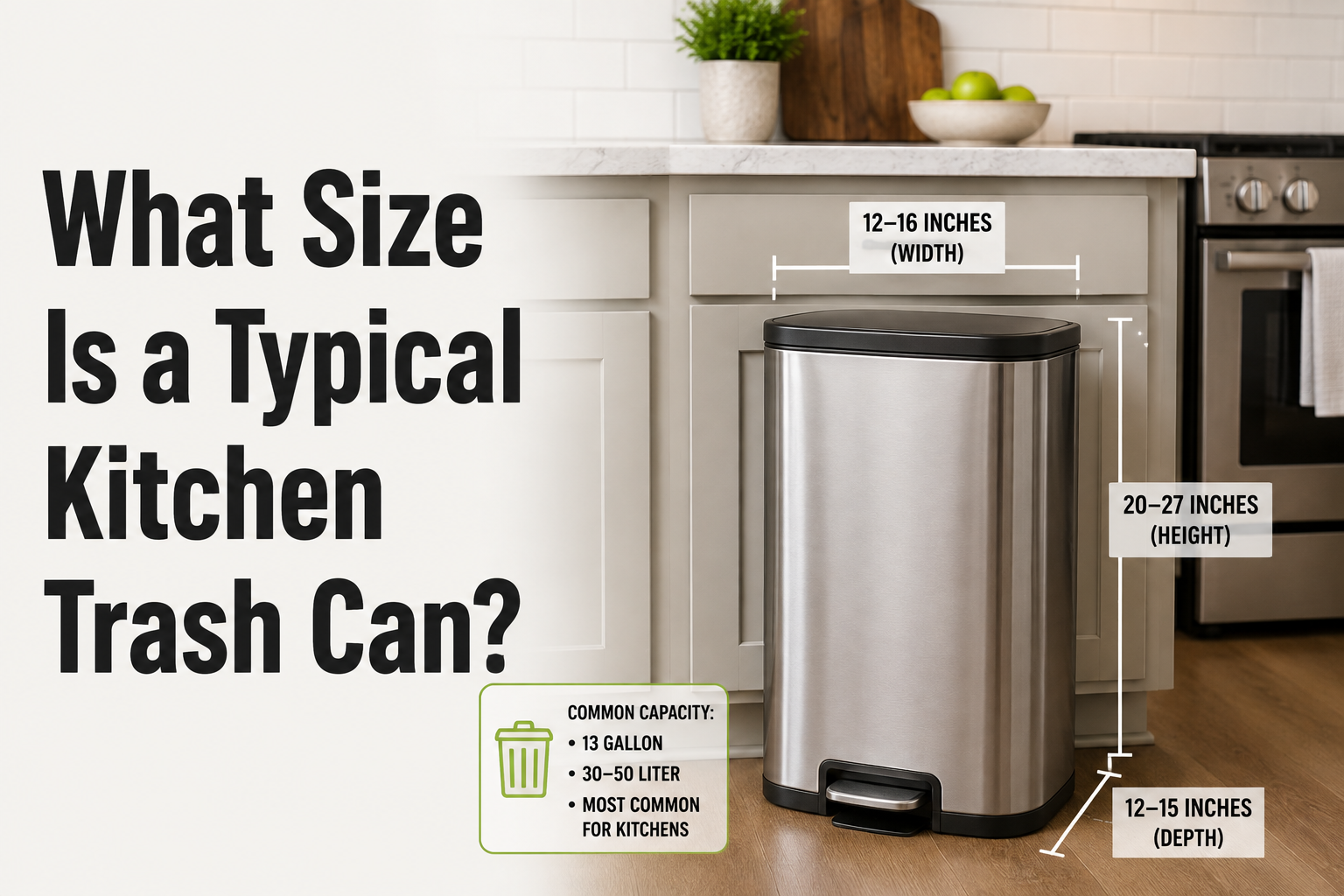

A typical kitchen trash can usually holds between 10 and 13 gallons, with 13 gallons being the most common size found in North American homes. This size is often called the “tall kitchen bag” size because most trash bag brands manufacture their standard rolls to match this exact capacity.
It fits comfortably under most sink cabinets, next to a counter, or as a freestanding unit near the cooking area. Smaller households sometimes use 8-gallon cans, while larger families or heavy-waste kitchens may prefer 16 to 20-gallon options.
The right size ultimately depends on how many people live in the home, how often trash is collected, and how much kitchen space is actually available.
Understanding Trash Can Sizing Basics
Trash can sizes are usually labeled in gallons in the US and in liters almost everywhere else, which can confuse shoppers comparing products online. Before choosing a can, it helps to understand how capacity is measured and why the word “typical” doesn’t mean the same thing for every household.
How Trash Can Capacity Is Measured
Manufacturers measure trash can capacity by the total volume of liquid or waste the container can hold when filled to the brim, not including the lid space.
This number is printed as gallons in the US market and liters in most international markets. A 13-gallon can, for example, is roughly equal to 49 liters, so shoppers comparing US and international listings need to do a quick mental conversion.
Common Unit Conversions
Since many households now shop from global marketplaces, converting between gallons and liters is a practical skill rather than just trivia.
A rough rule of thumb is that one gallon equals about 3.8 liters, so an 8-gallon can is close to 30 liters and a 20-gallon can is close to 76 liters. Keeping a simple conversion chart handy avoids the common mistake of ordering a can that looks right in liters but is actually too small once converted.
Why “Typical” Varies by Region and Household
The word “typical” changes meaning depending on where you live and how your household generates waste.
A single-person apartment in a dense city may consider an 8-gallon can typical, while a suburban family home might see 13 to 16 gallons as standard. Cultural habits around recycling, composting, and daily versus weekly garbage pickup also shift what counts as a normal size in different regions.
Standard Kitchen Trash Can Sizes Explained
Kitchen trash cans generally fall into four broad size categories, ranging from compact bins to near-commercial containers. Knowing these categories makes it easier to shop with confidence instead of guessing based on appearance alone.
Small Cans (4 to 8 Gallons)
Small trash cans in the 4 to 8-gallon range are best suited for bathrooms, home offices, or kitchens that are shared by only one or two people.
They take up very little floor space and are easy to carry out even when full, which makes them popular in studio apartments. The tradeoff is that they need to be emptied more frequently, since they fill up faster than mid-sized options.
Medium Cans (10 to 13 Gallons)
This is the size range most people picture when they hear the phrase “typical kitchen trash can,” and it’s the true household standard across the US.
A 13-gallon can strikes a practical balance between capacity and footprint, fitting neatly under most counters while still holding a full day or two of average kitchen waste. Because so many bag brands design their rolls specifically for this size, replacement bags are widely available and affordable.
Large Cans (16 to 20 Gallons)
Families with more than four members, or kitchens that produce a lot of packaging and food waste, often move up to a 16 to 20-gallon can.
These larger bins reduce how often the trash needs to be taken out, which is convenient for busy households. The downside is that they require more floor space and can feel bulky in smaller kitchen layouts.
Extra-Large or Commercial Cans (23 to 33 Gallons)
Cans in this range are less common indoors and are typically used in garages, outdoor patios, or small commercial kitchens rather than a standard home kitchen.
They’re built to handle heavier loads and are often paired with thicker contractor-grade bags. Most residential kitchens skip this size entirely unless they’re doing large-scale cooking or hosting frequent events.
The 13-Gallon Standard: Why It’s the Default
The 13-gallon size became the default kitchen trash can because it matches the most widely produced bag size on store shelves. Its dimensions also happen to fit naturally into the average American kitchen layout, which reinforced its popularity over decades.
History of the “Tall Kitchen Bag” Size
The phrase “tall kitchen bag” originated as a marketing term used by bag manufacturers decades ago to describe taller, narrower bags designed for upright kitchen cans rather than short, wide ones.
As this bag style became the norm on supermarket shelves, trash can makers began designing their products around it. Over time, the 13-gallon can and tall kitchen bag became a standardized pairing that most shoppers now recognize instantly.
Compatibility with Standard Trash Bags
Because so many national brands manufacture tall kitchen bags specifically for 13-gallon cans, finding replacement bags is rarely a problem.
This compatibility keeps ongoing costs predictable, since buyers aren’t stuck hunting for a niche bag size. It’s one of the biggest practical reasons this size remains dominant in stores today.
Dimensions Breakdown
A standard 13-gallon kitchen trash can typically stands around 24 to 27 inches tall and roughly 12 to 15 inches wide, though exact measurements vary slightly by brand and shape. In metric terms, that’s approximately 61 to 69 centimeters in height and 30 to 38 centimeters in width.
These dimensions are designed to sit comfortably under most standard 34 to 36-inch kitchen counters without touching the underside.
Factors That Determine the Right Size for You
No single size works for every home, so it helps to weigh a few personal factors before buying. Household size, available space, and daily habits all play a bigger role than simply picking whatever size looks popular online.
Household Size
The number of people living in a home is usually the strongest predictor of how much trash a kitchen produces each day.
A single person or couple may comfortably manage with an 8 to 10-gallon can, while a family of four or more often benefits from the 13 to 16-gallon range. Larger households generate more packaging, food scraps, and general waste, which quickly fills smaller bins.
Kitchen Square Footage and Cabinet Space
Available floor and cabinet space often limits size choices just as much as household needs do. A compact galley kitchen may only have room for a slim 10-gallon can, regardless of how many people live there.
Measuring the intended spot, including cabinet height if the can will sit under a counter, prevents an awkward return or exchange later.
Frequency of Trash Pickup
How often garbage collection happens in a neighborhood directly affects how large a can should be. Homes with daily or twice-weekly pickup can comfortably use smaller cans since waste doesn’t accumulate for long. Weekly-only pickup schedules usually call for a larger can to avoid overflow between collection days.
Cooking Habits
Households that cook frequently from scratch tend to generate more food scraps, packaging, and general kitchen waste than those who rely on takeout or pre-packaged meals.
Meal-prep-heavy kitchens or homes that don’t compost will fill a trash can noticeably faster. Recognizing these habits helps buyers avoid underestimating the size they actually need.
Under-Sink vs. Freestanding Placement
Where the can will physically live changes which sizes are even possible options. Under-sink placement is limited by cabinet height, pipe location, and door swing, which often rules out taller cans.
Freestanding placement offers more flexibility in height but still needs enough floor clearance so the lid can open fully.
Trash Can Types and How Size Interacts With Them
The type of trash can, not just its capacity, affects how much usable space it actually offers. Two cans with the same gallon rating can feel very different in daily use depending on their design.
Step-Can vs. Touchless or Sensor Cans
Step cans use a foot pedal to open the lid and are typically simpler and more budget-friendly across all size ranges. Touchless or sensor cans use a battery-powered motion sensor,
which adds convenience but also adds bulk to the base, sometimes reducing usable interior space slightly. Both styles come in the same common size ranges, so the choice mostly comes down to convenience and budget rather than capacity.
Slim or Rectangular vs. Round Designs
Slim, rectangular trash cans are popular in narrow kitchens because they fit neatly against walls or between cabinets without wasting corner space. Round cans often look more traditional and can hold slightly more volume for the same footprint depth.
Choosing between the two shapes usually depends on the exact layout of the kitchen rather than the size number alone.
Dual-Compartment Sizing Considerations
Dual-compartment cans split their total capacity between trash and recycling, which means each side holds less than the number printed on the box might suggest. A “26-gallon” dual can, for instance, often means 13 gallons of trash and 13 gallons of recycling combined.
Buyers should check the individual compartment sizes rather than assuming the full number applies to trash alone.
Built-In Pull-Out Cabinet Bins
Pull-out cabinet bins are installed directly inside a cabinet and slide out on rails, offering a hidden storage solution.
These systems are usually sized smaller, often in the 8 to 13-gallon range per bin, because they must fit within existing cabinet dimensions. They work well for kitchens that prioritize a clean look over maximum trash capacity.
Matching Trash Can Size to Bag Size
Choosing the right can size is only half the equation, since the bag also needs to match properly to avoid slipping or tearing. Mismatched bags are one of the most common frustrations people report after buying a new trash can.
Common Bag Size Chart
The table below shows how trash can size typically pairs with standard bag sizing sold in stores.
| Can Size | Common Bag Label | Approx. Bag Dimensions |
| 4 gallons | Small/bathroom bags | 17 x 18 inches |
| 8 gallons | Tall kitchen (small) | 21 x 24 inches |
| 13 gallons | Tall kitchen bag | 24 x 32 inches |
| 20 gallons | Large trash bag | 30 x 36 inches |
| 30–33 gallons | Contractor/outdoor bag | 33 x 39 inches |
How to Avoid Overhang or Bag Slipping
Bags that are too large for the can tend to bunch up or slip down inside, while bags that are too small won’t cover the rim properly and can tear under weight.
A good rule is to leave a few inches of overhang for tying without excess loose plastic hanging over the sides. Checking the can’s actual height and width against the bag packaging before buying prevents most of these fitting issues.
Cost Efficiency of Buying in Bulk
Standard sizes like the 13-gallon tall kitchen bag are usually the cheapest per-bag option because they’re mass-produced by nearly every major brand. Buying in bulk boxes of 100 or more often lowers the per-bag cost significantly compared to smaller packs.
Households with non-standard can sizes typically pay more since fewer brands manufacture those specialty dimensions.
Size Comparison Table
The chart below summarizes the key differences between common kitchen trash can sizes side by side for quick comparison.
| Size Range | Best For | Approx. Height | Typical Price Range |
| 4–8 gallons | Singles, small apartments | 14–20 inches | Low |
| 10–13 gallons | Standard households | 24–27 inches | Moderate |
| 16–20 gallons | Large families | 27–30 inches | Moderate to high |
| 23–33 gallons | Garages, outdoor, commercial | 30+ inches | Higher |
Pros and Cons by Size Category
Every size comes with tradeoffs, and understanding them helps buyers avoid regretting their purchase after a few weeks of use.
Small Cans: Pros and Cons
Small cans are easy to move, cheap to buy, and use inexpensive small bags, making them ideal for compact living spaces. However, they need to be emptied far more often, which can become a chore in busier households.
They’re best treated as a secondary can rather than the only trash solution in a family home.
Medium Cans: Pros and Cons
Medium 10 to 13-gallon cans offer the best overall balance of size, bag availability, and price for most households.
Their main limitation is that very large families may still find themselves emptying it daily during high-waste periods like holidays. For the average one to four-person home, though, this size rarely causes complaints.
Large Cans: Pros and Cons
Large cans reduce how frequently trash needs to be taken out, which saves time for busy households.
Their bigger footprint can be a problem in smaller kitchens, and a full bag becomes noticeably heavier to lift and carry. They work best in homes that already have generous kitchen space to spare.
Space-Saving Tips for Small Kitchens
Not every kitchen has room for a standard-sized can, so a few practical adjustments can help even compact spaces manage waste efficiently.
Slim Cans for Narrow Gaps
Slim, rectangular cans designed to fit into narrow gaps between the counter and a wall are a popular solution for tight kitchens.
They sacrifice some width but often make up for it with extra height, keeping total capacity reasonable. This shape works particularly well in galley-style or apartment kitchens.
In-Cabinet Pull-Out Systems
Installing a pull-out bin inside an existing cabinet keeps the trash can completely out of sight while still freeing up floor space.
These systems require some upfront setup but are a long-term space-saving solution for kitchens with limited square footage. Many are available as retrofit kits that don’t require replacing the entire cabinet.
Stackable or Multi-Bin Solutions
Stackable bins allow households to separate trash and recycling vertically instead of side by side, which saves valuable floor space.
This setup works well in kitchens that already sort waste but don’t have room for two full-sized cans. It’s a practical middle ground between a single large can and two separate standard-sized ones.
Common Mistakes When Choosing a Trash Can Size
A surprising number of buyers end up unhappy with their trash can simply because they skipped a few basic checks before purchasing.
Buying Too Small and Overflowing Issues
Choosing a can that’s too small based on price alone often leads to daily overflow, spilled trash, and odor problems between pickups.
This is one of the most common regrets shared in product reviews across major retailers. Matching the can to actual household waste habits, not just budget, avoids this issue.
Buying Too Large for the Space
On the opposite end, buying an oversized can without measuring first can block cabinet doors, drawers, or walkways in the kitchen.
It also means carrying out heavier, bulkier bags more often than necessary if the household doesn’t actually generate that much waste. Measuring the intended spot before ordering solves most of these problems.
Ignoring Lid Clearance and Cabinet Height
Buyers who plan to place a can under a counter or inside a cabinet sometimes forget to check lid clearance, resulting in a lid that won’t open fully.
This is especially common with step cans and touchless models that have hinged or swinging lids. Checking both the can’s height and the lid’s opening mechanism against the cabinet space prevents this frustrating mistake.
Frequently Asked Questions
What’s the most popular kitchen trash can size in the US?
The 13-gallon size is by far the most popular kitchen trash can size in the US, largely because it matches the widely available tall kitchen bag.
How many gallons should a family of four use?
A family of four typically does well with a 13 to 16-gallon can, depending on cooking habits and how often trash is collected.
What size fits under a standard sink cabinet?
Most standard sink cabinets comfortably fit a 10 to 13-gallon can, though exact clearance should always be measured beforehand.
Liters vs. gallons: which do other countries use?
Most countries outside the US measure trash can capacity in liters, with a 13-gallon can roughly equal to a 49-liter can elsewhere.
Conclusion
So, what size is a typical kitchen trash can? For most households, the answer is 13 gallons, thanks to its balance of capacity, footprint, and universal bag availability.
Smaller homes may lean toward 8-gallon cans, while larger families often prefer 16 to 20-gallon options for less frequent emptying. The right choice ultimately comes down to household size, kitchen space, and daily waste habits rather than a single universal number.
Related Articles
How to Install Roof Vent: Complete Guide 2026
What Is Roof Decking? A Complete Guide 2026
Pot Lights in Cathedral Ceiling: A Complete Planning and Installation Guide