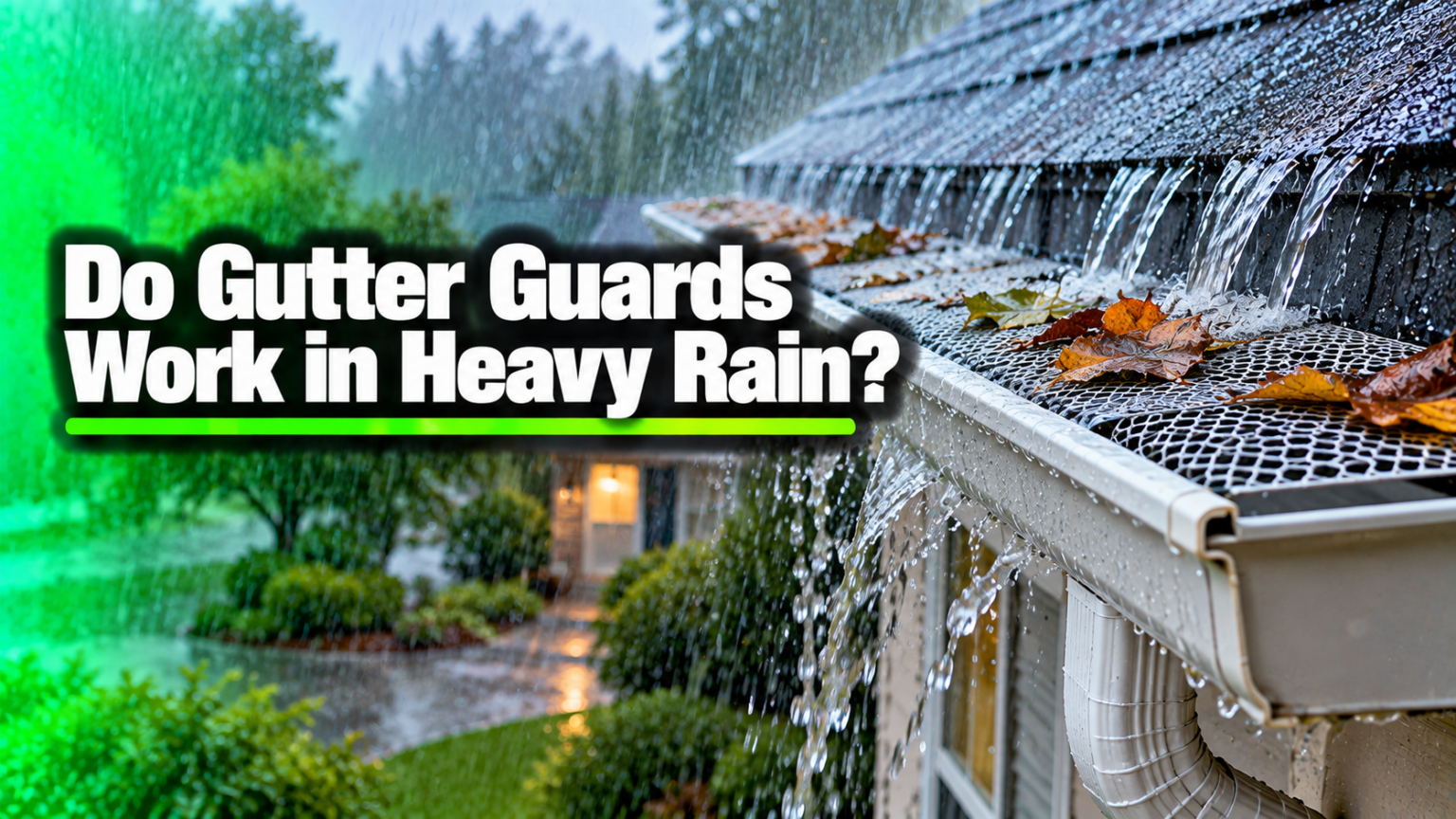

Yes, good gutter guards work in heavy rain, but the type you pick decides everything. A fine stainless steel micro mesh guard lets a hard downpour pour straight through while it blocks leaves, seeds, and grit. Cheap foam, brush, and some reverse curve covers do the opposite once rain gets intense, sending water sheeting over the front edge.
So the real answer is that a guard either helps or hurts in a storm, and its design, your gutter size, and how clean it stays are what tip the balance. Here is how each type behaves when the sky opens up, and what makes water spill over even a decent guard.
What counts as heavy rain, and why it matters
Heavy rain has a real number behind it. The American Meteorological Society defines heavy rain as more than 0.30 inches per hour, and a strong summer thunderstorm can push far past that, sometimes 1 to 3 inches in a single hour. That is a lot of water arriving in a short burst.
The roof math shows why that matters. Rain that lands on a wide roof gets funneled into one narrow channel. A single inch of rain on a 1,000 square foot roof works out to more than 600 gallons of water, and in a downpour most of it comes down fast. Your gutters and downspouts have to move all of it, quickly, or it goes over the side.
Roof shape adds to the challenge. On a steep or slick surface, water does not trickle down, it accelerates, and it reaches the edge moving fast. A metal roof is the extreme case, since water slides off it with little to slow it down. That speed is exactly what makes some guards fail, because the water arrives with too much momentum to turn cleanly into the gutter.
A guard sits on top of that system. Its job is simple. Let water in as fast as the roof delivers it, and keep debris out. In light rain almost any guard manages both. Heavy rain is the true test, because now water is racing off the roof at speed and the guard has a split second to grab it before it flies past.
Which gutter guards hold up best in heavy rain
The material and the shape of a guard decide how it acts in a storm. This table sums up how the common types compare when the rain is heavy.
| Guard type | How it handles heavy rain | Debris control |
| Stainless micro mesh | Best. Fine holes plus a wide open surface let intense rain through | Excellent. Stops leaves, seeds, and grit |
| Perforated metal screen | Good in most storms. Can shed water if holes are fine or clogged | Good for leaves, lets small grit through |
| Reverse curve (surface tension) | Mixed. Fast rain can overshoot the curved nose | Good, but the open slot can take in debris |
| Brush (bristle inserts) | Weak. Water passes but bristles slow it and trap debris | Poor over time |
| Foam inserts | Weakest. Saturates and slows, so water backs up and spills | Poor. Holds seeds and dirt |
Micro mesh is the type built for heavy rain. The holes are fine enough to stop grit, yet they are spread across a wide open surface, so a downpour drains through instead of pooling on top. That is why most guards sold in storm-prone regions use a stainless mesh over a rigid frame. Stainless matters here, because thin aluminum or plastic mesh can dent, warp, or tear and then let debris slip under.
Reverse curve guards run on a clever idea. Water clings to a curved nose and wraps back into the gutter while leaves tumble off the edge. It works well in ordinary rain. In a hard, fast downpour the water can move too quickly to make that turn, so part of it skips past the lip and lands on the ground. A steep roof or a slick metal roof speeds the water up and makes the overshoot worse.
Perforated metal screens sit in the middle. A rigid aluminum screen with plenty of holes drains heavy rain well and keeps leaves out, though smaller grit still slips through, and cheap versions can clog where the holes are fine. Foam and brush inserts are the ones to skip if storms are your main worry. They pass water when brand new, but they slow it down, and both trap seeds and dirt that choke the flow within a season or two.
How much rain can a good guard actually handle?
A well made micro mesh guard on a correctly sized gutter can keep up with the hardest rain most homes ever see. The limit in a storm is rarely the mesh itself. It is the gutter and downspout underneath, because those set how fast water can leave.
A standard 5 inch K-style gutter paired with a single 2×3 inch downspout drains a set amount of roof, often cited around 600 square feet in heavy rain. Feed more roof than that into one outlet and it bottlenecks, no matter how good the cover is. Step up to 6 inch gutters with 3×4 inch downspouts and the same system moves far more water. So the honest way to read a guard’s rain rating is together with the channel it sits on, not on its own.
There is one more thing worth knowing about mesh. The best micro mesh guards are installed at a slight angle, so the surface tips the water toward the gutter and lets debris slide off in the wind. That angle also helps rain shed grit during a storm instead of letting it settle. A flat, poorly set guard collects more film over time, which is part of why professional install often outlasts a rushed DIY job in heavy rain.
Why water still spills over guards in a downpour
A guard is only one part of the system, so water can pour over the front even when the cover itself is fine. These are the usual reasons, roughly in order of how often they cause trouble.
- Undersized gutters or downspouts. A 5 inch gutter with a small 2×3 downspout can only carry so much. If a large roof area drains into one outlet, it backs up in heavy rain and spills under any guard. Bigger gutters and downspouts fix this more often than a new cover does.
- A dirty or filmed mesh. Micro mesh is fine, and over months a thin layer of roof grit, pollen, and grime can coat it. Water then beads and runs off the top instead of soaking through. The guard can look clean from the ground while it quietly sheds water in a storm.
- Wrong gutter pitch. Gutters need a slight slope toward the downspout, about a quarter inch of drop for every 10 feet. Flat or sagging runs hold standing water, which leaves less room for a sudden surge and pushes the overflow forward.
- The reverse curve overshoot. As covered above, surface tension covers can let fast water skip past the nose in intense rain, and a steep or metal roof makes it more likely.
- A blocked downspout. If the outlet is jammed lower down with debris or a nest, water fills the gutter and overflows no matter how clean the guard is up top.
Notice that most of these have nothing to do with the guard rejecting water on purpose. The cover is usually doing its job. The channel underneath simply cannot keep up, or the mesh has gotten dirty without anyone seeing it.
Quick test: during the next hard rain, step outside and watch the gutters. Water sheeting over the whole front edge points to flow that is too slow, so a dirty mesh, the wrong pitch, or a downspout that is too small. Water dripping only at a corner is usually a sealing problem, not the guard.
How to keep guards draining when it pours
You can get strong heavy rain performance out of guards with a few smart choices, most of them made before the guard ever goes on.
Pick mesh for wet climates. If you get frequent hard storms, a stainless micro mesh guard on a solid frame is the safest bet. It has both the open area and the fine filtering to handle water and debris at the same time, which foam and brush inserts cannot.
Size the system for your roof, not just your house. Ask an installer to match gutter and downspout size to your actual roof area and your local rainfall. In storm-prone areas, 6 inch gutters and larger downspouts often cure overflow that no guard could fix on its own.
Keep the surface clean. Even the best mesh needs an occasional rinse. Once or twice a year, spray the guards from above with a garden hose to clear grit and pollen so water still soaks through. This is far less work than scooping out open gutters, but it is not zero, and skipping it is the most common reason a good guard starts to overflow.
Check the pitch and the outlets. Make sure the gutters still slope toward the downspouts and that the downspouts run clear all the way to the ground. A guard cannot rescue a channel that drains slowly, so this quick check pays off before every rainy season.
Watch your first big storm after install. The best time to catch a problem is during a heavy rain soon after the guards go on. If you see spillover then, you can adjust the pitch, clear a downspout, or upsize a part before water ever reaches the fascia or the foundation.
Are gutter guards worth it in heavy rain areas?
For most homes in rainy regions, quality guards are worth it, as long as you choose the right type. A stainless micro mesh guard keeps leaves and grit out, cuts your cleaning down to a quick rinse, and moves heavy rain about as well as an open gutter does. That combination protects your roof edge, your siding, and your foundation during exactly the storms that cause the most water damage.
The guards that give the whole category a bad name are the cheap foam and brush inserts, and, in the very hardest rain, some reverse curve covers. If a downpour still sends water over the front after you install one, the answer is almost always a better guard, a larger gutter and downspout, or a good cleaning, not a return to bare gutters that clog on the first pile of leaves.
It also helps to picture the alternative. An open gutter in a leafy yard fills with debris, and in a heavy storm that debris turns into a dam that sends water straight over the side and down the wall. A good guard trades that risk for a light yearly rinse. Seen that way, the question is less about whether guards can handle heavy rain and more about which guard, on a gutter sized for the job, handles it best for your home.
Conclusion
Good gutter guards do work in heavy rain, and the type is what makes or breaks them. Choose a stainless micro mesh guard, size your gutters and downspouts for your roof and your local rainfall, and rinse the mesh once or twice a year. Do that and a downpour drains through cleanly while the leaves stay out. If water still spills over the front, the cause is almost always a small or dirty channel underneath, not the guard on top of it.
Frequently asked questions
Do gutter guards cause overflow in heavy rain?
They can, if they are the wrong type or dirty. Foam, brush, and some reverse curve guards slow or shed fast water. A clean stainless micro mesh guard on a properly sized gutter rarely causes overflow.
What is the best gutter guard for heavy rain?
Stainless steel micro mesh on a rigid frame. It has enough open area to drain a downpour and holes fine enough to block leaves, seeds, and grit, which is why it is the top pick in storm-prone areas.
Why does water pour over my gutter guards when it rains hard?
Usually the gutter or downspout is too small for the roof, the mesh has filmed over with grit, or the pitch is off. The guard is often fine, the channel under it just cannot move water fast enough.
Do micro mesh guards ever clog?
Yes, slowly. Roof grit and pollen can film over the mesh and make water bead off the top. A quick rinse from above once or twice a year keeps it draining in heavy rain.
Can I install gutter guards myself for a rainy climate?
You can, but sizing matters more than the guard itself in heavy rain. If you are unsure your gutters and downspouts can handle your roof, have a pro check the sizing and pitch first.
Related Articles
How to Lock a Garage Door: A Complete Step-by-Step Guide
What Causes Bathroom Faucets to Corrode (And How to Stop It for Good)
How to Manually Flush a Toilet: Complete guide 2026
Joist Tape for Decking: The Complete Guide to Protecting Your Deck’s Substructure